
10 Ways to Use Facebook Ads Library 2025
Advertising on Facebook and Instagram is one of the most effective ways to reach customers today. But with so many brands competing for attention, it’s easy to spend money on ads that don’t perform.
That’s where the Facebook Ads Library helps. It’s a free tool from Meta that lets you see all the active ads running across Facebook and Instagram. With just a quick search, you can look up your competitors, explore what they’re testing, and get inspiration for your own campaigns.
You won’t see behind-the-scenes data like budgets or conversions, but you will see the copy, visuals, formats, and offers businesses are using right now. In other words, it’s like having a window into your competitors’ strategy.
Table of Contents
How To Use Facebook Ads Library 2025
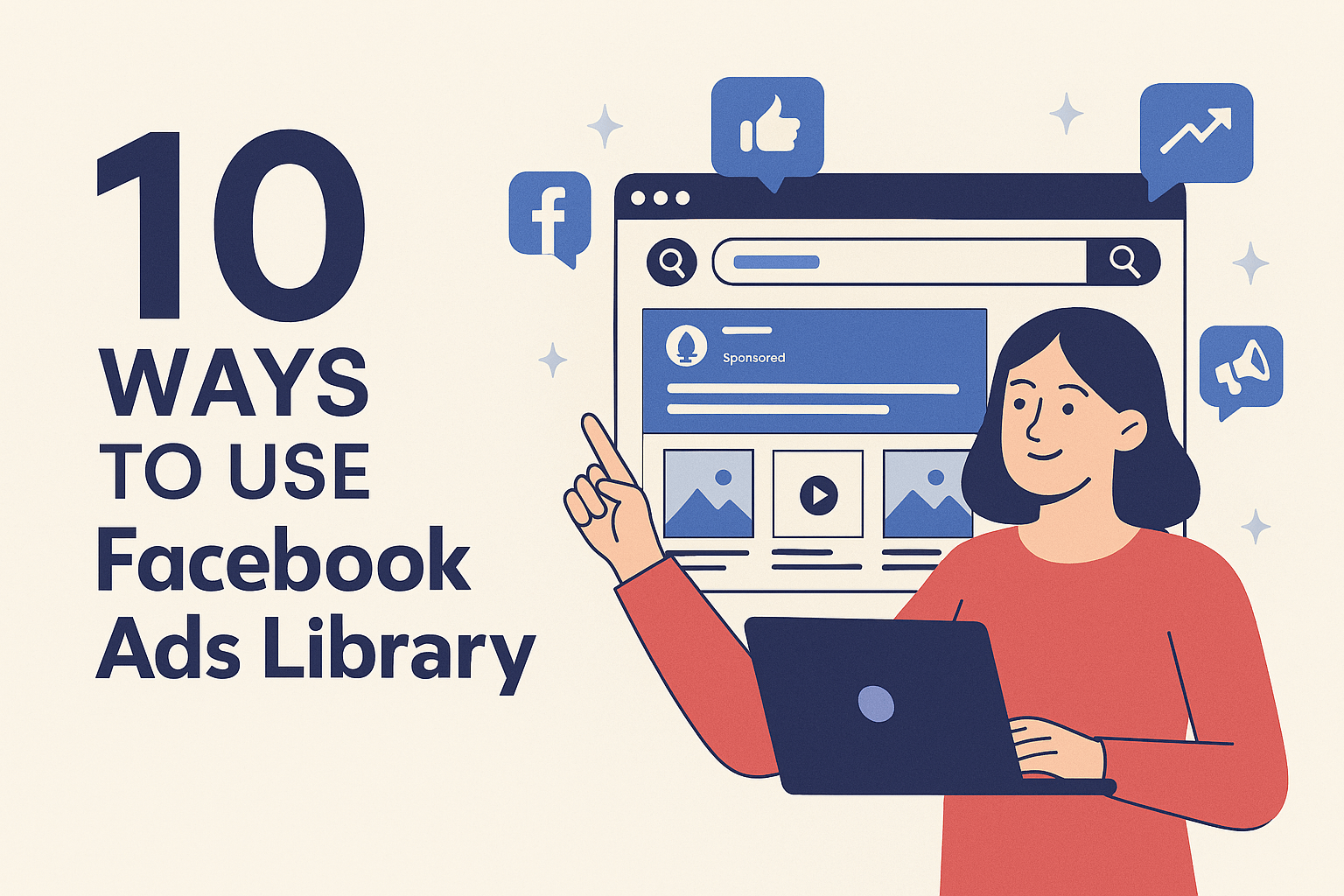
In this guide, we’ll cover 10 practical ways to use the Facebook Ads Library, from researching competitors and spotting trends, to improving your ad copy and studying funnels. Each step is simple enough to follow, but powerful enough to make a real difference in your marketing.
1. Study Competitors – See What’s Working in Your Niche
One of the best ways to get started with the Facebook Ads Library is by looking at what your competitors are already doing. Instead of guessing which types of ads, offers, or creatives might work, you can learn directly from brands that are already investing money in your space.
How to do it step by step:
- Make a list of 10–20 competitor brand names.
- Search each one in the Ads Library.
- Log their ads in a spreadsheet, include format, hook type, offer, CTA, and landing page.
- Check back weekly to see which ads are still running. (Ads that stay live for weeks or months are usually performing well.)
Example:
If you sell fitness supplements, search for brands like Optimum Nutrition or MyProtein. You may find that MyProtein focuses heavily on bundles (“Protein + Creatine Pack”), while Optimum Nutrition highlights authority (“#1 Brand Chosen by Athletes”). This gives you two different strategies worth testing: bundle deals vs authority-driven messaging.
Pro Tip:
Don’t just log their ads. Click through to see their landing pages. Are they sending traffic to direct product pages, or warming leads with a quiz? This reveals their funnel priorities.
2. Track Creatives That Stay Live – Spot Long-Term Winners
Not every ad that shows up in the Facebook Ads Library is successful. Many are just short tests that disappear after a few days. But when you notice ads that run for weeks or even months, that’s usually a strong signal the creative is performing well enough to keep.
How to do it step by step:
- Add a “days live” column to your spreadsheet. (Start date – today).
- Track whether ads are video, single image, or carousel.
- Watch for design patterns that repeat across brands (e.g., UGC-style vertical videos, carousels showing benefits step by step).
Example:
Search “CeraVe” in the Ads Library. You’ll likely find testimonial videos featuring dermatologists or real users. Many of these run for months, suggesting social proof in video format drives results in skincare.
Pro Tip:
Pay attention to aspect ratios. For example, vertical 9:16 videos often dominate mobile feeds. If competitors are prioritizing them, consider testing the same.
3. Improve Your Copywriting – Learn From Real Ad Examples
Great visuals grab attention, but it’s often the words that convince someone to click. The Facebook Ads Library is like a free copywriting classroom, you can study how brands open their ads, what benefits they highlight, and how they write calls-to-action.
How to do it step by step:
- Categorize hooks into types: pain point, promise, curiosity, question, testimonial, and authority.
- Save the first line of copy from every ad you log.
- Compare benefits vs features: are brands highlighting outcomes (e.g., “Sleep better tonight”) or product features (e.g., “Made with memory foam”)?
- Note CTAs Shop Now, Sign Up, and Download, and how they align with the copy.
Example:
Project management brands like Asana and ClickUp often use pain-based hooks: “Tired of managing projects across 10 different tools?” They then present a straightforward solution: “Get everything done in one place.” This pattern shows how pairing pain with resolution creates compelling ad copy.
Pro Tip:
Collect 20–30 hooks and look for the most common structures. Instead of copying, rewrite them in your own brand voice.
For example, if many ads start with “Tired of ___?” try framing yours as “Finally, a way to ___ without ___.”
4. Analyze Offers – Find Out What Customers Respond To
Even the best creative won’t save a weak offer. The Facebook Ads Library lets you see which incentives brands are putting front and center, from discounts and bundles to free trials and guarantees.
How to do it step by step:
- Add an “offer type” column: % off, bundle, free shipping, trial, gift, guarantee.
- Record if prices are shown.
- Note urgency tactics: “Ends tonight,” “Only 50 left,” “Limited time.”
- Compare across competitors to see which offers dominate.
Example:
Fashion retailers like H&M and Zara often feature ads offering “20% off first order” promotions. If you see this repeatedly, it’s likely effective in the fashion industry. But if you want to differentiate, you could test bundles (“Buy 2, Get 1 Free”) or perks like free shipping.
Pro Tip:
Seasonal offers can differ from those that are evergreen. Track both separately so you know what works year-round vs holiday-specific campaigns.
5. Identify Industry Trends – Stay Ahead of What’s Popular
The Ads Library isn’t just for spying on competitors. By searching keywords across your niche, you can spot creative and messaging trends before they peak.
How to do it step by step:
- Search keywords like “vegan snacks,” “ERP software,” and “credit repair.”
- Collect 50–100 ads from multiple brands.
- Group them by creative type, hook, or offer.
- Look for rising formats (e.g., UGC, short Reels, or carousels).
Example:
Search “vegan snacks.” You may have noticed that many brands now use unboxing-style videos, where real people open and taste products. This suggests that authenticity is a strong trend in the food industry.
Pro Tip:
Keep a swipe file. Save screenshots of ads that represent these trends so you can revisit them when planning your campaigns.
6. Benchmark Your Ads – Compare Against Competitors
Sometimes it’s hard to tell whether your ads are good enough. Benchmarking your work against competitors shows you where you’re strong and where you’re falling behind. By comparing side by side, you can spot blind spots and see which elements top brands include that you might be missing.
How to do it step by step:
- Add 5–10 of your own ads into your competitor spreadsheet.
- Create a simple scoring rubric (1–5 scale) for the following criteria: creative clarity, copy clarity, offer strength, and landing page quality.
- Compare averages to competitors.
Example:
If you run a local real estate business, consider comparing your ads with those of global brands like Century 21. You may notice they use more customer stories and push Messenger chat as a CTA. If your ads only link to a generic homepage, you’ll see where you’re behind.
Pro Tip:
This step helps you find blind spots. Even small businesses can often compete by adding essential elements like testimonials, urgency, or a more polished design.
7. Reduce Guesses – Build Smarter Campaigns Before Launch
Many ad campaigns fail because they’re based on guesses. Instead of starting from scratch, you can use the Facebook Ads Library to see what’s already being tested in your market.
How to do it step by step:
- Search generic product terms (e.g., “electric toothbrush,” “online course”).
- Log at least 20 ads from different brands.
- Look for repeating themes in hooks, CTAs, and creatives.
- Use these themes as the base for your test campaigns.
Example:
If you search “electric toothbrush,” you’ll notice that Oral-B emphasizes dentist approval and free trials, while Philips Sonicare highlights battery life and convenience. This tells you which selling points are most common, and which gaps you might fill.
Pro Tip:
Don’t focus on one-off ads. Look for patterns that multiple brands repeat. Those are safer bets to test first.
8. Explore Adjacent Niches – Get Fresh Inspiration Outside Your Market
Sometimes the best ideas don’t come from direct competitors. Looking at brands in related niches can spark new creative angles you wouldn’t find otherwise.
How to do it step by step:
- Pick 2–3 related niches that overlap with your audience.
- Search for them in the Ads Library.
- Record how they highlight benefits, build trust, and structure funnels.
- Adapt patterns that make sense for your own campaigns.
Example:
If you sell gym equipment, check out supplement brands like Optimum Nutrition or apparel companies like Gymshark. You’ll often see ads featuring real people using the products, which could inspire you to showcase your equipment in action.
Pro Tip:
Make a habit of logging at least one adjacent niche each month. Over time, this creates a broader swipe file of creative inspiration.
9. Track Seasonal Campaigns – Prepare for High-Impact Moments
Seasonal campaigns are high-pressure times. By studying others, you can prepare months in advance.
How to do it step by step:
- Search terms like “Black Friday,” “Back to School,” “Eid,” and “Christmas.”
- Collect ads from at least 10 brands.
- Note the creative elements (colors, designs), urgency language, and offer types.
- Save them in a seasonal swipe file.
Example:
Searching for “Black Friday” reveals that retailers like Best Buy are promoting countdown clocks and bold price drops, while luxury brands like Zara focus on minimal visuals with subtle discounts. This contrast reveals different positioning strategies.
Pro Tip:
Do your seasonal research 2–3 months ahead of the event. That gives you time to design and test campaigns early, so you’re ready when competition heats up.
10. Study Funnels Beyond the Ad – Understand the Full Journey
An ad is just the entry point. What happens after someone clicks often determines whether they convert. The Facebook Ads Library lets you see not just the creative, but also where brands are sending their traffic.
By studying funnels, you learn how competitors guide users from the first click to the final action. This shows you what kinds of landing pages, offers, and trust elements are working in your industry.
How to do it step by step:
- Click competitor ads in the Ads Library to see where they lead
- Categorize the funnel type: product page, category page, landing page, lead form, quiz, Messenger, or WhatsApp.
- Record page elements like testimonials, FAQs, countdowns, and form length.
- Screenshot the journey for reference.
Example:
Monday.com often directs ads to a free trial page featuring testimonials, client logos, and FAQs. This builds trust and removes objections before asking for a signup.
Pro Tip:
Study 10–20 funnels in your niche and note common elements. If most include social proof or FAQs, that’s a clear sign these elements reduce friction.
How to Research Systematically?
One-off research is useful, but the Ads Library becomes much more powerful when you track it consistently. Here’s a simple way to set up a research system:
- Set your goal – Decide what you’re focusing on: competitor research, seasonal campaigns, trend spotting, or benchmarking.
- Make a list – Write down 10–20 competitor pages and a few niche keywords to search each week.
- Log the details – Use a spreadsheet to track things like hook, creative type, offer, CTA, and funnel.
- Check weekly – Note which ads are still active. Ads that stay live are more likely to be working.
- Look for patterns – Compare your notes to see which hooks, formats, or offers come up the most.
- Save the best examples – Build a swipe file with screenshots of ads you want to keep for inspiration.
Test in your campaigns – Adapt what works, but always write in your own brand voice.
Read More: Top 15 Best Search Engines Other than Google
Conclusion:
The Facebook Ads Library is a simple but powerful tool. It shows you the exact ads that brands are running on Facebook and Instagram right now. By using it regularly, you can learn what competitors are testing, which creatives last, and how different businesses structure their funnels.
The key is to stay organized. If you log ads each week and track patterns in copy, offers, and formats, you’ll slowly build a clear picture of what works in your industry. Over time, this will help you make smarter decisions and avoid wasting budget on untested ideas.
Frequently Asked Questions About Facebook Ads Library
It’s a free tool from Meta that shows all active ads currently running on Facebook and Instagram. You can search by brand name, keyword, or topic.
No. The Ads Library only shows the creative, copy, format, and active status of ads. It doesn’t share conversions, spend, or results.
You can’t see results directly, but if an ad has been live for weeks or months, that usually indicates it’s performing well enough to keep running.
Yes. Search for terms like “Black Friday,” “Christmas,” or “Back to School” to see how brands adapt during seasonal campaigns.
For general insights, monthly is enough. But if you want to track which creatives last, checking weekly gives you the best view of long-term winners