
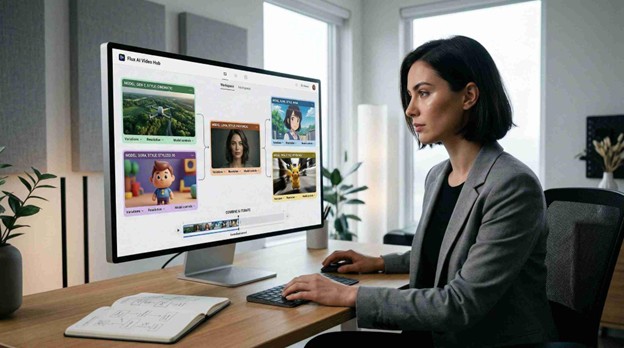
Why Having Access to Every AI Video Model in One Place Changes Everything
The AI video landscape in 2026 is no longer about finding a single tool that does it all. Instead, it is about having the right engine for the right shot. For years, creators were forced to hop between tabs and manage multiple subscriptions just to piece together a single professional sequence.
Today, the emergence of unified workspaces has eliminated this friction. By bringing every top-tier model into a single dashboard, Higgsfield has transformed video production from a technical hurdle into a fluid creative process. When you have access to Sora 2, Kling 3.0, and Veo 3.1 in one place, you are fundamentally changing the quality of your output.
The End of Model Loyalty
In the early days of generative video, creators often picked a side. You were either a Sora user or a Kling user. Each model had its own distinct personality. Some were better at physics, while others excelled at artistic textures.
Professional video creation requires a mix of these strengths. A wide shot might require the deep world simulation of Sora 2. Meanwhile, a close-up character moment with synchronized dialogue is better handled by a specialized Higgsfield ai video generator like Kling 3.0.
Having these models in one place through the Higgsfield ecosystem allows you to:
- Pick the best physics engine for complex object interactions.
- Switch to high-speed models for rapid social media prototyping.
- Access specialized lip-sync and audio-native models for dialogue scenes.
- Compare outputs side-by-side to find the most realistic generation.
Unified Consistency Across Different Engines
One of the biggest challenges of using multiple models used to be visual drift. If you generated a character in one tool and tried to replicate them in another, the likeness would break. This made multi-shot storytelling nearly impossible without a massive manual editing effort.
Unified platforms have solved this by layering proprietary consistency tools over the top of various models. On Higgsfield, features like Soul ID act as a universal identity layer. Whether you are generating a clip with Google’s Veo 3.1 or OpenAI’s Sora 2, your character’s face, clothing, and style remain locked.
This cross-model continuity is a game changer for marketing agencies building long-form brand campaigns. According to recent reporting from The Verge, the ability to maintain persistent digital identities is what separates professional-grade AI tools from hobbyist generators.
It allows e-commerce brands to maintain product consistency across different lifestyle shots. It also helps AI influencers appear in diverse environments without losing their recognizable look. This ensures your brand identity stays strong regardless of the underlying technology used.
Deterministic Control in a Multimodal Workspace
The move toward a unified workspace is also about moving from random generation to a deterministic workflow. When you have access to a tool like Cinema Studio on Higgsfield, you are not just rolling the dice with a prompt. You are applying professional cinematography rules to whatever model you choose.
By centralizing these tools, you can apply 8K camera settings, specific Anamorphic lens simulations, and multi-axis motion controls regardless of the underlying engine. This ensures that even if you switch from a fast model for b-roll to a heavy model for a hero shot, the optical look stays the same.
This level of integrated control is what elevates Higgsfield above standalone point solutions. It turns the AI from a simple generator into a full-scale production suite that lives entirely in your browser. You get the power of multiple labs without the complexity of multiple interfaces.
The Content Factory: Scaling Production
For brands and creators in 2026, the goal is personalization at scale. You need to produce hundreds of variations of a video to hit different demographics, languages, and platforms. Managing this across five different websites is a logistical nightmare.
The Higgsfield platform acts as a Content Factory. You can start with a single idea and branch it out:
- Use a high-fidelity model for a cinematic YouTube trailer.
- Switch to a fast, efficient model to generate 50 vertical variations for TikTok.
- Apply a specialized mixed-media model for artistic Instagram Reels.
- Finalize everything with native audio and synchronized SFX in one pass.
This workflow does not just reduce costs; it increases your market agility. You can react to trends in minutes rather than days because the entire pipeline is contained in one workspace. By removing the friction of file transfers, you keep your creative momentum high.
Breaking the Technical Bottleneck
The true power of having every model in one place is that it removes the need for a massive technical stack. You no longer need a high-end workstation or deep knowledge of five different interfaces. The platform handles the complex cloud rendering, the model versioning, and the storage.
This democratization means that a solo creator now has the same visual power as a major studio. You have the world’s most advanced AI research at your fingertips, organized into a professional interface that respects the rules of video production.
The transition to a multi-model ecosystem is the final step in making AI video a legitimate medium. It proves that the team is no longer a group of people in a room, but a collection of intelligent models orchestrated by a single creative vision. Higgsfield makes this possible by unifying the best technology under one roof.
FAQs
1. Which AI model is best for realistic human movement?
While Sora 2 is famous for its physics, many professional creators prefer Kling 3.0 or the latest Veo models for character-focused work. Kling 3.0 specifically offers 15-second cinematic sequences with native audio, making it ideal for scenes where human-like timing is essential.
2. Can I combine different models in the same video project?
Yes. In a unified workspace, you can generate different clips using different models and then use the built-in editor to stitch them together. Since you can lock character consistency with Soul ID, the viewer will never know you switched engines between shots.
3. Does having more models make the interface harder to use?
Quite the opposite. A good unified platform simplifies the experience by standardizing the controls. You use the same camera sliders, prompt structure, and reference image tools regardless of which specific model is doing the rendering in the background.