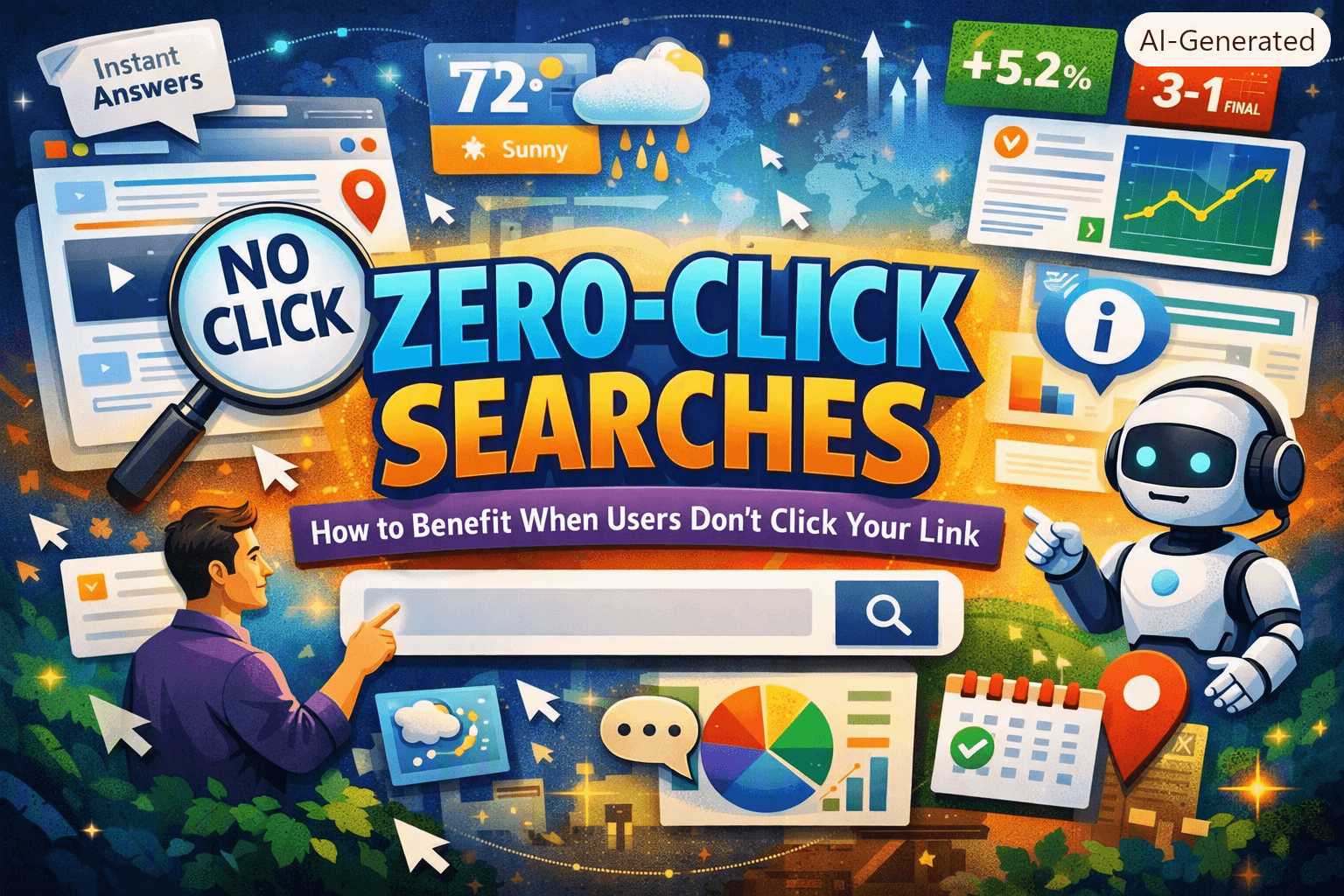
Zero-Click Searches: How to Benefit When Users Don’t Click Your Link
Imagine running a busy coffee shop, but suddenly, half the people walking past ask for the menu, read it right there on the sidewalk, and walk away without ever buying a cup of coffee. It sounds frustrating, doesn’t it?
That is exactly what is happening in search engines right now. Recent data from SparkToro shows that 68.01% of Google searches now end without a single click. In just a couple of years, that zero-click rate has jumped from around 60% to nearly 70%. With features like AI Overviews, featured snippets, and local packs, Google is answering questions directly on the search results page.
You might be panicking. If users aren’t clicking through to your website, how do you actually drive traffic?
Don’t worry, this isn’t as complicated as it sounds. The reality is that search is evolving, not dying. You just need to shift your strategy from chasing raw clicks to maximising brand visibility, trust, and direct actions. By adapting to the zero-click era, you can actually build a stronger brand presence than you had before.
Brand Visibility Through Knowledge Panels
Think of a Knowledge Panel as your digital storefront. When someone searches for your brand name, it is the big, eye-catching box that appears on the right side of the screen (or at the top on mobile). It acts as your instant résumé.
Even if a user never clicks through to your homepage, seeing a well-structured Knowledge Panel builds immense trust. It tells the user you are a legitimate, established entity.
Data from Keyword.com indicates that local business Knowledge Panels earn around 1.4% of the SERP click-through rate. While that number might seem small, the real value is in the zero-click visibility. When users see your logo, ratings, and key details right there on the page, it reinforces your brand authority.
To win this space, you need to optimise your entity signals. This means ensuring your social media profiles, Wikidata, and local business listings are perfectly consistent. You want Google to have no trouble understanding exactly who you are.
Source Citation Opportunities in AI-Generated Answers
The biggest game-changer in the zero-click era is AI Overviews. Google is pulling information from the web to generate instant answers at the top of the search results.
Here is the hard truth: Ahrefs found in early 2026 that the presence of an AI Overview reduces the click-through rate for the number one organic result by 58%.
But there is a silver lining. If your content is cited in that AI-generated answer, you get massive exposure. A study by CXL revealed that 55% of AI Overview citations come from the top 30% of a webpage. This means your content needs to be structured clearly, providing direct answers to specific questions right at the beginning of your articles.
If you are an SEO agency working with clients, you need to focus on “Answer Engine Optimization” (AEO). Write clearly, cite primary sources, and structure your content with clear headings and concise paragraphs. When AI cites your brand, users still see your name, which builds the kind of brand recall that eventually leads to direct searches.
Direct Actions From Local Search Results
Local search has always been the king of zero-click behaviour. When someone searches for “coffee shops near me” or “plumber in Chicago,” they want a phone number or directions, not a long blog post.
The Local Pack (that map and list of three businesses) is a perfect example of this. Users get the information they need and take action immediately. They might call you directly from the search results page, request a quote via Google Messages, or click the “Directions” button to start navigating to your shop.
To win the local zero-click game, your Google Business Profile must be pristine. Ensure your hours are accurate, your phone number is correct, and you actively solicit reviews. The more direct actions users take from the SERP, the less you actually need them to click through to your website to convert.
Key Information Displayed Through Rich Results
If you want to stand out in a crowded search results page, you need to play with rich results. These are search listings that include extra visual information like star ratings, images, pricing, or FAQ accordions.
A massive study by Milestone Research analyzed over 4.5 million queries and found that users click on rich results 58% of the time, compared to a 41% click-through rate for standard non-rich results.
Even more impressive, FAQ rich results boast an average click-through rate of 87% for non-branded keywords. Video thumbnails also perform exceptionally well, capturing a 62% click-through rate.
By implementing structured data (schema markup) on your website, you can signal to Google exactly what your content is about. This not only increases your chances of earning rich results but also draws the user’s eye, making your listing impossible to ignore.
Search Visibility Metrics Beyond Organic Clicks
If you keep tracking your SEO success solely by organic click-through rate (CTR), you are going to be disappointed. The rules of the game have changed.
We need to start looking at broader metrics that capture the real value of zero-click visibility. Instead of just counting clicks, look at:
- Brand Search Volume: Are more people typing your brand name directly into Google? This is a strong indicator that your zero-click visibility is building trust.
- Knowledge Panel Impressions: How often is your entity data being displayed on the SERP?
- Direct Actions: Are users calling your business or requesting directions directly from the search results?
A recent analysis by Backlinko looking at 4 million search results showed that the number one organic result gets an average CTR of 27.6%, while the tenth spot gets significantly less. But with zero-click features, the CTR for all organic positions is shifting.
Ultimately, the goal is to be the authoritative voice Google relies on. Whether a user clicks through or not, your brand presence on the search results page is your best marketing asset.