
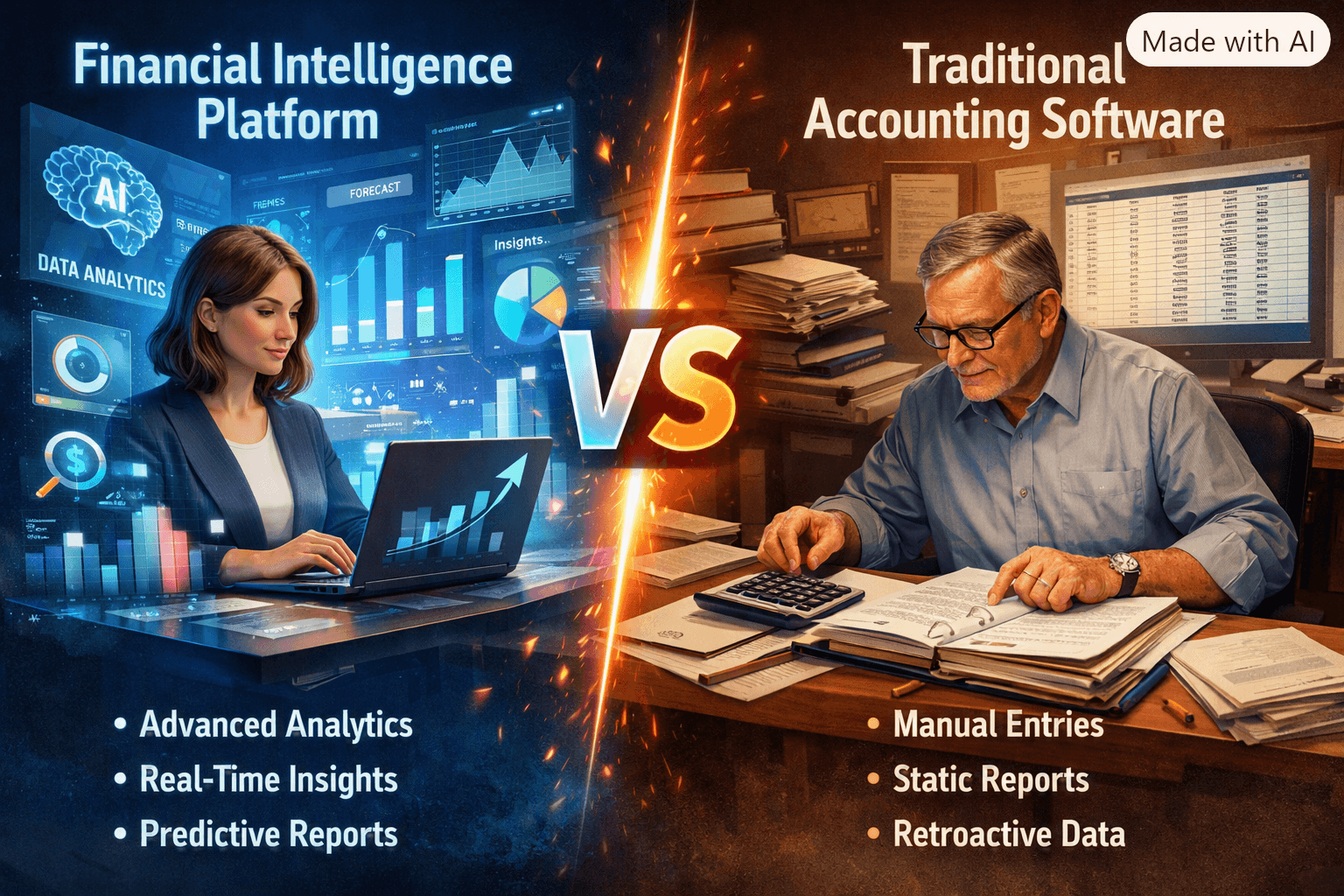
Financial Intelligence Platform vs Traditional Accounting Software: Which Enhances Financial Reporting?
In the realm of financial reporting, the tools used can significantly impact the quality and efficiency of the process. As businesses navigate complex financial environments, the choice between a Financial Intelligence Platform and traditional accounting software becomes pivotal. Each offers unique features that can either enhance or limit a company’s financial reporting capabilities. This article will explore how these platforms differ, their respective advantages, and which might be the most effective choice for improving financial reporting.
Financial Intelligence Platforms: A Modern Approach to Financial Reporting
Financial Intelligence Platforms are revolutionizing modern financial reporting by leveraging artificial intelligence and advanced analytics. Unlike traditional systems, these platforms provide a comprehensive view of financial data, facilitating advanced Financial Statement Analysis and accurate forecasting. A Financial Intelligence Platform can integrate with various data sources to deliver real-time insights, allowing businesses to swiftly adapt to market changes and optimize decision-making processes. Such platforms also support the application of the International Financial Reporting Standards (IFRS), ensuring compliance on a global scale.
One notable advantage of these platforms is their ability to automate General Ledger Reconciliation, reducing manual errors and saving time for finance teams. By utilizing sophisticated algorithms, they can also enhance risk management through a detailed Risk Assessment Matrix, identifying potential financial discrepancies before they escalate into significant issues. The integration of these features ultimately leads to more accurate and timely financial reporting.
Traditional Accounting Software: Features and Limitations
Traditional accounting software has been a staple in financial management for decades. These systems typically offer fundamental functionalities like Accrual Accounting, automated Depreciation Schedules, and basic report generation. While they provide essential tools for managing day-to-day accounting tasks, their capabilities are often limited when it comes to complex financial analysis and strategic forecasting.
One significant limitation of traditional accounting software is its lack of advanced data integration and analysis features. Unlike Financial Intelligence Platforms, these systems may struggle with real-time data processing and often require manual updates to maintain Tax Compliance Software standards. Additionally, the preparation of a comprehensive Variance Report may be cumbersome due to the software’s limited analytical capabilities.
Moreover, traditional software might not support the intricate requirements of Forensic Accounting, which can be crucial for identifying financial fraud or discrepancies. This limitation can hinder a company’s ability to conduct thorough and efficient financial investigations.
Comparative Analysis: Financial Intelligence vs. Traditional Software
When comparing Financial Intelligence Platforms to traditional accounting software, several key differences emerge. A primary distinction is the capability of Financial Intelligence Platforms to perform sophisticated Financial Statement Analysis, which is often beyond the reach of traditional systems. This comprehensive analysis is crucial for companies aiming to make data-driven decisions and enhance their financial strategies.
Furthermore, the automation features in Financial Intelligence Platforms, such as the generation of Accounts Payable Aging Reports, streamline processes and reduce the likelihood of human error. In contrast, traditional software may require manual intervention for such tasks, increasing the chance of inaccuracies. A recent study by Yahoo Finance indicates that companies using advanced platforms have seen up to a 40% reduction in reporting errors.
The capacity to comply with global standards, such as the IFRS, is another advantage of Financial Intelligence Platforms. They ensure that reporting aligns with international norms, which is essential for multinational corporations. Traditional software may lack this adaptability, potentially leading to non-compliance issues. Additionally, the implementation of Activity-Based Costing (ABC) is more seamless in financial platforms, offering detailed insights into cost management.
Choosing the Right Solution for Enhanced Financial Reporting
Selecting the appropriate solution for enhancing financial reporting involves evaluating the specific needs and goals of a business. A Financial Intelligence Platform might be ideal for companies seeking to leverage advanced analytics and automation to improve their reporting accuracy and efficiency. These platforms are suitable for businesses that require integration with diverse data sources and compliance with international standards.
On the other hand, traditional accounting software may still be a viable option for smaller businesses with less complex financial needs. These systems are generally easier to implement and require less initial investment. However, companies should consider the potential limitations in scalability and advanced analytics when choosing this option.
Ultimately, a comprehensive understanding of a company’s financial reporting needs and the capabilities of each platform will guide the decision-making process. An insightful article from the Journal of Accountancy highlights how businesses that invest in modern platforms often achieve improved financial performance and strategic agility.
Conclusion
The choice between a Financial Intelligence Platform and traditional accounting software can significantly influence the quality of financial reporting. Businesses must weigh the benefits of advanced analytics, real-time data integration, and global compliance against the simplicity and familiarity of traditional systems. The decision should align with the company’s specific financial reporting goals and operational requirements, ensuring a strategic advantage in an ever-evolving financial landscape.