
How AI Agents Are Changing the Way B2B Teams Find and Reach People
Every sales and recruiting team now has an AI agent problem. Not a lack of agents. A lack of things those agents can actually do without a human stepping in to copy a name, open a new tab, or paste a result into a spreadsheet. The technology got smart fast. The workflows around it did not keep pace.
The Adoption Gap Nobody Talks About
Gartner predicts that by the end of 2026, 40% of enterprise applications will feature task-specific AI agents, up from under 5% in 2025. That is a fast curve. But adoption and usefulness are not the same thing. Only 20% of organizations report that they have actually scaled an AI agent across their operations, according to McKinsey’s most recent state of AI research, and the gap is even wider outside large enterprises. Most agents today can reason well. Few can act on current, verified information without a person filling in the gaps.
Deloitte’s 2026 State of AI in the Enterprise report puts a finer point on it. Roughly 73% of companies plan to deploy agentic AI within two years, yet only 25% have moved 40% or more of their AI pilots into production. The bottleneck usually is not the model. It is what the model is allowed to see and touch.
Why Most Agents Still Can’t Do the Job
An AI agent is only as useful as the data it can reach. A recruiting or sales agent that can write a flawless outreach message is still stuck if it cannot confirm who holds a role today, what their direct email is, or whether the company has grown since the last data refresh. That is the piece most agent deployments quietly skip, and it is why so many pilots stall before they reach a second team.
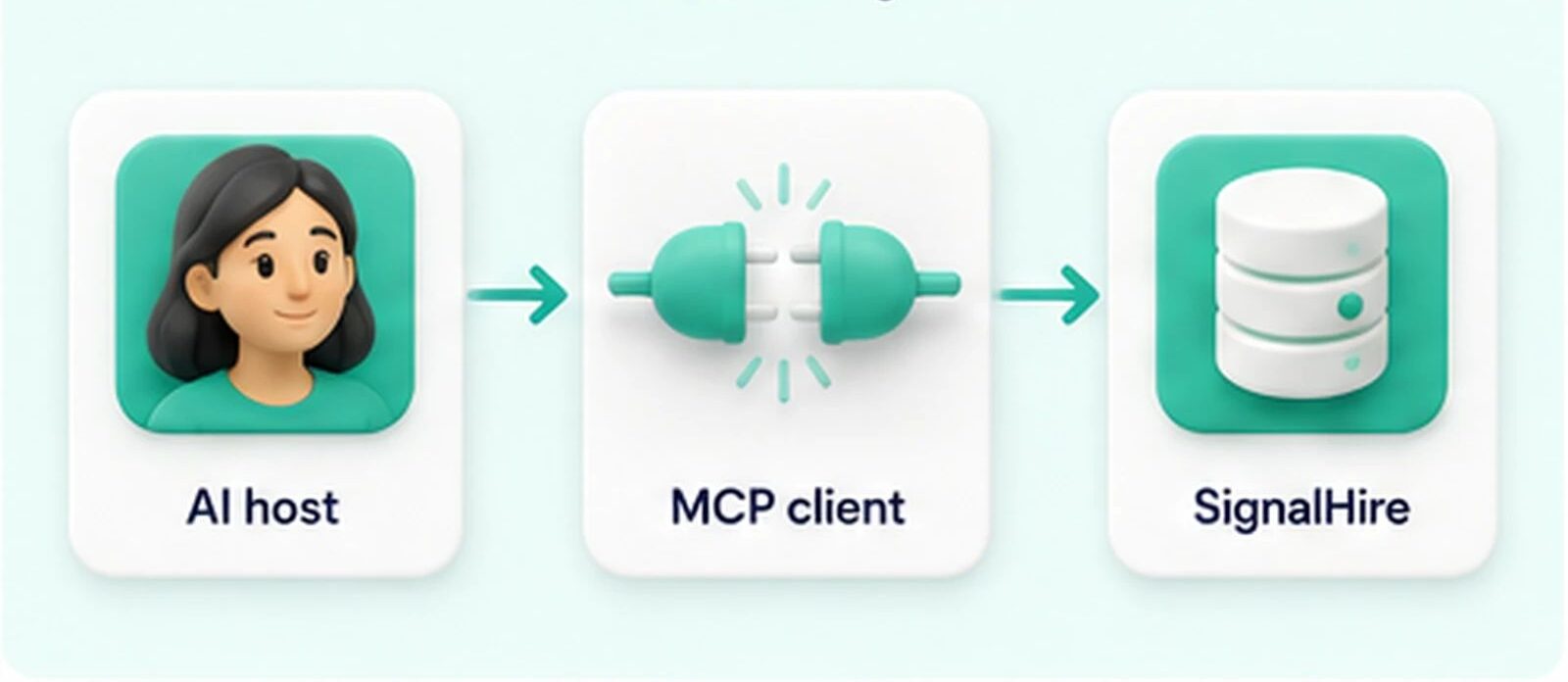
SignalHire’s MCP server was built to close exactly that gap. MCP, short for Model Context Protocol, is the open standard that lets an AI host like Claude or ChatGP connect directly to an external data source in the same conversation, instead of routing through a browser tab or a manual export. SignalHire’s server sits behind that connection and gives an agent live access to 850M+ verified professional profiles and 30M+ companies, refreshed from 40+ data sources every 7 to 10 days.
What Actually Changes for a Team
In practice, this turns a multi-step research task into a single instruction. A recruiter can ask an agent to find every VP of Engineering at Series B fintech companies in Austin and return verified emails for the ten most recently hired. A sales rep can ask for the CMO’s direct contact at a target account without opening a second tool. The agent searches, filters by title, seniority, industry, or location, and reveals a verified email or phone number for one contact credit, only when a match is found. Nothing is charged for a search that comes up empty, which matters more than it sounds. Bad or unreachable B2B contact data is estimated to cost companies over $3 trillion a year in wasted outreach, stalled pipelines, and rework.
Setup takes about 30 seconds for a non-developer: authorize once, and the connection is live inside the existing paid plan, starting at $49 a month, with no separate MCP fee. Developers get more room to build. A scheduled script can run a search every Monday morning and drop a shortlist into Slack before the team’s first meeting. Response formatting supports markdown, CSV, or JSON, so the output slots into whatever system already exists.
The Advice Worth Taking From This
Teams evaluating AI agents in 2026 should stop asking whether an agent can write good outreach copy. Most can. The better question is whether the agent can verify who it is writing to before the message goes out. An agent connected to a live, verified contact source will always outperform one working from a static list, because people change jobs and companies restructure faster than most databases get refreshed. Gartner’s own estimate is that B2B contact data decays by roughly 3% a month, nearly 30% a year, which means a list built in January is already unreliable by December.
The unique conclusion here is not that AI agents need more intelligence. It is that they need a live wire to the real world. The intelligence is largely solved. The access problem is what separates a demo from a working pipeline. Tools like SignalHire exist precisely to hand agents that access, so the research, verification, and outreach steps a person used to do by hand happen inside one conversation instead of five open tabs.
For teams still treating their AI agent as a chatbot that writes emails, the shift worth making in the next quarter is simple: give it a real database to work from, and measure how much manual research time disappears.