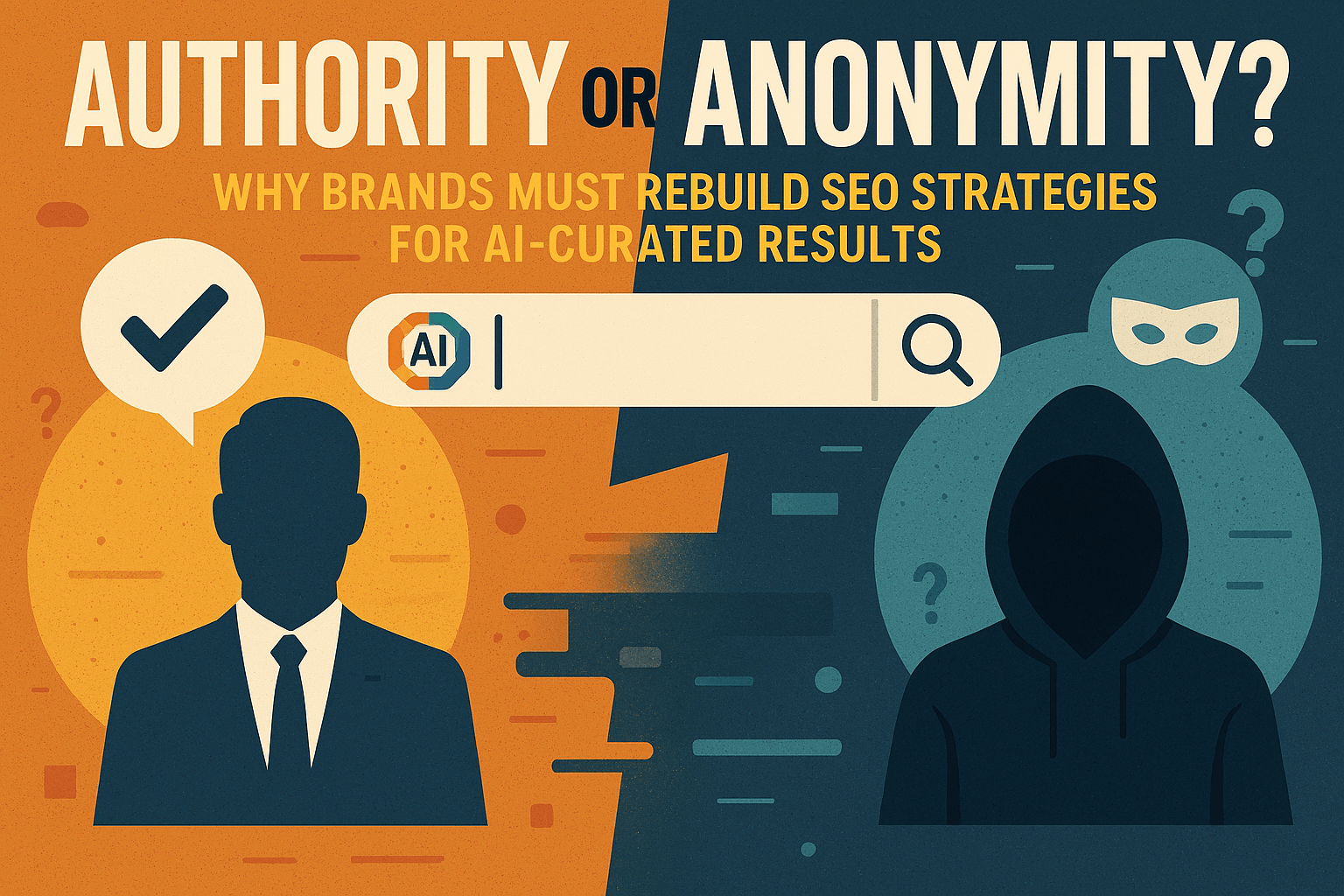
Authority or Anonymity? Why Brands Must Rebuild SEO Strategies for AI-Curated Results
For two decades, SEO rewarded optimization. Build enough links, hit the right keyword density, earn the right domain authority score, and rankings will follow. The brand behind the content was almost incidental.
That era is ending. Fast.
AI-powered search has shifted the fundamental question from “does this page rank for the query?” to “does this source deserve to be cited?” It is a distinction that changes nearly everything about how brands need to approach content and authority-building.
The data is unambiguous. Pages with 15 or more recognized entities show a 4.8x higher AI citation probability. Brand search volume, not backlinks, is now the strongest predictor of AI citations, with a correlation of 0.33, compared with 0.18 for traditional domain authority. Meanwhile, AI Overviews now appear in more than 50% of searches, up from 6.49% in January 2025, and organic CTR for queries with AI Overviews has dropped 61%.
The pipeline from “ranking well” to “getting clicks” is breaking down. A new pipeline is forming: earning citations. And the brands that understand the difference between the two will be the ones still generating organic visibility in 2027.
The Shift from Optimization to Recognition
Traditional SEO was an engineering problem. Enough of the right inputs, links, keywords, and technical health produced the right outputs. Authority was a score. A number. Something you could acquire through systematic effort.
AI systems think about authority differently. They are pattern-matching against everything they know about a brand’s reputation: who cites it, who discusses it, how it appears in third-party coverage, and whether its authors have genuinely recognized expertise. They ask, in effect, “Is this source someone a well-informed person would trust?”
That is a PR question as much as a technical one.
A landmark study by Search Engine Land analyzing 8,000 AI citations found that strong organic search presence and broad web visibility drive AI citations, not the other way around. Being cited by AI is an outcome of overall web authority, not a separate optimization target. Which means brands trying to gain AI citations without building genuine authority will find themselves stuck on an expensive treadmill.
Why Anonymous Optimization No Longer Works
Much of traditional SEO rewarded anonymity. Content mills could rank. Thin affiliate sites could dominate SERPs. Pages with no discernible author or organizational identity could outperform branded content because the algorithms evaluated pages, not publishers.
AI systems are fundamentally less tolerant of anonymity. They weigh E-E-A-T signals heavily: Experience, Expertise, Authoritativeness, Trustworthiness and 96% of AI Overview citations come from sources with demonstrably strong E-E-A-T profiles. An unattributed page that happens to rank well does not meet that bar. A page authored by a recognized expert, published by a known organization, and covered by third-party media sources does.
This creates a structural advantage for brands that have invested in genuine reputation-building: identified authors with publishing histories, consistent earned media presence, and association with credible industry organizations. And it creates a structural disadvantage for brands that have relied purely on technical optimization while keeping the humans behind their content invisible.
The old question was: “How do we make this page rank?” The new question is: “How does the broader internet understand who we are and what we know?”
What AI Systems Actually Look For
Understanding what drives AI citation is worth examining concretely, because the signals differ meaningfully from traditional ranking factors.
Named Entities and Recognition
Entity recognition is now core to how AI systems evaluate content credibility. Pages that reference recognized organizations, named experts, standards bodies, and published research outperform pages that express the same information without anchoring it to recognized sources. Fifteen or more recognized entities is the threshold that research identifies for significantly elevated citation probability. That number reflects a level of integration with the broader information ecosystem, not just having an opinion, but demonstrating familiarity with the established conversation.
Recency and Active Publishing
Eighty-five percent of AI Overview citations come from content published within the last two years, and 44% from 2025 alone. This is not simply a freshness signal. It reflects something more significant: AI systems are tracking whether a source is actively engaged in their domain. A brand that published a definitive guide in 2019 and has gone quiet is not being recognized as an active participant. Consistent publishing signals ongoing expertise.
Third-Party Validation
Brand search volume correlates more strongly with AI citation than with domain authority. That is counterintuitive to traditional SEO logic but makes sense from an AI credibility standpoint: people searching for your brand by name already know you exist and trust you enough to seek you out directly. Third-party coverage in news, industry publications, and expert blogs creates the off-site signal that AI systems use to triangulate whether a brand’s self-presentation is credible.
Multi-Modal Coverage
Content across multiple formats, text, video, and structured data shows AI selection rates that are 156% higher than those for text-only content. YouTube accounts for 23.3% of AI citations across major platforms. Reddit and LinkedIn appear consistently as high-citation sources. Brands that exist only as websites are missing the distributed presence that AI systems use to build confidence in a source’s credibility.
The Human Verification Advantage
Here is where an important nuance enters the conversation. The push toward AI-generated content as a way to scale authority-building is, in many ways, self-defeating.
AI systems are increasingly capable of distinguishing between content that reflects genuine human expertise and content generated by pattern-matching. The E-E-A-T framework explicitly weights lived experience. Content that includes specific scenario-based insights, first-person practitioner knowledge, and references to real-world outcomes performs differently from content that covers a topic comprehensively but from no particular experiential vantage point.
This is why the most durable AI citation strategies combine technological scale with human expertise. The question is not “how do we produce more content?” but “how do we produce content that reflects knowledge AI systems cannot generate on their own?”
Fullintel’s media intelligence platform takes this approach to its logical conclusion. Its AI is trained on over a decade of analyst-curated media data, meaning its pattern recognition is built on expert human judgment, not just raw text volume. The result is what the company calls AI-powered monitoring combined with human analyst verification: a hybrid model where automation handles scale while trained analysts ensure accuracy and context.
That distinction matters beyond media monitoring. It illustrates a broader principle for brands considering AI-curated search: the sources AI systems trust most are those in which human expertise is legible, verifiable, and demonstrably present,t not just claimed.
Rebuilding for the Citation Era
What does this mean practically for brands reworking their SEO strategies?
Identify and Develop Recognized Authors
Named authors with publishing histories, social presence, and third-party recognition are not a nice-to-have. They are an AI citation prerequisite. Identify the two or three people in your organization with genuine domain expertise. Build their external profiles: bylines in industry publications, conference speaking, and association memberships. Make their expertise legible to the broader information ecosystem, not just on your own site.
Earn Third-Party Coverage, Not Just Links
Backlinks from high-authority domains still matter for traditional SEO. But AI citation requires something more: genuine coverage. Articles that discuss your brand, quote your spokespeople, and reference your research. Being mentioned in context by credible third-party sources is the off-site signal AI systems use to validate whether your brand’s self-reported authority is accurate. This is digital PR, not link building.
Publish Original Research
Original data is the most consistently cited content type across AI platforms. Studies, surveys, proprietary analyses, anything that generates a finding that the AI cannot get from aggregating existing text. Brands that commission original research and publish it properly (with methodology, attribution, and clear findings) become reference points that other content cites. That second-order citation effect compounds authority in ways that general content cannot.
Structure Content for Standalone Excerptability
AI systems pull specific passages from content to construct answers. Content structured with clear answer capsules, complete, standalone responses to specific questions placed immediately after heading-level questions is more likely to be cited than content that builds toward conclusions. The traditional SEO technique of making readers scroll through extensive content before reaching the answer is actively counterproductive for AI citation.
Track Your AI Visibility, Not Just Rankings
Standard rank tracking tells you where you appear in blue-link results. It tells you nothing about whether you are being cited in AI Overviews, ChatGPT responses, or Perplexity summaries. Brands need visibility into their AI citation performance separately from their traditional search performance. Strategic media analysis frameworks built for this emerging environment treat AI citations as a distinct measurement category tracking brand mentions across AI platforms, identifying which content is being cited and why, and measuring whether earned media coverage translates into AI citation probability.
This is not a solved problem. Roughly 40-60% of domains cited in AI responses change completely within a month, even for identical queries. Citation patterns are volatile. Continuous monitoring, not periodic audits, is required.
The Strategic Implications
It is worth naming the uncomfortable truth at the center of this transition: the brands most exposed to the shift toward AI-curated results are the ones that built their search presence primarily through technical optimization rather than genuine authority.
If your rankings depend on link acquisition programs, keyword-optimized thin content, and domain authority scores, the floor is moving. Not gone, traditional SEO still matters, but no longer sufficient. AI systems are surfacing sources with accumulated credibility, not just optimized pages.
The brands best positioned for this environment look more like media organizations than traditional content marketers. They have recognizable experts. They produce original research. They earn coverage in third-party publications. Their content is structured to answer questions directly. Their presence spans formats and platforms, not siloed in a single domain.
Read More: Clickfor Net Explained
That profile requires a different kind of investment than SEO has historically demanded. Less technical. More reputational. It requires the organization to develop the expertise it claims, make it visible, and enable third parties to recognize and validate it.
Anonymous optimization was always fragile. It worked because search algorithms were imperfect proxies for authority. AI systems are better proxies. And brands that built their visibility on gaps in the proxy are finding those gaps closing.
The window to rebuild on genuine authority is open. It will not stay that way indefinitely.
–
About The Author
Ted Skinner is VP of Marketing at Fullintel and the author of the bestselling business book Predictable Results: How Successful Companies Tackle Growth Challenges and Win, where he leads the company’s content strategy and thought leadership in media intelligence. With more than 20 years of marketing leadership experience spanning media intelligence, SaaS, and management consulting, he has built and led communications functions that connect media data to executive decision-making. He writes regularly on crisis communications, AI implementation in PR, and the evolving relationship between media coverage and business outcomes.