
How to Be Remembered by AI: The Rules of LLMO in 2025
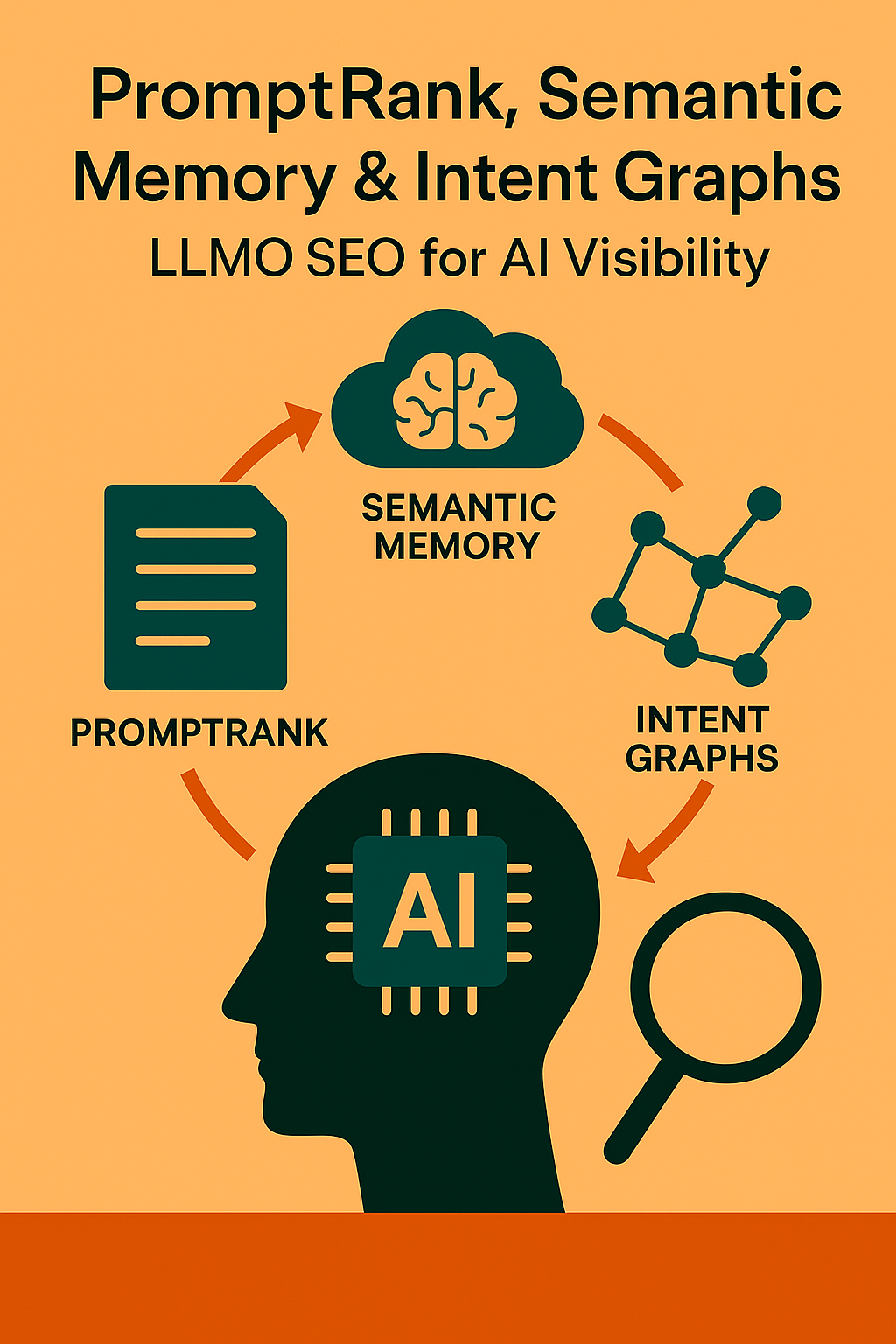
PromptRank, Semantic Memory & Intent Graphs | LLMO SEO for AI Visibility
Search used to be a breadcrumb trail. You left some keywords, sprinkled meta tags like birdseed, and hoped Google’s crawlers would follow the scent. That era’s over. Search engines aren’t crawling anymore, but remembering.
In the post-spider era of search, visibility hinges on three things: whether you’re promptable, memorable, and contextually relevant. That’s PromptRank, Semantic Memory, and Intent Graphs. Together, they form the backbone of Generative Engine Optimization (GEO), or as some prefer, LLMO- the practice of making content not just findable, but usable by AI systems that don’t “search” in the traditional sense.
This isn’t just a new flavor of SEO for AI. It’s a new standard for visibility.
PromptRank: Not What You Say, How Recallable It Is
When someone asks ChatGPT a question, it doesn’t go out and search. It assembles a response from what it’s already internalized—fragments of web content, answers, docs, JSON, whatever it’s digested before. So the real question is: how likely is your content to surface when someone’s asking?
That’s PromptRank.
And it’s not abstract. One Nature study showed that changing the phrasing of a prompt—just slightly—led to drastically different outputs, even when the models were trained on the same data. What’s happening here isn’t relevance; it’s alignment with prompt shape.
You want to be picked? Then structure your content like an answer, not a blog post. Think: clear claims, extractable facts, modular logic blocks. Good PromptRank isn’t about keywords—it’s about being autocomplete-friendly.
Pro tip: AI doesn’t reward fluff. It can’t quote your flourish. But it can lift your bullet point.
Semantic Memory: It’s Not Indexed, It’s Stored
LLMs don’t “index” like search engines—they embed. If traditional search was about filing your content under the right tab, semantic memory is about stuffing it into the AI’s brain in a way that’s actually accessible later.
This is why semantic caching has taken off. GPTCache, for example, reduces redundant API calls by ~69% with hit rates above 60%—not because it’s faster, but because meaning has become a retrievable asset.
So if your content is buried in nested divs, ambiguous language, or overloaded pages, forget it—it’s noise. AI needs structure and signal: hierarchy, clarity, atomic blocks. This is less about ranking and more about memory architecture.
Write like someone’s going to quote you without attribution. Because that’s exactly what’s happening.
Intent Graphs: Don’t Just Exist—Belong
Here’s where it gets interesting.
Old SEO treated queries like darts. Throw enough pages at enough keywords, and something will stick. But modern AI builds context-aware journeys. It’s less “what’s the best hiking backpack” and more “I’m planning a Patagonia trip in July, I’m 5’4”, and I hate sweaty backs—what do I buy?”
Intent graphs are how that gets answered. Tools like Neo4j and Algolia are building pipelines where AI interprets not just what someone is asking, but why, what comes next, and how they got there.
If your content isn’t designed to slot into that journey—if it’s not anticipatory, relational, or modular—you’re not part of the path.
Best content doesn’t just answer the question. It answers the one after.
Structuring for AI: Format or Fade
Now that you know the rules, here’s the brutal truth: most content isn’t failing because it’s bad. It’s failing because it’s invisible.
Platforms like Geordy fix this at the infrastructure level with LLMO. Not a dashboard, not another rank tracker—just structured output. It spits out llms.txt, semantic blocks, and AI-readable metadata so that your content isn’t just indexed—it’s ingested. Whether you use it or not, some form of structural adaptation is table stakes now.
To balance the picture: tools like AI Search Grader (by Mangools) and Grepbox provide diagnostics. They’ll tell you if you’re being seen by AI engines—but they won’t fix your visibility. That split matters.
Analytics show you the gap. Structured data closes it.
Beyond Tactics: What GEO Actually Demands
If you’re waiting for a CMS plugin or magic checkbox labeled “Optimize for AI Search,” you’re already behind. GEO isn’t a tool. It’s a shift in how content is read.
To play in this space, you’ll need to start thinking like an LLM:
- Can this paragraph stand alone?
- Is this statement attributable?
- Is this sentence a clear, compressed answer to a likely prompt?
- Is this page a fragment of a bigger decision path?
And maybe more urgently:
- Can this content be remembered after it’s read once?
If not—it’s not SEO anymore. It’s background noise.