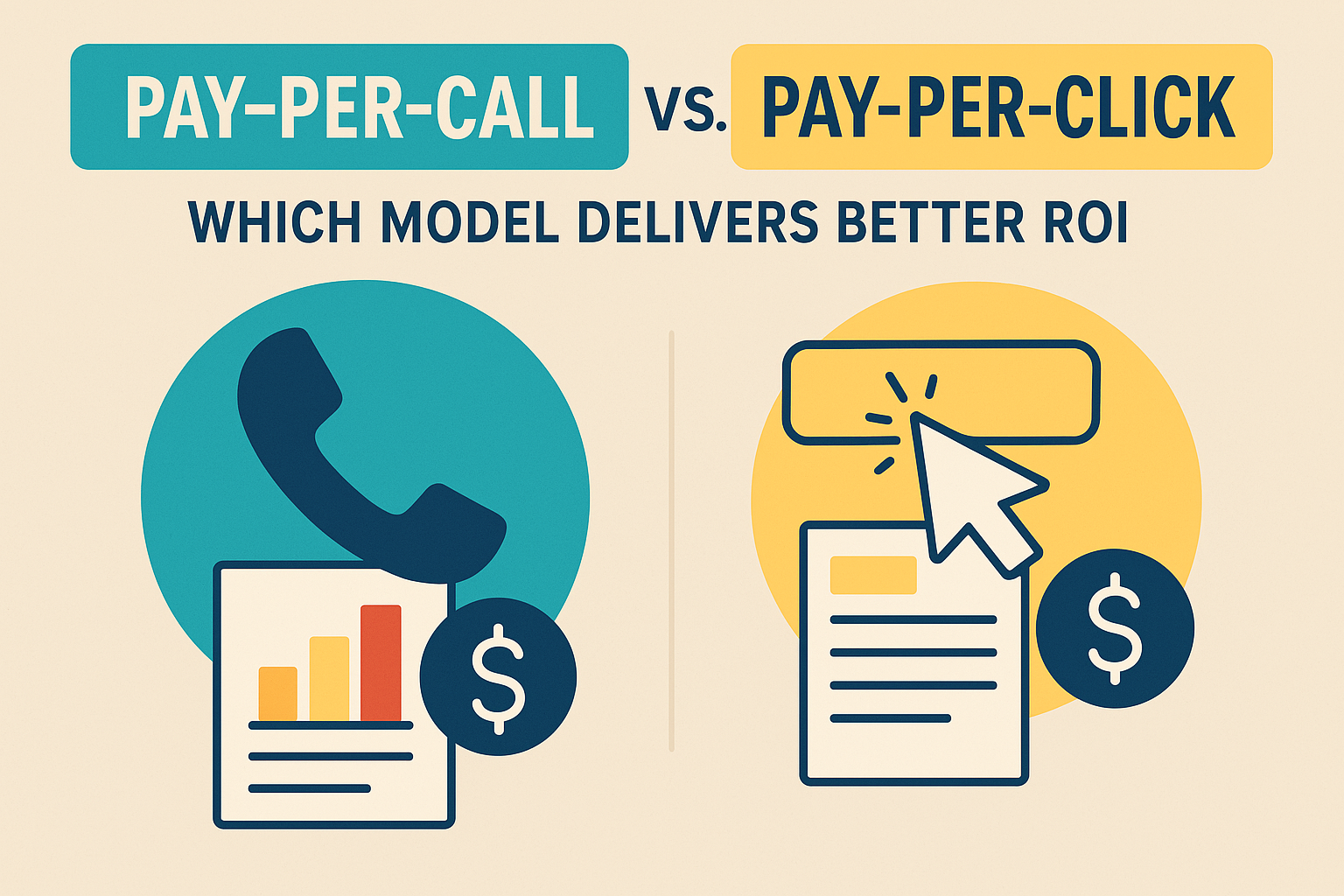
Pay-Per-Call vs. Pay-Per-Click: Which Model Delivers Better ROI
As businesses continue to seek more efficient ways to acquire high-intent customers, pay-per-call lead generation emerges as a powerful strategy in performance marketing. Despite some marketers thinking that no one likes to talk on the phone anymore, people still prefer to have a conversation with a live agent.
However, pay-per-click with its automation and 24/7 conversion opportunities stands out as bright. While each model shines in its own way, most marketers are still thrilled with the question “Which method brings better ROI, and what should I choose?”. Let’s examine both of those approaches to find which suits you better.
What Is Pay-Per-Call?
Pay-per-call marketing methods ensure that affiliates generate phone calls from the target audience for advertisers. In this case, the merchant determines the qualification criteria for the call and allows advertisers to create a promotion that encourages potential leads to initiate the call. Here is how the pay-per-call campaigns work:
- A user sees an ad with a call button or a tracked phone number.
- The user places a call to the business, typically looking for a quote, booking, consultation, or urgent service.
- The call is tracked using unique phone numbers and call tracking software.
- The advertiser pays only when a valid call is received (e.g., over 30 seconds, during business hours, from a specific region).
People who are ready to call typically have higher purchase intent and want a real human connection. Pay-per-call campaigns typically have high conversion rates up to 50%. It is no wonder, as people who are looking for a business’s phone numbers are ready to take immediate action.
So, pay-per-call lead generation suits businesses that provide services and typically use the immediate connection between salesperson and client, such as legal firms, healthcare providers, insurance, solar, travel, and even hospitality businesses.
What Is Pay-Per-Click?
Pay-per-click (PPC) is a more traditional digital promotion model where advertisers pay a fee each time someone clicks on their ad. Pay-per-click ads are commonly used in search engines, social media, and display networks. In this case, a promotion looks like this:
- Affiliates create a pay-per-click ad targeting specific keywords, interests, demographics, or behaviors.
- The ad is displayed on a search results page or other digital platform.
- A user clicks on the pay-per-click ad and is directed to your website or landing page.
- Advertisers will pay affiliates only when the click happens, regardless of whether it leads to a sale.
PPC campaigns benefit businesses that are oriented toward online communication, such as e-commerce companies. SaaS businesses, firms, or individuals who sell online courses and digital products, etc. Here, affiliates bring highly targeted and scalable traffic, which is great for testing offers and increasing brand awareness.
Pay-Per-Call and Pay-Per-Click Marketing: Key Differences
Choosing the right performance marketing model and digital marketing tools can make or break your campaign ROI. While pay-per-click has long been the go-to strategy for driving website traffic for decades, pay-per-call is a great strategy for businesses that require direct human interaction.
Each model offers unique strengths, and the best choice depends on your goals, industry, and sales funnel. To help you decide, here’s a side-by-side breakdown of the key differences between pay-per-call and pay-per-click campaigns across critical performance areas like cost, conversion rate, lead quality, and more.
| Feature / Factor | Pay-Per-Call | Pay-Per-Click |
| What Advertisers Pay For | A qualified phone call from a lead | A click on the ad, regardless of the outcome |
| Lead Quality | Usually higher since with pay-per-call promotion, advertisers get direct, human contact | Varies since it may include cold traffic or bot clicks |
| Conversion Rates | Often 15–50% (voice interaction = faster trust) | Typically 2–5% (requires landing page optimization) |
| Cost Per Lead | Higher ($20–$100+) but more likely to close | Lower CPC ($1–$5), but often lower lead-to-sale ratio |
| Speed to Conversion | Immediately, since the sales team can close the deal over the phone | Delayed since the users who came from pay-per-click ads may browse, return later, or abandon |
| Best For | Services, local businesses, companies with high-value transactions (solar, insurance, etc) | E-commerce, SaaS, or businesses that are looking for online signups and brand visibility |
| Tracking Setup | Requires call tracking software | PPC advertising is easier to track since you can use Google Analytics, UTM tags, and other simpler software. |
| Fraud Risk | It’s hard to fake a phone call, so fraud risks are low | Click fraud and low-quality traffic are common frauds |
| User Intent | Very high, since they’re taking time to call | It can be low because clicks may be accidental or casual |
| Sales Process Fit | Great for sales that need consultation or qualification | Best for fast, self-serve, or funnel-driven transactions |
Each performance marketing approach has its specifics. Meanwhile, you don’t need to be stuck with a single solution. You are free to experiment and use various marketing approaches until you find one that perfectly suits your business.
However, whether you are an advertiser or affiliate, we recommend that you use comprehensive lead generation services that help you track both pay-per-click and pay-per-call campaign results. That way, you сan mix different promotions to get the best results.
When to Use Pay-Per-Click vs. Pay-Per-Call
Deciding between pay-per-click and pay-per-call isn’t just about cost, but more about finding a balance between how your customers prefer to convert and what option suits your needs and budget.
While pay-per-click marketing is often the default choice for digital advertisers, pay-per-call can offer significantly better results for service-oriented or high-intent industries. The key lies in understanding how each model aligns with your sales process. So, let’s examine when each lead generation method shines the best with this comprehensive table.
| Choose Pay-Per-Click if… | Choose Pay-Per-Call if… |
| You sell products or services directly online | You convert leads primarily through phone calls |
| Your offer is straightforward and doesn’t require a personal explanation | Your service is complex, high-stakes, or emotionally driven |
| You’re focused on traffic, brand awareness, or top-of-funnel activity | You’re focused on qualified leads with high purchase intent |
| Your landing pages are optimized to drive conversions | Your team is equipped to close over the phone in real time |
| You can scale affordably through broad targeting and A/B testing | You need fewer leads, but with stronger conversion potential |
| You rely on automation, retargeting, or drip campaigns | You rely on live interactions, consultations, or urgent responses |
| Your sales process is digital-first: forms, checkouts, demos | Your sales process is phone-first: bookings, quotes, or service coordination |
| You serve national or global audiences | You serve local or regional customers who prefer calling |
Both pay-per-click and pay-per-call advertising can drive strong ROI, but only when aligned with the way your audience wants to engage. As you see from the above examples, pay-per-click suits high-scale, web-based funnels with an automated sales funnel. In contrast, pay-per-call shines in businesses that require live conversation. So, to ensure the maximum possible ROI, choose the method that fits your particular situation.
Final Thoughts
When it comes to performance marketing, there’s no one-size-fits-all resolution. You can run pay-per-click campaigns at any time, whereas with pay-per-call marketing, you need to consider the working hours of the sales unit. If the affiliate sets their promo during the call center’s off-days, they just spend time and money on the promo without results.
The most effective way to increase conversions and ROI for both affiliates and advertisers is to strategically combine pay-per-click and pay-per-call advertisements.