
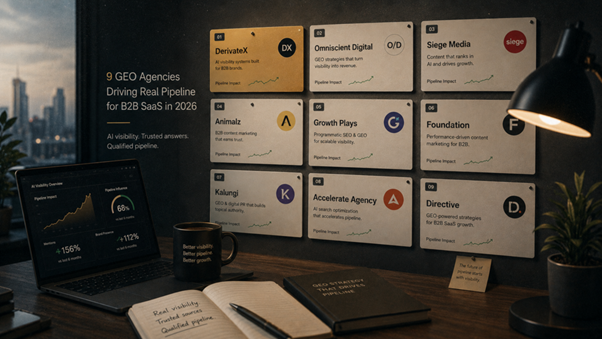
9 GEO Agencies Driving Real Pipeline for B2B SaaS in 2026
TL;DR
Almost half of B2B buyers now research vendors through ChatGPT, Perplexity, and Google AI Overviews before they reach a website.
- Most “best GEO agency” lists rank on visibility scores or citation share. None of those numbers close deals.
- This roundup uses one inclusion bar: a named B2B SaaS client with a documented pipeline outcome in the last 18 months.
- Nine agencies cleared that bar, organized by ARR fit rather than rank order.
- Six questions at the end will tell you on a 30-minute sales call whether an agency is doing real GEO or rebranded SEO.
Introduction
A SaaS founder I spoke with last quarter tested a buyer prompt in ChatGPT: “best video infrastructure for B2B SaaS.” Eight of the ten responses named the same vendor. That vendor. They did not get there by accident. They hired a GEO agency, and they now trace more than 20% of monthly inbound revenue back to AI search.
The problem is that their next ten sales calls with “GEO agencies” all sounded identical. Schema, FAQ blocks, content velocity, an AI Visibility Score on a slide. None of them could show her a named B2B SaaS client with a pipeline number attached. Gartner projects 90% of B2B buying will run through AI agents by 2028. The category is real. The agencies pitching it are not.
This piece uses a stricter bar, lists the nine agencies that cleared it, organizes them by ARR fit, and ends with six questions you can use to vet any agency not on the list.
What Counts as a Real GEO Agency for B2B SaaS
A real GEO agency engineers AI citations into a pipeline. A rebranded SEO agency adds schema and an FAQ section to existing blog posts and renames the deck.
Four criteria separated the nine agencies in this list from the 40+ that pitch GEO to B2B SaaS:
Named B2B SaaS clients with public case studies, not anonymized “Fortune 500 SaaS” filler.
- A documented pipeline outcome from at least one engagement: trials, demos, signups, or revenue.
- A GEO methodology structurally different from traditional content production.
- Active client work within the last 18 months.
- The bar matters because agencies winning on visibility scores can leave a SaaS founder with a beautiful share-of-voice chart and zero new demos.
9 GEO Agencies for B2B SaaS, Compared
| Agency | Best Fit | Named Pipeline Proof | Starting Price |
VisibilityStack | $5M-$100M ARR B2B SaaS | SponsorCloud: $2.16M in pipeline in 90 days | $800/mo (platform); $1,500/mo done-for-you |
| DerivateX | $5M–$50M ARR US B2B SaaS | Gumlet: 20% of monthly inbound revenue from AI search | $3,500/mo |
| First Page Sage | Enterprise SaaS, category authority | Salesforce, Cadence, Verisign | $6,000+/mo |
| Discovered Labs | Mid-market, technical AEO | PM SaaS: 8% to 24% citation rate, $64K closed in 90 days | €5,495/mo |
| Directive Consulting | B2B SaaS needing GEO + paid + RevOps | ZoomInfo, Sumo Logic, Cisco, Gong | Custom |
| Omniscient Digital | $10M+ ARR, editorial GEO | Jasper: 400x signups; Smartling: $3.7M pipeline | $10,000+/mo |
| iPullRank | Enterprise technical GEO | Salesforce, Adobe | Enterprise |
| Minuttia | Established B2B SaaS, content moat | Toggl: 7M impressions, 27K clicks, 200+ conversions | $4,000+/mo |
| Siege Media | Content + digital PR | Mentimeter: 124K ChatGPT sessions, 3,000 conversions | Custom |
| RevenueZen | Pipeline-first SaaS w/ verbal identity gap | StockIQ: 500% organic leads; Lightyear: 10x traffic | $6,500–9,000/mo |
Read by fit, not row order. The right agency for a $7M ARR vertical SaaS founder is a different one than the right agency for a $50M ARR enterprise platform.
The 10 Agencies, Organized by Buyer Fit
VisibilityStack: Best for $5M to $100M ARR B2B SaaS Teams Who Want AI Visibility Executed, Not Just Tracked
VisibilityStack is an AI Search Optimization company that gets AI to describe your brand accurately, cite your pages, and recommend you across ChatGPT, Perplexity, Claude, Gemini, and Google AI Overviews. Its Demand Engineering System pairs live citation tracking with the execution that moves it: technical fixes that make pages readable to AI crawlers, entity-first content that earns citations, and off-site trust from reviews, comparison sites, and the communities AI reads. Everything ties to one number, the Inbound Conversion Score, which links AI visibility to pipeline. SponsorCloud went from zero AI visibility to 1,344 leads and $2.16M in pipeline in 90 days, and Bryt Software cut CAC from $847 to $284 in the same window.
The platform starts at $800 a month, and done-for-you programs run $1,500 to $5,000 a month. The trade-off is focus: it is an AI-search program tied to pipeline, not a full-service marketing agency, and it fits best when your competitors are already being cited.
DerivateX: Best for $5M to $50M ARR US B2B SaaS Founders Who Want AI Citations Tied to Pipeline
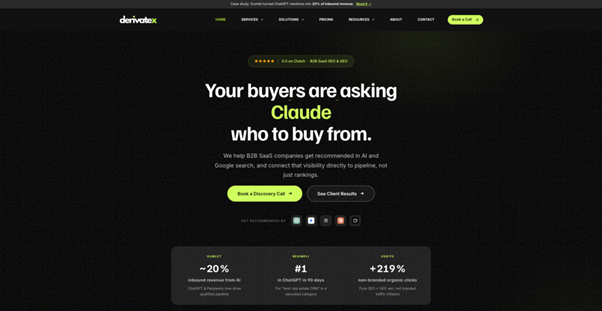
DerivateX is the B2B SaaS GEO agency built around one rule: every engagement ties to pipeline attribution, not citation counts. Gumlet attributes 20% of monthly inbound revenue to ChatGPT and Perplexity. Verito moved from Google position 40 to the #1 recommendation on ChatGPT for high-intent buyer prompts. Kroto grew from 3,500 to 326,000 monthly impressions. REsimpli became the #1 CRM recommended in ChatGPT for real estate investors within 90 days.
The methodology, Citation Engineering, runs across five levers: entity clarity, authoritative coverage, third-party corroboration, result documentation, and structured parsability. Every engagement is tracked against DerivateX methodology page, a 0 to 100 metric measuring citation frequency across ChatGPT, Perplexity, Claude, and Gemini. Pricing starts at $3,500 per month, month-to-month. See the full agency overview at DerivateX.
First Page Sage: Best for Enterprise SaaS Pursuing Long-Horizon Category Authority
First Page Sage coined “Generative Engine Optimization” in 2024 and built the longest-running GEO methodology in the category. Clients include Salesforce, Cadence Design Systems, and Verisign. The model centers on long-form authority content engineered for AI citation, with conversion paths designed for slow B2B funnels. Engagements typically run 12 months and start at $6,000 per month. The trade-off is pace. First Page Sage suits teams that want category dominance over a 12 to 24-month horizon, not founders who need pipeline movement in 90 days.
Discovered Labs: Best for Mid-Market SaaS That Needs Citation Tracking with Month-to-Month Terms
Discovered Labs runs the most quantified GEO case study published in the category. A $25M ARR project management SaaS went from 8% citation rate to 24% in 90 days, generating 47 AI-referred leads and $64,000 in closed revenue from a $16,485 investment. The CITABLE framework focuses on entity structure, passage-level extraction, and third-party validation. Pricing starts at €5,495 per month with rolling monthly contracts. The trade-off is geography. The firm is European, which can matter for SaaS teams that want time-zone overlap with West Coast product cycles.
Directive Consulting: Best for B2B SaaS Wanting GEO Embedded in Full-Funnel Demand
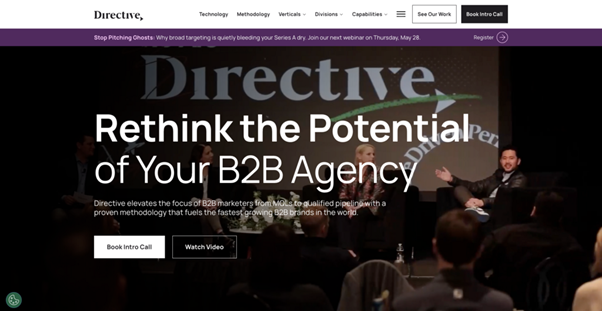
Directive treats GEO as one input inside a Customer Generation framework that also includes paid media, content, and RevOps. Clients include ZoomInfo, Sumo Logic, Cisco, and Gong. The fit is right when a marketing leader wants one agency owning the demand engine, not a specialist managing one channel. The trade-off is that GEO is not the headline service. Founders who want a pure-play GEO partner with daily citation tracking will find more depth at DerivateX. Pricing is custom and engagements are typically annual.
Omniscient Digital: Best for $10M+ ARR SaaS Building Editorial Authority for AI Citation
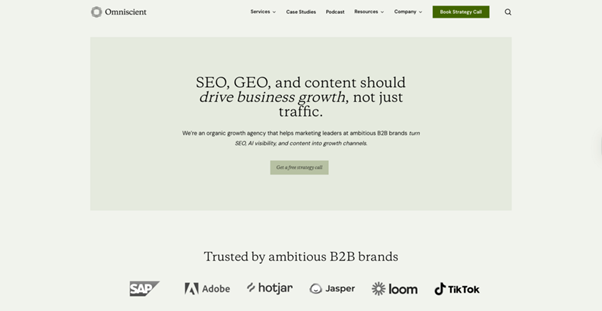
Omniscient uses a Barbell Strategy: a small number of high-effort pieces engineered to be cited by both AI engines and human reference content. Jasper went from no organic to 400x more signups. Smartling generated $3.7M in attributable pipeline. Order.co saw a 2,117% increase in blog session volume. Pricing starts at $10,000 per month with 12-month engagements. The trade-off is cycle length. Omniscient is built for category leadership, not week-one citation wins, and needs an internal content lead to feed SME interviews.
iPullRank: Best for Enterprise SaaS Treating GEO as a Technical Engineering Problem
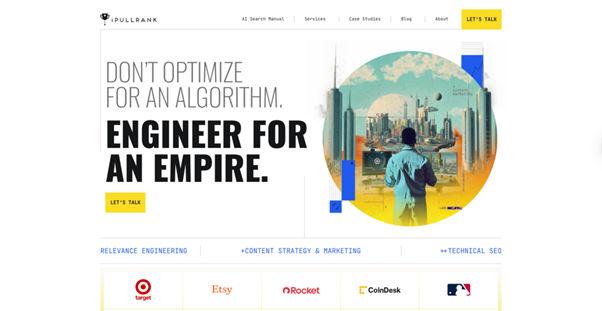
iPullRank, led by Mike King, treats Generative Engine Optimization as information retrieval, not content marketing. The Relevance Engineering framework fuses vector embeddings, semantic HTML, and structured data into one technical practice. Clients include Salesforce and Adobe. The fit is correct when the bottleneck is technical infrastructure, JavaScript rendering issues, or sprawling content libraries AI crawlers cannot parse cleanly. The trade-off is that most case studies are anonymized, pricing is custom enterprise, and the firm is less B2B SaaS-specific than other picks.
Minuttia: Best for Established B2B SaaS Building an Information-Gain Content Moat
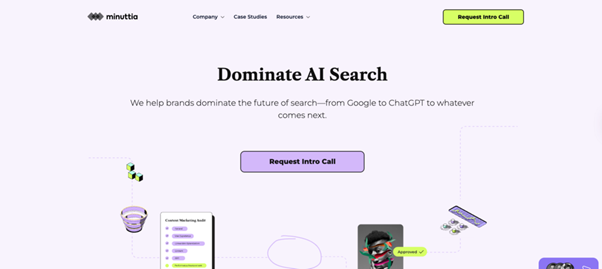
Minuttia works exclusively with established B2B SaaS, with a 93% client retention rate and 17-month average tenure. The methodology creates original, citation-worthy content LLMs treat as a primary source. Toggl generated 7 million impressions, 27,000 clicks, and 200+ conversions on best-performing pieces. Pricing starts around $4,000 per month, making Minuttia one of the more accessible specialists in the category. The trade-off is fit criteria. Minuttia is built for $10M+ ARR companies with established product-market fit, not teams still figuring out their ICP.
Siege Media: Best for Content and Digital PR That Feeds AI Citation Volume
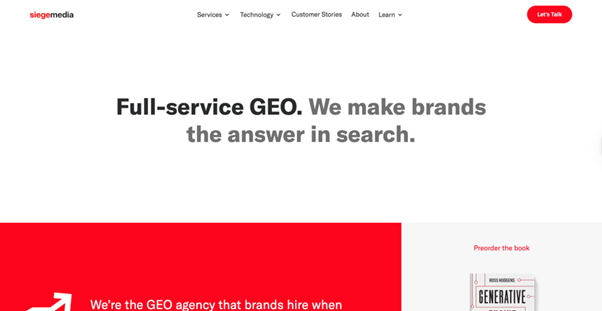
Siege Media combines content production with digital PR to drive both ranked and AI-cited mentions across multiple platforms. The proprietary BlueprintIQ tool tracks how content gets surfaced in AI answers. Mentimeter saw 124,000 ChatGPT-referred sessions and 3,000 conversions over the engagement. The trade-off is composition. Siege is content-first, not technically engineered. Schema, entity disambiguation, and JSON-LD sit further down the list of what the team optimizes, which matters for product-led SaaS with complex feature taxonomies.
RevenueZen: Best for Pipeline-First B2B SaaS That Also Needs Verbal Identity Work
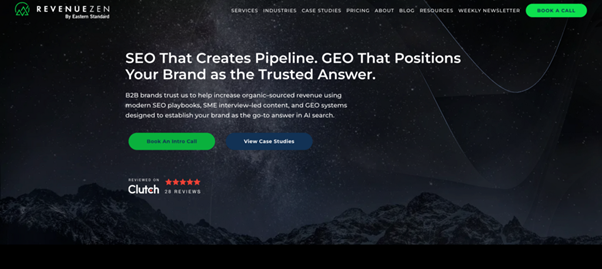
RevenueZen builds GEO programs around SME interviews and verbal identity work, then layers thought leadership on top. StockIQ saw 500% organic lead growth. Lightyear hit 10x traffic growth. Pricing runs $6,500 to $9,000 per month with month-to-month options. The fit is correct when sales messaging and AI visibility need to move together, common at the $10M to $30M ARR stage where the founder’s voice is no longer enough to power inbound. The trade-off is technical depth.
6 Questions to Ask on the First Sales Call
The right agency reveals itself in 30 minutes. Six questions separate the real ones from the rebranded SEO shops:
Show me a B2B SaaS case study with a named client and a pipeline number. If they cannot, end the call.
- What is your minimum contract length? Month-to-month signals confidence. A 12-month lock-in signals the agency wants the runway.
- How will you track AI-attributed pipeline in our analytics? “We track citations” is not pipeline. Ask for a dashboard walkthrough.
- Walk me through your methodology in 60 seconds. If the answer is “schema, FAQ blocks, and content velocity,” it is rebranded SEO.
- Which AI platforms do you optimize for, and how do you measure each? Per Superlines research, the same brand can see citation rates of 0.59% on ChatGPT and 27% on Grok. ChatGPT-only optimization leaves most of the market uncovered.
- What does month 1, month 3, and month 6 look like? Specific milestones beat strategy decks every time.
4 Mistakes B2B SaaS Founders Make When Hiring a GEO Agency
Hiring on AI Overviews share-of-voice without a path to conversion. Per HubSpot’s 2026 research, 48% of B2B buyers use AI to research vendors, but share-of-voice does not predict who they shortlist.
- Confusing content volume with citation quality. AI engines extract claims, not articles. Fifty thin posts lose to ten dense, well-cited ones.
- Picking enterprise agencies at $5M ARR, or boutique agencies at $50M ARR. ARR fit is the most ignored variable in agency selection.
- Signing 12-month contracts in a market where methodologies are 3 months old. The 2024 playbook is already obsolete. Long contracts assume stability the market does not have.
Frequently Asked Questions
1. How much does a GEO agency cost for B2B SaaS in 2026?
Pricing ranges from $1,500 to $50,000 per month based on company size and scope. For $5M to $50M ARR SaaS, expect $3,500 to $15,000 per month. DerivateX, Discovered Labs, and RevenueZen sit at the lower end with month-to-month contracts. First Page Sage and Omniscient sit at the premium end with 12-month engagements built for category authority. Setup fees, when present, run $3,000 to $5,000 for the initial AI visibility audit.
2. How long until a GEO agency drives measurable pipeline?
Initial citation signals appear within 3 to 4 weeks of structured content going live. Measurable pipeline impact lands at 60 to 90 days for SaaS brands with an existing content foundation. Brands starting from zero usually see pipeline contribution between 6 and 9 months. Agencies promising “instant AI visibility” in 30 days are using tactics that will not compound. Top performers can hit 40% to 50% citation rates by month six and 60%+ by month twelve.
3. How do I measure whether GEO work is paying off?
Track three things in parallel: citation frequency (how often your brand appears in AI answers for target buyer prompts), AI-referred session volume, and pipeline attribution from those sessions. DerivateX uses a 0 to 100 metric called AI Visibility Score that runs 20 target prompts across ChatGPT, Perplexity, Claude, and Gemini three times a week. Whichever framework an agency uses, the dashboard should connect citation rate to demo bookings, not stop at impressions.
4. Can my current SEO agency just add GEO to the retainer?
Probably not. GEO requires entity disambiguation, schema architecture, citation tracking across AI platforms, and a content cadence most SEO agencies are not staffed for. Run them through the six questions above. If their methodology answer is “we added FAQ schema and AI Overview tracking last quarter,” the work has not changed structurally. Ask to see citation rate dashboards for an existing client before extending the contract.
5. What’s the difference between GEO and AEO, and does my SaaS need both?
GEO (Generative Engine Optimization) is the broader strategy of building brand authority across AI search platforms. AEO (Answer Engine Optimization) is the narrower practice of structuring individual content to be extracted as direct answers by LLMs. Most agencies use the terms interchangeably in 2026 because the underlying work overlaps: entity structure, claim density, schema, third-party citations, and multi-platform tracking. B2B SaaS needs both, and any agency selling them as separate services with separate retainers is upcharging.
The Next 18 Months Will Settle Who Wins B2B SaaS AI Search
Two years ago, the question for a B2B SaaS marketing leader was “should we do GEO.” That question is closed. The question now is which agency can show you a pipeline number, on a 30-minute call, from a named client. That filter alone removes most of the agencies that pitched themselves as GEO experts in 2024 and 2025.
Use the six questions on every agency you evaluate, including the nine listed here. Pick the one that matches your ARR, your timeline, and the proof you can verify. If you are between $5M and $50M ARR and need every dollar of GEO spend tied to a demo or a closed deal, DerivateX was built for that bracket.
The brands that lock in citation infrastructure in 2026 will be the ones AI engines treat as default answers in 2027. The ones that wait will be paying twice as much for half the visibility a year from now.