
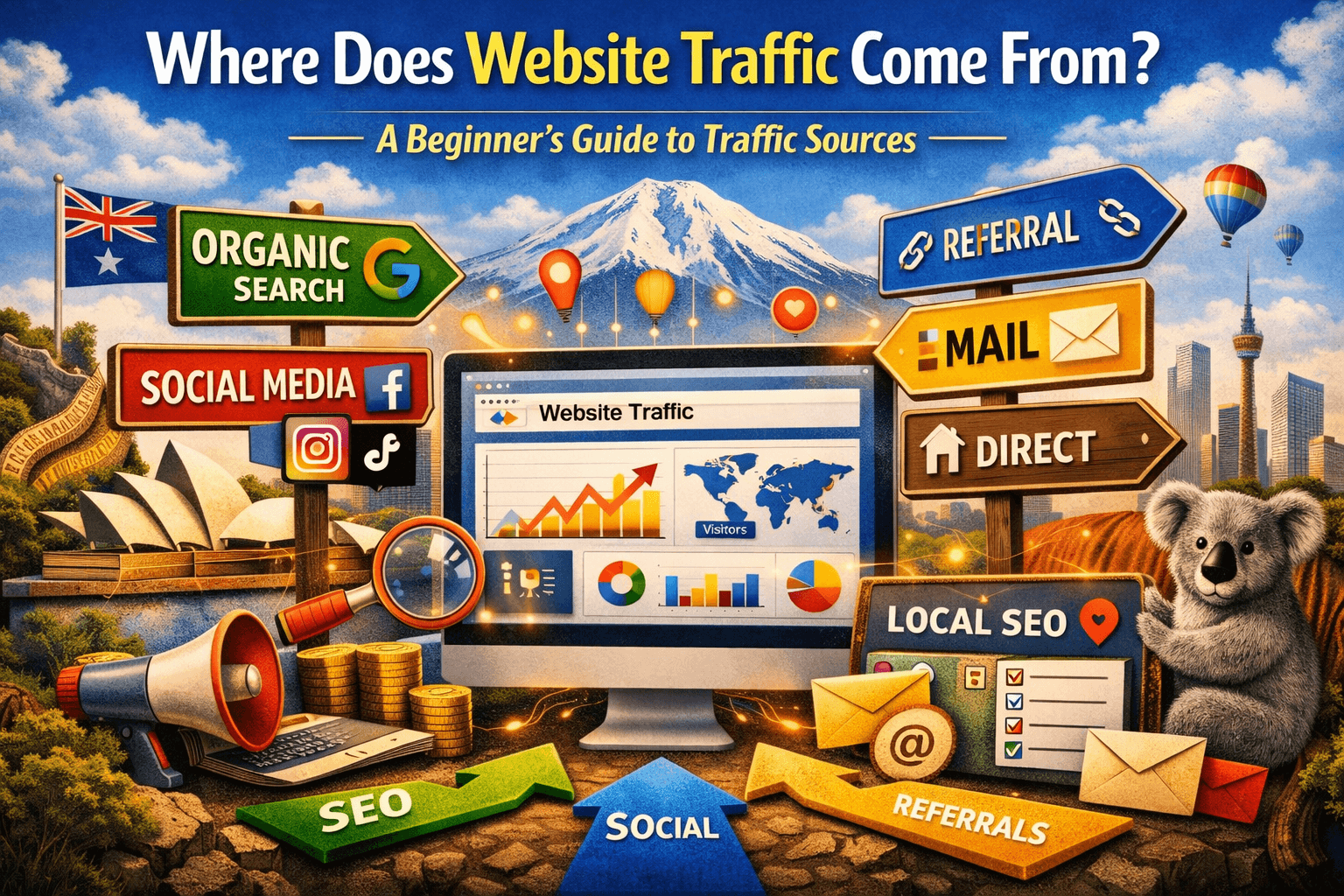
Where Does Website Traffic Come From? A Beginner’s Guide to Traffic Sources
Every website gets visitors from somewhere. Some find you through Google. Others click a link in an email or see your post on social media. Each of those paths has a name, and knowing the difference between them helps you make smarter decisions about where to spend your time and money.
This guide covers the main traffic sources, how they work, and what you can actually do to improve each one.
Understanding Website Traffic: What It Means and Why It Matters
Website traffic is the total number of visits your site receives over a given period. Each visit comes from a specific source, and that source tells you a lot about how people found you and how likely they are to take action.
Traffic volume alone does not tell the whole story. A site with 10,000 monthly visitors who all leave in seconds has a problem. A site with 2,000 visitors who read, click, and buy has something working. The goal is not just more traffic. It is the right traffic.
Traffic data also shows you which marketing efforts are working. If your paid ads are driving clicks but no purchases, that is a signal to investigate. If your blog posts are generating consistent organic visits month after month, that is a signal to invest more in content.
Google Analytics 4 (GA4) is the standard free tool for measuring this. It groups your visitors by source and shows you how each group behaves on your site. You can see which channels bring the most visitors, which ones drive the most conversions, and where people drop off.
Key takeaway: Traffic without context is just a number. Understanding where visitors come from turns that number into a strategy.
Direct, Organic, and Referral Traffic: The Core Sources Explained
These three sources form the foundation of most websites’ traffic mix. They represent visitors who came without a paid prompt, which generally means they had a reason to show up.
Direct Traffic
Direct traffic happens when someone types your URL directly into a browser or clicks a bookmarked link. These are usually people who already know your brand. They have visited before, heard your name from someone, or saw it on a business card or packaging.
A high direct traffic share is a good sign. It means people remember you. Patagonia, for example, sees consistent direct traffic because its brand is well established. People do not need to search for it. They just go.
One thing to watch: GA4 sometimes misclassifies traffic as direct when tracking fails. If your direct traffic spikes suddenly with no obvious reason, check your tracking setup before celebrating.
Organic Search Traffic
Organic traffic comes from unpaid search results on Google, Bing, or other search engines. Someone types a query, your page appears, and they click. You did not pay for that click. You earned it through SEO.
This is typically the most valuable long-term traffic source. Once a page ranks, it can bring visitors for months or years without additional spend. A post ranking in the top three results for a high-volume keyword can generate thousands of visits per month consistently.
HubSpot reports that over 50% of all website traffic comes from organic search across industries. For B2B companies especially, organic search often drives the majority of qualified leads.
To grow organic traffic, you need content that matches what people search for, pages that load fast and work on mobile, and links from other websites pointing to yours.
Referral Traffic
Referral traffic comes from clicks on links placed on other websites. This includes blog posts that mention you, news articles, industry directories, forum threads, and partner websites.
A mention in a high-traffic publication can send thousands of visitors in a single day. When The Wirecutter links to a product, that product often sells out. That is referral traffic at scale.
Beyond volume, referral links also build your site’s authority in Google’s eyes, which strengthens your organic rankings over time.
It is worth noting that not all referral traffic behaves the same. Some tools, like a traffic bot, can simulate or analyze visit patterns to help webmasters understand how automated versus human traffic behaves. In some cases, this type of traffic may also temporarily help a page appear more active and support short-term visibility in search engines. Understanding that distinction helps you read your analytics accurately and avoid drawing wrong conclusions from your data.
Key takeaway: Direct, organic, and referral traffic all signal credibility. They reflect genuine interest and tend to convert better than paid sources.
Paid, Social, and Email Traffic: How Campaigns Drive Visitors
Beyond the organic channels, most businesses use paid and owned channels to actively drive visitors. These sources require more effort or budget, but they deliver results faster and with more control.
Paid Search Traffic
Paid search traffic comes from ads that appear at the top of search results pages. You bid on keywords, and your ad shows when someone searches for those terms. Google Ads and Microsoft Ads are the main platforms.
The advantage is speed. You can launch a campaign today and have visitors by tomorrow. The limitation is cost. You pay for every click, and when you stop spending, the traffic stops.
For high-intent keywords like “buy running shoes size 10” or “emergency plumber Chicago,” paid search converts well because the visitor already wants what you offer. Retailers like Nike and Zappos both run paid search campaigns alongside their strong organic presence because both channels serve different buyer stages.
Social Media Traffic
Social traffic comes from platforms like Instagram, LinkedIn, Facebook, TikTok, Pinterest, and X (formerly Twitter). It can be organic, from your own posts, or paid, from ads.
Social traffic tends to be higher volume but lower intent. Someone scrolling Instagram is not necessarily looking to buy. But they might discover your brand, share your content, or sign up for your email list.
LinkedIn is an exception for B2B companies. A well-targeted LinkedIn post or ad can reach decision-makers directly. Companies like Salesforce and Drift have built significant pipelines through LinkedIn content alone.
TikTok has become a major discovery channel for e-commerce. A single viral video can drive thousands of visits in hours. Brands like Stanley Cup and Crumbl Cookies built massive audiences primarily through TikTok content before spending on ads.
Email Traffic
Email traffic comes from links inside the emails you send to your subscribers. When someone clicks a link in your newsletter or a promotional email, GA4 records that as email traffic.
Email consistently delivers among the highest returns on investment of any digital marketing channel. Campaign Monitor research has shown that for every dollar spent on email marketing, businesses see an average return of $42.
The quality of email traffic is high because these visitors already opted in. They chose to hear from you. Brands like Morning Brew have built entire business models around an email audience, sending newsletters that drive consistent traffic and high engagement daily.
Key takeaway: Paid and social channels help you grow fast. Email helps you retain and convert. The strongest strategies use all three in combination.
Tracking Traffic Sources: How to Measure, Compare, and Improve Them
Knowing your traffic sources is only useful if you track them consistently and act on the data.
Set Up GA4 Correctly
GA4 is free and connects directly to your website. You install a tracking code (or use Google Tag Manager), and it begins recording where visitors come from, what they do on your site, and whether they complete goals like purchases or form submissions.
Go to Reports > Acquisition > Traffic Acquisition to see your channel breakdown. You will see sessions, engagement rates, and conversions by source.
Use UTM Parameters
When you share links in emails, social posts, or ads, add UTM parameters. These are short tags you append to a URL that tell GA4 exactly where the click came from.
For example, a link in your March email newsletter might look like:
yoursite.com/offer?utm_source=email&utm_medium=newsletter&utm_campaign=march2025
Without UTM tags, GA4 may classify these visits incorrectly, usually as direct traffic. With them, you see exactly which campaign or email drove results.
Compare Channels by Conversion, Not Just Volume
More traffic is not always better. Look at which channels bring visitors who actually do something. In GA4, set up conversion events for purchases, form fills, or phone calls. Then compare conversion rates by channel.
You might find that email traffic converts at 5% while social converts at 0.5%. That tells you where to focus energy. If your organic traffic is growing but not converting, the issue might be content targeting the wrong keywords.
Identify Gaps and Double Down on Strengths
If you get very little organic traffic, you likely have an SEO gap. If referral traffic is near zero, you may not have enough external links pointing to your site. If email traffic is strong, your list is engaged, and you should send more.
Look at competitors using tools like Ahrefs or Semrush. These tools estimate competitor traffic by source, show you which keywords they rank for, and reveal where their backlinks come from. That data helps you find opportunities you are missing.
Review Monthly, Act Quarterly
Traffic data changes slowly. Checking it every day causes you to react to noise. Review your channel breakdown monthly to spot trends. Then adjust your strategy every quarter based on what the data shows over time.
Set a simple monthly ritual: open GA4, check your top three traffic sources, compare them to last month and last year, and identify one thing to improve.
Key takeaway: Tracking gives you the evidence to stop guessing. The goal is to know which channels work, understand why, and put more resources behind what is already performing.
Website traffic comes from many places, and each source behaves differently. Direct traffic reflects brand strength. Organic traffic reflects search authority. Referral traffic reflects your presence across the web. Paid, social, and email channels give you speed, reach, and retention.
You do not need to master all of them at once. Start by understanding where your current traffic comes from. Then pick one channel to strengthen, track the results, and build from there. That is how most successful sites grow: one channel at a time, with clear data guiding each decision.