
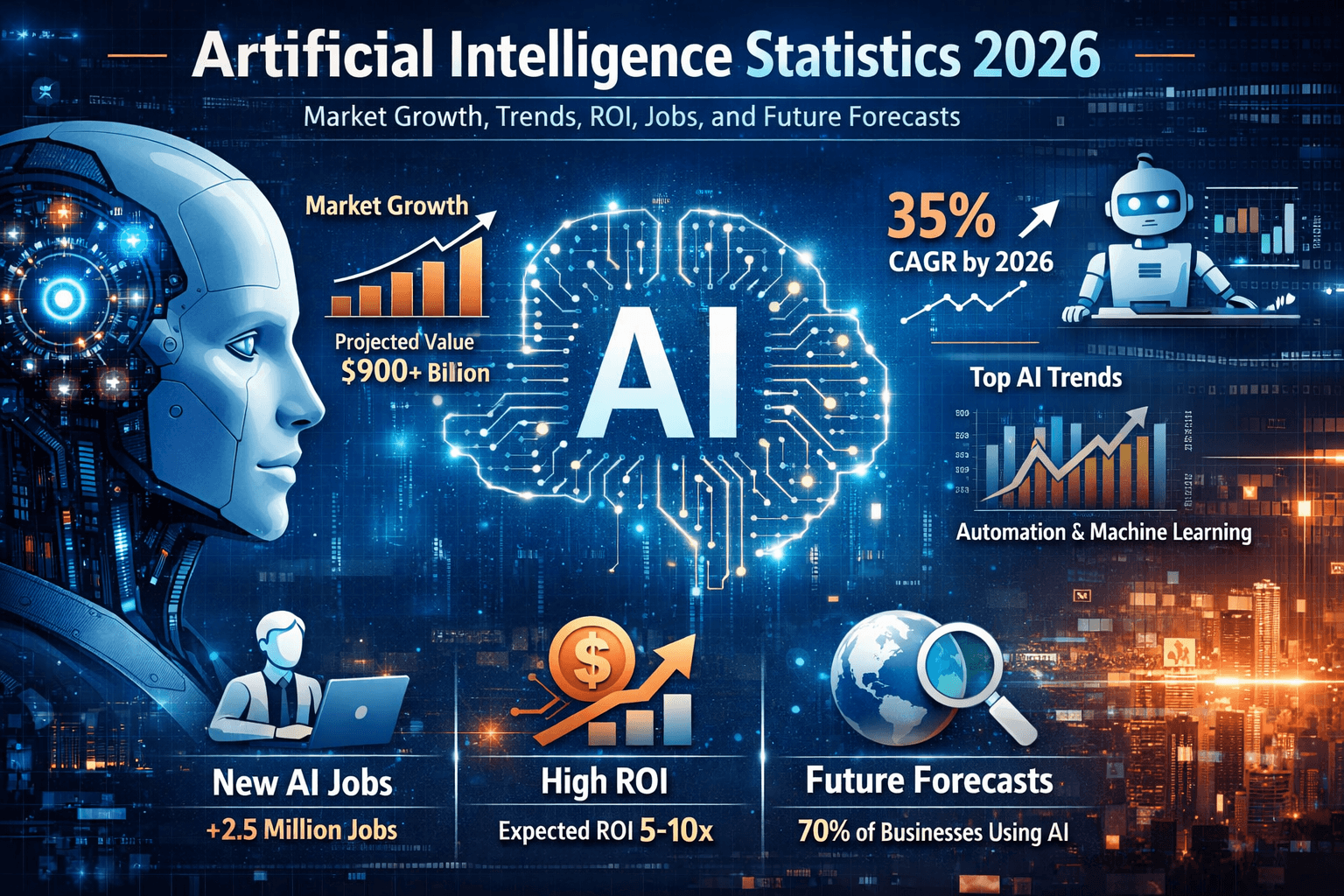
Artificial Intelligence Statistics 2026: Market Growth, Trends, ROI, Jobs, and Future Forecasts
Artificial intelligence is growing faster than any major technology trend in history. Recent data shows 88% of organizations now use AI in at least one business function, while 79% have adopted generative AI. The global generative AI market exceeded $62 billion in 2025 and is projected to reach over $471 billion by 2033, highlighting AI’s massive impact on business, jobs, and innovation.
Why AI Statistics Matter
Artificial intelligence is no longer a technology reserved for research labs or science fiction movies. It has become part of everyday life. From voice assistants and recommendation engines to advanced business software and self-learning systems, AI is influencing how people work, learn, shop, and communicate. The speed of this transformation is remarkable. Businesses that once spent years adopting new technologies are now integrating AI solutions within months because competition is forcing them to move faster.
Statistics help us understand the real impact behind the headlines. News stories often focus on dramatic breakthroughs, billion-dollar investments, or concerns about automation. While those stories attract attention, decision-makers need reliable data. AI statistics reveal how many organizations actually use AI, where companies are investing, which industries benefit the most, and what challenges remain unsolved. Reliable numbers separate hype from reality.
Today’s AI landscape is particularly interesting because generative AI has accelerated adoption across nearly every industry. Organizations that previously struggled to find practical AI applications are now discovering use cases in customer support, software development, content creation, research, and operations. Understanding the latest artificial intelligence statistics allows businesses, marketers, students, and investors to make smarter decisions in a rapidly evolving environment.
Key Artificial Intelligence Statistics at a Glance
The latest data paints a picture of explosive growth across the AI ecosystem. One of the most significant findings comes from recent global surveys showing that 88% of organizations use AI in at least one business function, a substantial increase from previous years. At the same time, 79% of organizations report using generative AI technologies, demonstrating how quickly tools powered by large language models have entered mainstream business operations.
The market numbers are equally impressive. The global generative AI market reached approximately $62.2 billion in 2025 and is expected to grow to more than $471 billion by 2033, reflecting a compound annual growth rate of 27.6%. Such growth rates are rarely seen in mature technology sectors and indicate strong demand from enterprises worldwide.
Another important statistic is that despite widespread adoption, only a small percentage of companies have fully scaled AI across their organizations. Research suggests that most companies remain in pilot or experimentation phases. This gap highlights one of the biggest opportunities in the market today. Organizations that successfully move from testing AI to integrating it into core workflows may gain significant competitive advantages.
Top AI Statistics Table
| Metric | Latest Data |
|---|---|
| Organizations using AI | 88% |
| Organizations using Generative AI | 79% |
| Companies experimenting with AI agents | 62% |
| Organizations reporting AI-driven innovation | 64% |
| Global Generative AI Market (2025) | $62.2 Billion |
| Forecast Market Size (2033) | $471.2 Billion |
| Expected CAGR | 27.6% |
Sources: McKinsey State of AI 2025, Grand View Research
Global AI Market Size and Growth
The growth of the AI market resembles a rocket launch. For years, artificial intelligence developed steadily in the background. Then the arrival of advanced generative AI tools accelerated adoption across industries at an unprecedented pace. Organizations that once viewed AI as an experimental technology now consider it a strategic priority.
Recent market research estimates the global generative AI market at over $62 billion in 2025. Forecasts suggest this figure could exceed $471 billion by 2033. This projected growth is fueled by increasing enterprise adoption, cloud infrastructure investments, advances in computing power, and broader accessibility of AI tools. Businesses no longer need teams of data scientists to leverage AI. User-friendly platforms have lowered barriers to entry and expanded adoption opportunities.
The economic impact extends beyond software revenue. AI is influencing semiconductor manufacturing, cloud computing, telecommunications, healthcare technology, education platforms, and financial services. Governments are also investing heavily in AI infrastructure and regulation. Strong demand for AI hardware and computing resources has already contributed to significant economic growth in technology-focused regions around the world.
As adoption increases, experts expect AI to become as foundational as the internet itself. Businesses that once viewed AI as optional increasingly see it as essential for maintaining competitiveness. The market trajectory suggests artificial intelligence will remain one of the fastest-growing sectors throughout the next decade.
AI Adoption Statistics
The most important AI statistic may not be market size but adoption. A technology only creates value when people use it. Current research indicates that AI adoption has reached a tipping point. Nearly nine out of ten organizations now use AI in some capacity. This level of penetration signals a major shift from experimentation to mainstream business usage.
Adoption patterns vary across industries. Technology companies continue to lead implementation efforts, but healthcare providers, financial institutions, retailers, manufacturers, and educational organizations are rapidly increasing investments. Customer service automation, predictive analytics, content generation, and software development support are among the most common use cases.
Generative AI has played a major role in accelerating adoption. Unlike traditional AI systems that often required specialized expertise, generative AI tools provide immediate value to employees. Workers can generate reports, analyze data, create content, summarize information, and automate repetitive tasks with minimal training. This ease of use has contributed to adoption rates rising faster than many analysts predicted.
Interestingly, adoption does not necessarily equal maturity. While 88% of organizations use AI, only a smaller portion have successfully scaled AI initiatives across entire enterprises. Many organizations remain in pilot stages, testing use cases and evaluating return on investment before broader deployment.
AI in the Workplace
Artificial intelligence is reshaping work environments around the world. Some employees worry AI will replace jobs, while others see it as a powerful productivity tool. The reality appears to be more complex. Current evidence suggests AI is transforming how work is performed rather than simply eliminating entire professions.
Organizations report benefits including reduced cycle times, improved productivity, faster information retrieval, and enhanced decision-making capabilities. AI-powered tools assist employees by automating repetitive activities, allowing workers to focus on higher-value tasks. Software developers use AI coding assistants, marketers leverage AI content tools, and analysts use AI for research and reporting.
At the same time, workforce transformation is creating challenges. Surveys indicate many executives expect AI to influence hiring patterns and workforce structures over the next several years. Some companies anticipate reductions in entry-level positions due to automation of routine tasks. However, new roles related to AI implementation, governance, prompt engineering, and AI operations continue to emerge.
The workplace of the future is likely to involve close collaboration between humans and AI systems. Rather than replacing workers entirely, organizations increasingly seek ways to combine human creativity, judgment, and emotional intelligence with AI’s speed and analytical capabilities.
Generative AI Statistics
Generative AI has become the fastest-growing segment within the broader artificial intelligence market. The popularity of AI assistants, chatbots, image generators, and coding tools has fundamentally changed public awareness of AI technology. What was once a specialized field has become accessible to everyday users.
According to recent research, 79% of organizations have adopted generative AI technologies. This rapid adoption reflects the immediate value these tools provide across a wide range of business functions. Content creation, customer support, software development, knowledge management, and data analysis are among the leading applications.
Enterprise spending on AI has also surged. Industry reports suggest enterprise AI expenditures reached approximately $37 billion in 2025, making AI one of the fastest-growing software categories in history. Organizations continue investing despite concerns about implementation challenges because potential productivity gains remain significant.
Yet generative AI adoption is not without obstacles. Research highlights concerns regarding accuracy, reliability, security, privacy, and governance. Many organizations are still learning how to integrate generative AI effectively into existing workflows. Success often depends not just on technology selection but also on organizational readiness, employee training, and process redesign.
AI Investment Statistics
Investment activity provides another powerful indicator of AI’s momentum. Venture capital firms, technology giants, governments, and private investors continue pouring billions of dollars into AI-related initiatives. The scale of investment reflects confidence that AI will remain a transformative force across multiple industries.
Large technology companies are investing heavily in AI infrastructure, including data centers, advanced chips, cloud platforms, and foundation models. These investments support not only current applications but also future innovations. Strong demand for AI computing resources has already influenced global supply chains and economic forecasts.
Startup funding remains exceptionally strong. AI-focused companies continue attracting major investments, with investors betting on breakthroughs in enterprise software, healthcare, robotics, education, cybersecurity, and scientific research. Competition among leading AI firms has intensified as organizations race to develop increasingly capable models and services.
Investors are particularly interested in companies that demonstrate measurable business outcomes rather than merely showcasing impressive technology. As the market matures, organizations must prove that AI investments generate productivity improvements, revenue growth, or cost savings. This shift from experimentation toward measurable value is likely to shape the next phase of AI investment trends.
AI Industry Statistics by Sector
Healthcare
Healthcare represents one of the most promising applications of artificial intelligence. AI assists medical professionals in diagnostic imaging, patient monitoring, drug discovery, and administrative automation. Researchers increasingly use machine learning models to analyze large datasets and identify patterns that may improve patient outcomes.
The healthcare industry values AI because it can process enormous amounts of information quickly. Doctors still make critical decisions, but AI serves as a powerful support system. This combination of human expertise and machine intelligence has the potential to improve efficiency and accuracy while reducing administrative burdens.
Finance
Financial institutions were among the earliest adopters of AI technologies. Banks, insurance companies, and investment firms use AI for fraud detection, risk assessment, customer service, algorithmic trading, and regulatory compliance. The ability to analyze large datasets in real time makes AI especially valuable in financial environments.
Generative AI is also helping financial professionals create reports, summarize research, and support decision-making processes. While adoption continues growing, firms remain cautious about governance, transparency, and regulatory requirements.
Education
Education is experiencing significant AI-driven transformation. Teachers and students increasingly use AI-powered learning platforms, tutoring systems, content generation tools, and assessment technologies. Personalized learning experiences are becoming more accessible because AI can adapt content based on individual learning styles and progress.
Educational institutions face challenges related to academic integrity and responsible AI use. However, many educators see AI as a tool that can enhance learning outcomes when implemented thoughtfully and ethically.
AI Risks and Challenges
The excitement surrounding AI often overshadows the challenges organizations face during implementation. While adoption rates continue rising, many companies struggle to move beyond pilot projects. Studies indicate that scaling AI successfully requires more than purchasing software licenses. Organizations must redesign workflows, establish governance frameworks, and invest in employee training.
Trust remains another major issue. Surveys show that some members of the public remain cautious about AI involvement in high-stakes decisions. Concerns include bias, privacy, misinformation, accountability, and transparency. As AI systems become more capable, expectations regarding responsible development and deployment continue increasing.
Organizations also face technical challenges. AI models may produce inaccurate outputs, require significant oversight, and introduce security risks if not properly managed. Success increasingly depends on balancing innovation with governance. Companies that address these challenges proactively are more likely to achieve sustainable AI-driven growth.
Future AI Predictions
Predicting the future of AI is difficult because the technology evolves rapidly. Even so, several trends appear likely to shape the next decade. AI agents capable of performing multi-step tasks are attracting growing attention. More than 60% of organizations are already experimenting with these systems, suggesting significant future adoption potential.
Experts also anticipate continued advances in reasoning capabilities, multimodal systems, and automation. AI will likely become more integrated into everyday software, making intelligent features standard rather than exceptional. Industries ranging from healthcare to manufacturing may experience profound productivity improvements as AI systems mature.
Economic impacts could be substantial. Regions benefiting from AI infrastructure investments may experience accelerated growth. Businesses that successfully combine AI capabilities with human expertise could achieve significant competitive advantages. At the same time, policymakers, educators, and employers will need to address workforce transitions and ethical considerations.
The next chapter of artificial intelligence will not simply be about better technology. It will be about how societies adapt to a world where intelligent systems become deeply embedded in daily life and economic activity.
Conclusion
Artificial intelligence has moved from emerging technology to mainstream business necessity. The latest artificial intelligence statistics reveal a world rapidly embracing AI across industries, functions, and regions. With 88% of organizations already using AI and generative AI adoption approaching 80%, the technology has reached a scale few innovations achieve in such a short period.
The numbers tell two stories at once. On one hand, market growth, investment activity, and adoption rates are extraordinary. On the other hand, many organizations still struggle to scale AI effectively and capture full business value. This gap creates opportunities for businesses willing to invest in strategy, governance, and workforce development.
AI’s future will likely be defined not by whether organizations adopt it, but by how effectively they integrate it into everyday operations. The organizations that learn to combine human strengths with AI capabilities will be best positioned for long-term success.
FAQs
1. What percentage of companies use artificial intelligence?
Recent research shows that approximately 88% of organizations use AI in at least one business function.
2. How large is the global AI market?
The global generative AI market reached about $62.2 billion in 2025 and is projected to exceed $471 billion by 2033.
3. What is the fastest-growing area of AI?
Generative AI is currently the fastest-growing AI segment, driven by widespread adoption of chatbots, AI assistants, content generators, and coding tools.
4. Will AI replace jobs?
AI is expected to automate some tasks and reshape certain roles, but it is also creating new opportunities in AI development, governance, operations, and human-AI collaboration.
5. What industries use AI the most?
Technology, healthcare, finance, retail, manufacturing, and education are among the industries with the highest levels of AI adoption and investment.