
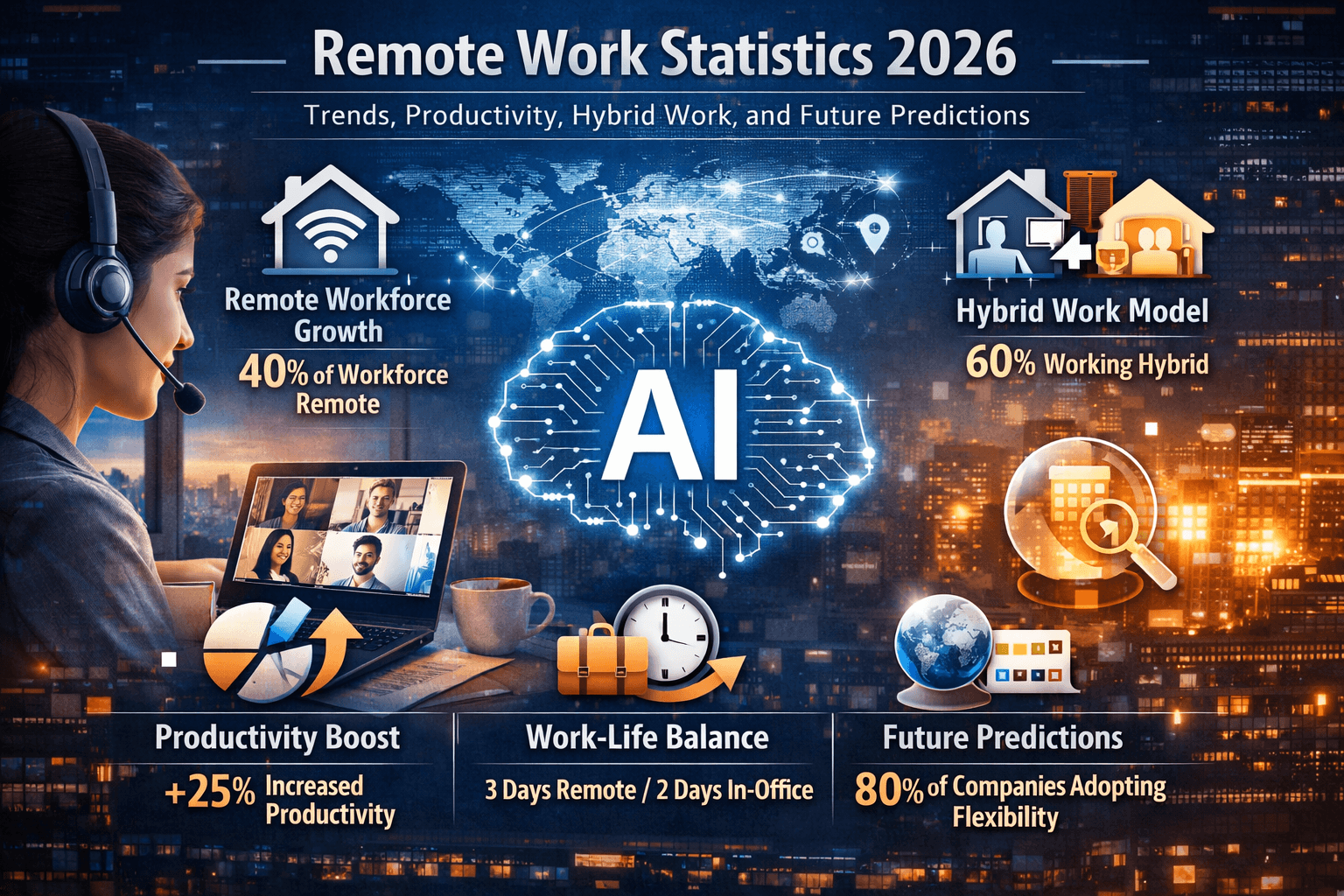
Remote Work Statistics 2026: Trends, Productivity, Hybrid Work, and Future Predictions
Remote work remains a major part of the modern workplace in 2026. Recent data shows 26% of remote-capable employees work fully remotely, while 52% work in hybrid arrangements. Most workers still prefer flexible schedules, and organizations continue reporting benefits such as improved work-life balance, stronger retention, and higher employee satisfaction.
Remote Work Statistics 2025: The Ultimate Guide
What Counts as Remote Work?
Remote work has changed from a temporary solution into a permanent part of modern business. A few years ago, many companies viewed working from home as an emergency measure. Today, it is a strategic decision used to attract talent, improve employee satisfaction, and reduce operational costs. The definition of remote work has also expanded. It now includes fully remote employees who rarely visit an office, hybrid workers who split time between home and the workplace, and distributed teams operating across different countries and time zones.
The workplace of 2025 looks very different from the workplace of 2019. Instead of asking whether remote work is possible, organizations are asking how to make it more effective. Businesses have invested heavily in collaboration software, cybersecurity, cloud platforms, and virtual communication tools. This investment has made location less important than outcomes. Employees can contribute to projects, attend meetings, and collaborate with colleagues from almost anywhere.
Remote work is no longer limited to technology companies. Healthcare administration, finance, marketing, education, customer service, and consulting have all embraced flexible work arrangements. This widespread adoption means remote work statistics now influence decisions across nearly every industry.
Why Remote Work Statistics Matter
Statistics help employers and employees understand where the workforce is heading. Without reliable data, organizations would struggle to create policies that match employee expectations. Businesses use these numbers to make decisions about office space, recruitment, workforce planning, and employee engagement strategies.
For job seekers, remote work data reveals where opportunities are growing. Understanding trends can help professionals choose industries, develop skills, and negotiate flexible arrangements. Investors and policymakers also use these statistics to assess economic changes and workforce development needs.
Perhaps most importantly, remote work statistics separate myths from reality. Many assumptions exist about productivity, collaboration, and employee satisfaction. Data provides a clearer picture of what is actually happening in workplaces around the world.
Key Remote Work Statistics at a Glance
Global and U.S. Workforce Trends
The latest workplace data shows that remote and hybrid work remain strong despite increasing return-to-office discussions. Among U.S. employees with remote-capable jobs, Gallup reports that 52% work in hybrid arrangements, 26% work fully remotely, and 22% work entirely on-site. This demonstrates that flexible work continues to dominate for jobs that can be performed outside traditional offices.
The numbers tell an important story. While some companies have introduced office attendance requirements, remote work has not disappeared. Instead, organizations have settled into a balance between flexibility and in-person collaboration. Research indicates that work location patterns have remained relatively stable since 2022, suggesting that hybrid work has become a long-term workplace model rather than a temporary trend.
The strongest demand continues to come from knowledge workers. Employees increasingly value flexibility alongside salary, benefits, and career growth opportunities. Many workers view flexibility as a standard expectation rather than a workplace perk.
UK Remote and Hybrid Work Data
The United Kingdom presents a similar picture. Data from the UK’s labor market shows that 28% of working adults in Great Britain participated in hybrid work between January and March 2025. The percentage of hybrid workers has steadily increased since 2022.
Educational attainment plays a significant role in remote work access. Workers with degree-level qualifications are substantially more likely to work in hybrid arrangements compared to those without formal qualifications. Income levels also influence remote work participation, with higher-income employees more likely to benefit from flexible work opportunities.
These findings highlight an important trend. Remote work opportunities are not distributed equally across all professions. Knowledge-intensive industries continue to offer the greatest flexibility, while many frontline and service-based roles remain location dependent.
| Key Statistic | Latest Data |
|---|---|
| U.S. Hybrid Workers | 52% |
| U.S. Fully Remote Workers | 26% |
| U.S. On-Site Workers | 22% |
| UK Hybrid Workers | 28% |
| Employees Preferring Hybrid Work | About 60% |
| Employees Preferring Fully Remote Work | About 33% |
Sources: Gallup and UK labor market data.
Growth of Remote Work Since the Pandemic
The Transformation of Workplace Models
The pandemic accelerated a workplace transformation that might otherwise have taken a decade. Organizations that once resisted remote work suddenly discovered that many employees could remain productive outside traditional offices. What began as a necessity evolved into an opportunity.
The years following the pandemic became a large-scale workplace experiment. Companies tested different approaches, from fully remote operations to hybrid schedules and mandatory office attendance. The results revealed that flexibility could coexist with productivity when supported by the right technology and management practices.
As organizations gained experience, they shifted from emergency remote work to intentional remote work. This distinction matters. Early remote work often involved rushed processes and limited infrastructure. Modern remote work relies on structured communication, clear performance expectations, and purpose-built collaboration tools.
How Hybrid Work Became the Standard
Hybrid work emerged as the preferred middle ground. Employees gained flexibility while businesses maintained opportunities for face-to-face collaboration. Research consistently shows that hybrid arrangements are the most popular option among workers with remote-capable jobs. Around six in ten employees prefer hybrid work over fully remote or fully on-site arrangements.
This preference explains why hybrid models have remained stable despite ongoing return-to-office discussions. Businesses discovered that forcing employees back to the office full-time often created resistance and increased turnover risk. Hybrid work allows organizations to balance business needs with employee expectations.
Think of hybrid work as a bridge connecting two worlds. On one side is the flexibility and autonomy of remote work. On the other side is the collaboration and social interaction of traditional offices. Many organizations have found that employees perform best when they can access both.
Employee Preferences and Remote Work
What Workers Want in 2025
Employee expectations have changed dramatically. Flexibility is now one of the most influential factors affecting job satisfaction and retention. Gallup research shows that many employees would consider searching for a new job if remote flexibility were removed.
Owl Labs research highlights a growing focus on schedule flexibility rather than location flexibility alone. Workers increasingly want control over when they work, not just where they work. This shift reflects changing attitudes toward productivity. Employees are focusing on outcomes rather than fixed schedules.
Many professionals are embracing concepts like “microshifting,” where work is completed in focused periods throughout the day rather than during a traditional nine-to-five schedule. This approach allows employees to align work with personal responsibilities and peak productivity hours.
Generational Differences in Work Preferences
Different generations view remote work through different lenses. Younger workers often seek opportunities for mentorship, networking, and professional development. Recent research suggests that fewer than one-quarter of remote-capable Gen Z workers prefer fully remote jobs. Many value in-person interactions that support learning and career growth.
Older generations, particularly those with established careers and family responsibilities, often place a higher value on location flexibility. Their workplace networks are already developed, making remote work more practical.
Despite these differences, hybrid work remains the most widely preferred arrangement across generations. The common thread is flexibility. Employees want options rather than rigid workplace mandates.
Productivity and Performance Statistics
Productivity Findings
One of the biggest debates surrounding remote work focuses on productivity. Early concerns suggested employees would become less productive outside the office. Yet many studies tell a different story. Gallup reports that remote workers are working fewer hours than before, but productivity remains stable. This suggests that efficiency, rather than time spent working, may be the key performance driver.
Managers also report positive outcomes from flexible work arrangements. Studies indicate that many leaders believe hybrid and remote teams maintain or improve productivity levels. Technology has made collaboration easier than ever, reducing many of the barriers that once limited remote work effectiveness.
Productivity in remote environments often depends on communication quality, management effectiveness, and employee autonomy. Organizations that focus on outcomes rather than monitoring activity tend to see stronger results.
Challenges Affecting Performance
Remote work is not without challenges. Some employees report feelings of isolation, loneliness, and reduced social connection. Gallup data suggests fully remote workers may experience higher levels of stress and negative emotions compared to some hybrid employees.
Another concern involves career development. Research indicates that reduced face-to-face interaction can affect mentorship opportunities and workplace learning, particularly for early-career professionals. Some studies have linked remote-capable occupations with declines in entry-level hiring due to training and supervision challenges.
These findings highlight an important lesson. Successful remote work requires more than technology. It also requires intentional leadership, employee support, and strong organizational culture.
Business Impact of Remote Work
Hiring and Talent Acquisition
Remote work has transformed recruitment. Companies can now hire talent from broader geographic regions, reducing dependence on local labor markets. This expanded talent pool creates opportunities to find specialized skills while improving workforce diversity.
Job seekers increasingly prioritize flexible work options when evaluating employers. Organizations that offer remote or hybrid arrangements often gain a competitive advantage in attracting candidates. Flexible work has become a key differentiator in a competitive labor market.
At the same time, remote positions often attract significantly larger applicant pools. Competition for fully remote roles remains intense because workers across multiple locations can apply for the same opportunity.
Employee Retention and Satisfaction
Retention remains one of the strongest arguments for flexible work. Research shows that many employees would actively consider leaving if flexibility were removed. When workers feel trusted and empowered, engagement often increases.
Remote work also supports work-life balance. Reduced commuting time gives employees more flexibility for family responsibilities, health, education, and personal development. Studies suggest these benefits can positively influence overall job satisfaction.
Organizations that combine flexibility with strong communication and career development opportunities are often best positioned to retain top talent.
Industry-Specific Remote Work Statistics
Technology Sector
The technology industry remains one of the most remote-friendly sectors. Gallup reports that remote-capable technology employees are nearly as likely to work fully remotely as they are to work in hybrid arrangements. Only a small percentage are fully on-site.
Technology companies have several advantages when implementing remote work. Digital workflows, cloud-based systems, and virtual collaboration tools naturally support distributed teams. Software development, cybersecurity, cloud engineering, and digital marketing roles frequently operate effectively without a centralized office.
Remote work has become deeply integrated into the technology industry’s culture. Many professionals expect flexibility as a standard employment benefit.
Other Remote-Friendly Industries
Several industries continue to embrace remote and hybrid work models:
- Finance and accounting
- Marketing and advertising
- Customer success
- Education and e-learning
- Project management
- Consulting
- Human resources
- Business operations
Data suggests customer success, education, and enterprise software sectors maintain particularly high concentrations of remote opportunities.
Not every industry can adopt remote work equally. Manufacturing, hospitality, healthcare delivery, transportation, and retail often require physical presence. As a result, workplace flexibility varies significantly between occupations.
Future of Remote Work
Emerging Trends
The future of remote work appears less focused on location and more focused on flexibility. Employees increasingly want control over schedules, workloads, and work environments. This evolution reflects a broader shift toward outcome-based performance measurement.
Artificial intelligence is also changing how remote teams collaborate. AI-powered tools support communication, project management, scheduling, and productivity. These technologies help distributed teams operate more efficiently across locations and time zones.
Organizations are also experimenting with new workplace structures, including asynchronous communication, four-day workweeks, and flexible scheduling models.
Predictions Beyond 2025
The data suggests that hybrid work will remain the dominant model for remote-capable roles. Rather than choosing between remote and office work, organizations are likely to continue blending both approaches. Research increasingly points toward balanced hybrid arrangements as a sustainable long-term solution.
Future success will depend less on where employees work and more on how effectively organizations manage distributed teams. Companies that invest in culture, communication, leadership development, and employee wellbeing will likely gain the greatest benefits.
Remote work is no longer an experiment. It is becoming a permanent feature of the modern economy.
Conclusion
Remote work statistics in 2025 reveal a clear reality: flexible work is here to stay. Hybrid work has emerged as the dominant model, balancing employee flexibility with organizational collaboration needs. Gallup data shows that most remote-capable employees now work either remotely or in hybrid arrangements, while employee demand for flexibility remains strong.
The future workplace will likely continue evolving toward greater flexibility, supported by technology, changing employee expectations, and new management practices. Organizations that embrace this shift thoughtfully can improve recruitment, retention, productivity, and employee satisfaction. The companies that thrive will not simply decide where work happens. They will focus on creating environments where people can perform at their best, regardless of location.
FAQs
1. What percentage of employees work remotely in 2025?
Among U.S. employees with remote-capable jobs, 26% work fully remotely and 52% work in hybrid arrangements.
2. Is remote work still growing?
Remote work growth has stabilized, but hybrid work remains highly popular and continues to be a major workplace model.
3. Do employees prefer remote or hybrid work?
Most employees prefer hybrid work arrangements, while roughly one-third prefer fully remote work.
4. Does remote work improve productivity?
Many studies suggest productivity remains stable or improves when organizations provide effective tools, communication systems, and flexible work environments.
5. Which industries offer the most remote jobs?
Technology, finance, customer success, consulting, education, marketing, and software-related industries remain among the most remote-friendly sectors.