
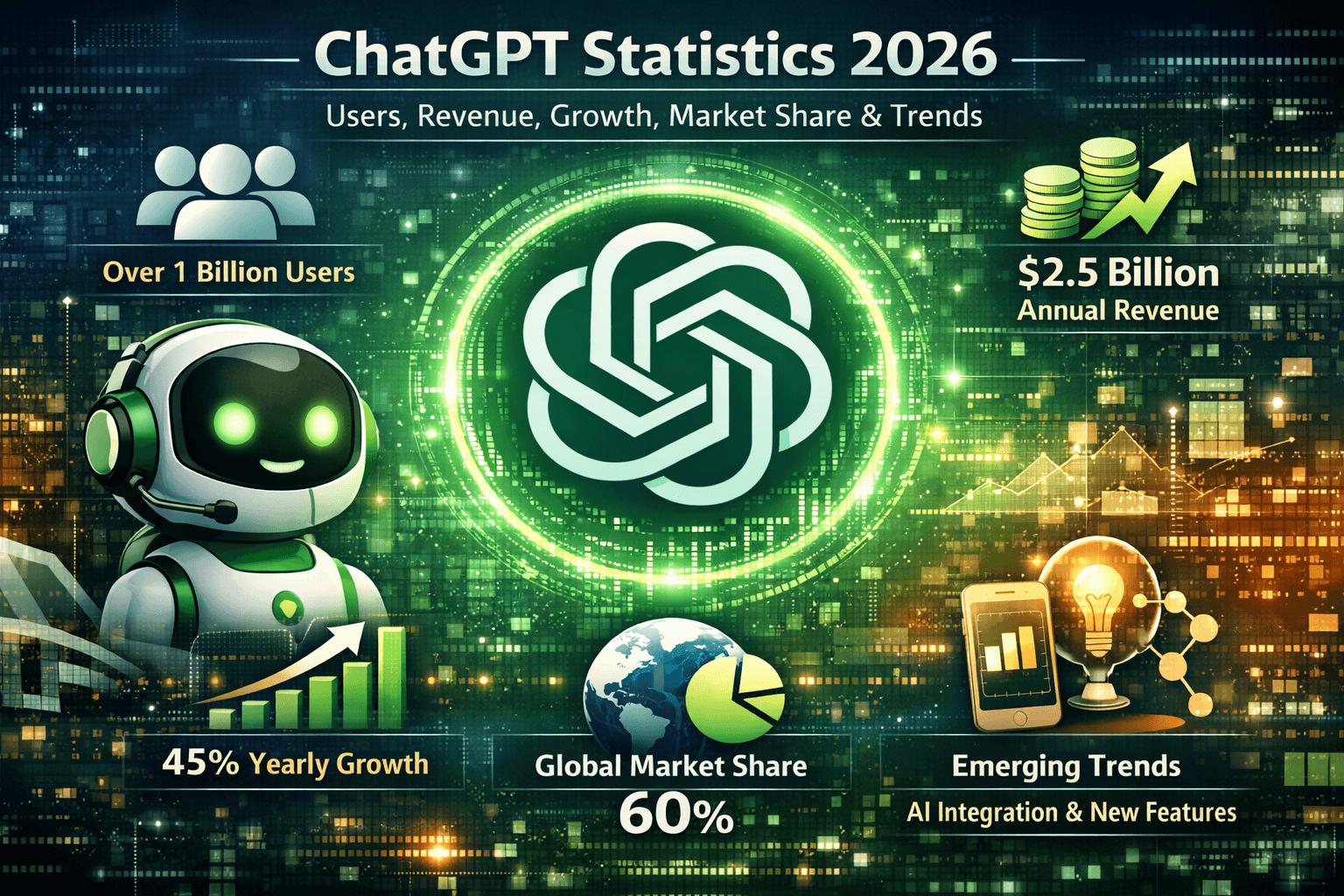
ChatGPT Statistics 2026: Users, Revenue, Growth, Market Share & Trends
ChatGPT has grown into one of the world’s largest AI platforms, reaching approximately 900 million weekly active users and more than 50 million paying subscribers in 2026. It is used by individuals, businesses, educators, developers, and marketers worldwide for writing, coding, research, customer support, and productivity tasks.
What Is ChatGPT?
ChatGPT is an artificial intelligence chatbot created by OpenAI. Since its launch in November 2022, it has changed the way people search for information, create content, write code, learn new skills, and solve everyday problems. What started as a simple conversational AI tool quickly became one of the most widely used technology products in history.
The platform can answer questions, generate articles, summarize documents, write emails, create software code, analyze data, and assist with business workflows. Millions of students, professionals, marketers, entrepreneurs, and developers rely on ChatGPT daily. Its appeal comes from simplicity. Instead of learning complex software, users simply type a question and receive an intelligent response.
The growth of ChatGPT reflects a major shift in how people interact with technology. Search engines traditionally required users to browse multiple websites. ChatGPT delivers direct answers, personalized explanations, and interactive conversations. This change has attracted users from nearly every industry and age group.
Today, ChatGPT is not just a chatbot. It has become a productivity platform, research assistant, writing partner, coding helper, and business tool all rolled into one. That broad usefulness explains why its growth has been extraordinary.
ChatGPT Growth at a Glance
Key Milestones Since Launch
Few digital products have experienced growth comparable to ChatGPT. Within months of launching, it became a global phenomenon. Its rapid adoption surprised technology analysts, investors, and even competitors.
The platform crossed major milestones at record speed. By 2025, weekly active users had already reached hundreds of millions. By early 2026, OpenAI announced that ChatGPT had reached approximately 900 million weekly active users, bringing it close to the historic one-billion-user mark. The company also reported over 50 million paying subscribers, demonstrating that users are willing to pay for premium AI capabilities.
Growth has been fueled by continuous model improvements, mobile applications, enterprise adoption, and integration into everyday workflows. Features such as advanced reasoning, multimodal capabilities, image generation, coding assistance, and business tools have expanded ChatGPT’s usefulness far beyond simple conversation.
Fastest Growing Consumer Application
Technology history includes major success stories such as social networks, streaming platforms, and mobile apps. Yet ChatGPT achieved something unique. It became widely recognized as one of the fastest-growing consumer applications ever launched.
The speed of adoption demonstrates how strongly users value AI assistance. Unlike many technology trends that remain niche products, ChatGPT reached mainstream audiences. Students use it for homework help. Businesses use it for productivity. Developers use it for coding. Writers use it for content creation. This broad appeal creates a powerful network effect where more users generate more feedback, helping improve the product further.
ChatGPT User Statistics
Weekly Active Users
One of the most important indicators of ChatGPT’s success is its active user base. According to recent reports, ChatGPT reached approximately 900 million weekly active users in early 2026, representing enormous growth from previous years.
To put this into perspective, many well-known digital platforms took a decade or more to reach similar audience levels. ChatGPT achieved this scale in just over three years. Such rapid growth reflects both curiosity about AI and genuine utility.
The platform’s user growth has accelerated through mobile adoption, workplace integration, educational use, and international expansion. Users increasingly rely on ChatGPT as a daily assistant rather than an occasional tool. This shift from experimentation to habitual use is one of the strongest signals of long-term success.
Paying Subscribers
While user growth is impressive, paying customers reveal whether a platform can build a sustainable business. OpenAI reported that ChatGPT surpassed 50 million paying subscribers by early 2026.
These subscribers include individual users and organizations paying for premium plans. The willingness of millions of users to subscribe highlights the perceived value of advanced AI features. Faster responses, better models, expanded usage limits, and specialized capabilities encourage users to upgrade.
Subscription growth has become a major revenue driver. It also demonstrates trust. Users are not simply testing AI anymore. They are incorporating it into their daily personal and professional lives.
Daily Usage Patterns
Usage statistics reveal fascinating trends about how people interact with AI. Research indicates ChatGPT processes billions of prompts daily. Estimates suggest more than 2 billion prompts or queries are handled each day across the platform.
People use ChatGPT for a wide variety of tasks. Writing assistance remains one of the most popular categories. Information gathering, brainstorming, education, and productivity tasks also rank highly. Coding represents a smaller percentage of overall usage than many people assume, though it remains highly valuable for developers.
This diversity of use cases is important. It means ChatGPT is not dependent on a single audience segment. Instead, it serves multiple industries and user groups simultaneously.
ChatGPT Revenue Statistics
Revenue Growth
The financial growth of ChatGPT and OpenAI has been nearly as impressive as user growth. Industry estimates suggest OpenAI generates billions of dollars annually through subscriptions, enterprise services, and API products. Some reports estimate annualized revenue exceeding $25 billion, with monthly revenue approaching $2 billion.
These figures illustrate the commercial potential of generative AI. Businesses increasingly view AI not as an experimental technology but as essential infrastructure. Organizations invest in AI to improve productivity, reduce costs, automate tasks, and enhance customer experiences.
Revenue growth also supports ongoing research and development. Advanced AI models require substantial computational resources and engineering investment. Strong financial performance allows OpenAI to continue improving its technology.
Subscription-Based Business Model
The majority of ChatGPT revenue comes from subscriptions and enterprise offerings. Users can access free versions of ChatGPT, but premium plans provide enhanced features, higher usage limits, and access to advanced models.
This model resembles successful software-as-a-service businesses. Free access attracts users. Premium capabilities convert a percentage into paying customers. As the platform becomes more valuable, conversion rates improve.
The strategy has proven highly effective. Millions of subscribers provide predictable recurring revenue while allowing OpenAI to continue expanding infrastructure and services.
ChatGPT Market Share Statistics
AI Chatbot Market Position
ChatGPT remains one of the most recognized names in artificial intelligence. Various market studies suggest it holds a leading share of the AI chatbot market, though competition continues to intensify. Some reports estimate ChatGPT controls between 40% and 80% of the AI assistant market, depending on measurement methodology.
The platform’s brand recognition provides a significant advantage. For many users, “AI chatbot” and “ChatGPT” have become almost synonymous. This mindshare creates strong organic growth and user retention.
Market leadership is reinforced by continuous innovation. New model releases, multimodal capabilities, and business-focused tools help maintain relevance in a rapidly evolving industry.
Competition from Gemini and Claude
The AI landscape is becoming increasingly competitive. Google’s Google Gemini and Anthropic’s Claude have gained significant traction. Recent workplace usage reports suggest ChatGPT still leads, but competitors are steadily growing their share.
Competition benefits users because it drives innovation. Companies must continually improve model quality, user experience, pricing, and performance. The result is a rapidly advancing AI ecosystem.
Researchers have also observed that many users utilize multiple AI tools rather than relying on a single platform. This suggests the market may support several major players rather than a winner-takes-all outcome.
Business and Enterprise Adoption
Fortune 500 Usage
One of the strongest indicators of ChatGPT’s maturity is enterprise adoption. Reports indicate that approximately 92% of Fortune 500 companies use ChatGPT in some capacity.
Large organizations deploy AI across numerous departments. Marketing teams generate content. Customer service teams improve response efficiency. Developers accelerate software creation. Human resources departments streamline communication and documentation.
Enterprise adoption is particularly significant because large organizations evaluate technology carefully. Their investment signals confidence in ChatGPT’s practical business value.
Business Subscribers
OpenAI has reported millions of business users utilizing ChatGPT products. Estimates indicate more than 9 million paying business users rely on the platform.
This growth reflects a broader shift toward AI-powered workplaces. Businesses increasingly treat AI as a productivity multiplier rather than an optional tool. Teams use ChatGPT to reduce repetitive work, improve decision-making, and enhance creativity.
The business market remains one of the most important growth opportunities for ChatGPT over the coming years.
How People Use ChatGPT
Education and Learning
Education represents one of the most impactful ChatGPT use cases. Students use it to understand difficult concepts, summarize information, generate study materials, and receive personalized explanations.
Unlike traditional search results, ChatGPT can adapt explanations based on a learner’s knowledge level. This creates a tutoring-like experience that makes learning more accessible.
Teachers and educational institutions are also exploring AI-assisted learning. While concerns exist regarding misuse, many educators recognize the technology’s potential to support personalized education.
Content Creation
Content creation remains one of the largest ChatGPT use cases. Bloggers, marketers, businesses, and social media managers use the platform to brainstorm ideas, create outlines, draft articles, and improve writing quality.
The platform helps reduce writer’s block and accelerates content production. It functions like a collaborative writing partner available at any time.
For SEO professionals, ChatGPT assists with keyword research, content planning, metadata generation, and optimization strategies. This has made it particularly popular among digital marketers.
Coding and Development
Software development has become another major use case. Developers use ChatGPT to generate code, explain programming concepts, debug applications, and accelerate development workflows.
Although coding represents a smaller percentage of overall prompts compared to writing and information requests, its impact is significant. Developers can complete tasks faster and spend more time focusing on complex problem-solving.
The introduction of specialized coding tools and AI-assisted development environments continues expanding this category.
ChatGPT Demographics
ChatGPT’s audience spans virtually every age group and industry. Early adoption was concentrated among technology enthusiasts, developers, and younger users. Over time, the user base expanded dramatically.
Research suggests younger users remain highly active, but adoption now includes professionals, educators, business leaders, freelancers, and retirees. Geographic expansion has also accelerated, with strong growth occurring in both developed and emerging markets.
The broad demographic appeal demonstrates that AI is no longer limited to technical users. It has become a mainstream technology accessible to everyday people.
This widespread adoption contributes to network effects. As more people use AI, awareness grows, leading even more users to experiment and eventually integrate it into their routines.
Future Growth Predictions
Looking ahead, ChatGPT appears positioned for continued expansion. With approximately 900 million weekly active users, the platform is approaching the symbolic milestone of one billion users.
Future growth will likely come from several areas. Enterprise adoption remains a major opportunity. AI-powered productivity tools will continue spreading throughout workplaces. Educational applications are expected to expand. Mobile usage will likely increase further.
Competition from Gemini, Claude, and other AI platforms will intensify. Yet growing competition may actually accelerate overall market growth by increasing awareness and adoption of AI technologies.
The future of ChatGPT depends not only on technological improvements but also on trust, safety, reliability, and user experience. Organizations that successfully balance innovation with responsibility will be best positioned to lead the next phase of AI adoption.
Conclusion
ChatGPT has evolved from an experimental chatbot into one of the largest and most influential technology platforms in the world. Current statistics show approximately 900 million weekly active users, over 50 million paying subscribers, billions of daily interactions, and growing adoption across businesses, schools, and households worldwide.
Its growth reflects a larger transformation in how people access information, solve problems, and complete work. Businesses are embracing AI-powered productivity. Students are using AI-assisted learning. Developers are accelerating software creation. Content creators are scaling production.
As artificial intelligence continues advancing, ChatGPT remains at the center of one of the most important technology shifts of the modern era. The numbers tell a remarkable story, but they may represent only the beginning.
FAQs
1. How many people use ChatGPT in 2026?
ChatGPT has approximately 900 million weekly active users globally as of early 2026. (TechCrunch)
2. How many paying subscribers does ChatGPT have?
OpenAI reports more than 50 million paying subscribers across its premium offerings.
3. What is ChatGPT’s market share?
Market share estimates vary, but ChatGPT remains one of the leading AI chatbot platforms globally, maintaining a dominant position in consumer AI usage.
4. How do businesses use ChatGPT?
Businesses use ChatGPT for customer support, content creation, software development, marketing, research, sales enablement, and workflow automation.
5. Is ChatGPT still growing?
Yes. ChatGPT continues to grow in users, subscribers, enterprise adoption, and revenue, while approaching the milestone of one billion weekly active users.