
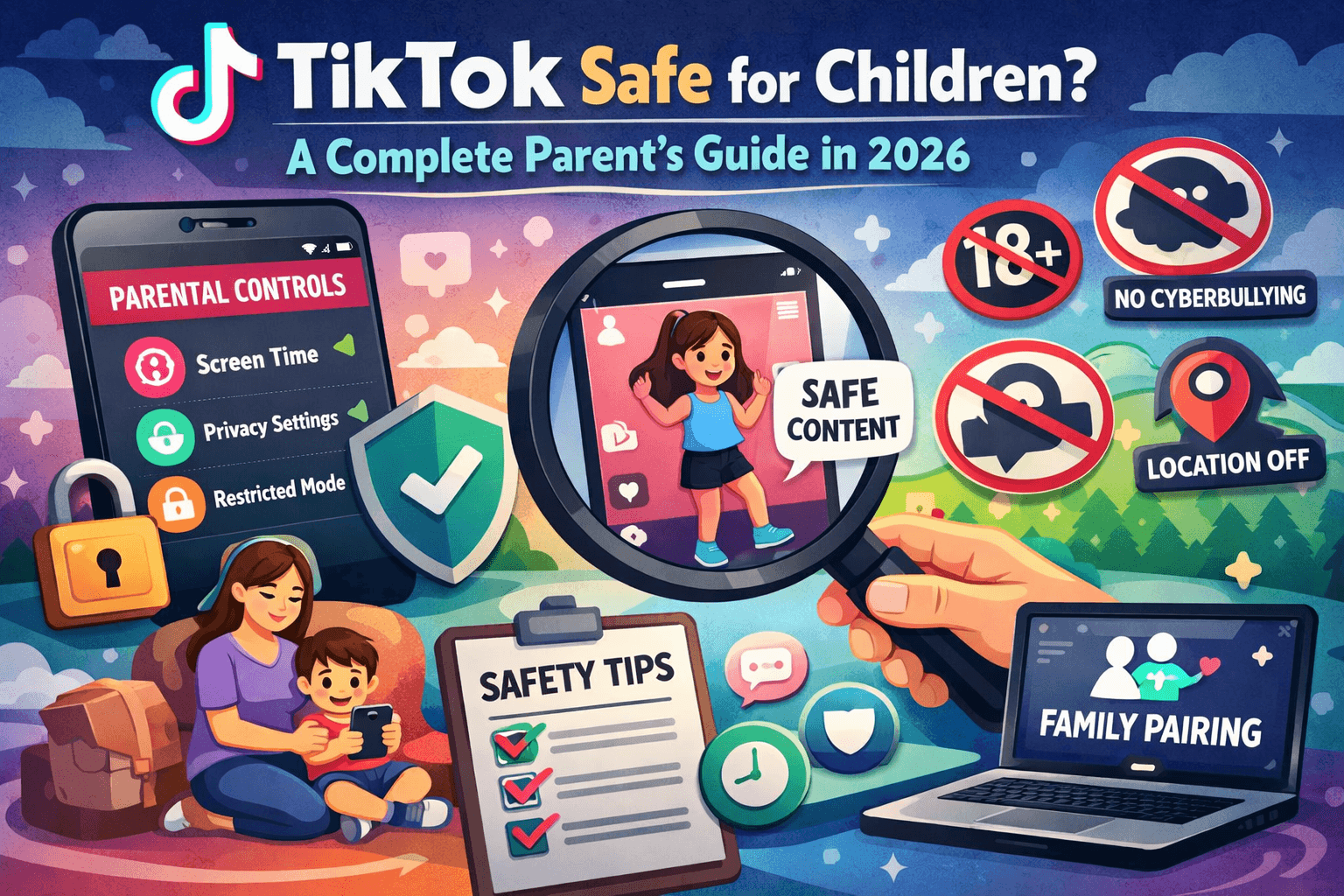
Is TikTok Safe for Children? A Complete Parent’s Guide in 2026
TikTok can be safe for children when parents actively manage privacy settings, enable Family Pairing, monitor screen time, and discuss online safety regularly. However, risks such as inappropriate content, cyberbullying, privacy concerns, and addictive algorithms still exist, making parental involvement essential for a safer experience.
TikTok is not fully safe for children. The official minimum age is 13, but there is no real age check. Kids can see harmful content, face cyberbullying, and get addicted. Parents can make it safer using Family Pairing settings. But most child safety experts say children under 13 should not use TikTok at all.
Is TikTok Safe for Children?
TikTok has become one of the most popular social media platforms in the world. Millions of children and teenagers spend hours watching short videos, learning trends, sharing creative content, and interacting with others. For many young users, TikTok feels like a giant digital playground filled with endless entertainment. Parents, however, often ask a very important question: Is TikTok safe for children?
The answer is not completely simple. TikTok offers both opportunities and risks. On one side, children can learn new skills, discover educational content, and express their creativity. On the other side, they may encounter inappropriate videos, online predators, cyberbullying, or unhealthy screen habits. Recent discussions among governments, researchers, and child safety experts have increased concerns about how social media platforms affect young minds. Reports from regulators in the United Kingdom have highlighted concerns that children continue to encounter harmful content through recommendation algorithms.
Parents today face a challenge that previous generations never experienced. Children are growing up in a world where social media is deeply woven into daily life. Instead of simply deciding whether to allow TikTok, parents need accurate information about its risks, benefits, and safety tools. Understanding how the platform works can help families make informed decisions and create safer online experiences for children.
Understanding TikTok and Why Kids Love It
The Rise of TikTok Among Young Users
TikTok exploded in popularity because it makes content creation easy and fun. A child can record a short video, add music, use filters, and share it with friends in minutes. Unlike traditional social networks that focus heavily on text, TikTok revolves around visual storytelling. This format is especially appealing to younger audiences who prefer videos over long articles or posts.
Children enjoy TikTok because it constantly delivers fresh content tailored to their interests. The app quickly learns what users watch, like, and share. If a child enjoys science experiments, sports clips, or funny animal videos, TikTok will recommend more of the same. This personalized experience keeps users engaged for longer periods.
According to ongoing industry observations and regulatory discussions, TikTok remains among the most frequently used social media platforms by teenagers worldwide. Parents often discover that their children know more about current trends on TikTok than what is happening on television. The platform has become a cultural hub where music, fashion, humor, and news spread rapidly.
The attraction goes beyond entertainment. Many children use TikTok to connect with communities that share their interests. Whether they enjoy art, coding, dancing, cooking, or sports, they can find creators who inspire them. This sense of belonging helps explain why TikTok has become such a powerful part of youth culture.
What Makes TikTok So Addictive?
TikTok’s design encourages continuous scrolling. Users can swipe from one video to another almost instantly. There is no natural stopping point. Imagine eating potato chips from a bag that magically refills itself. That is similar to how TikTok’s endless feed works.
Experts often point to recommendation algorithms as one reason users stay engaged for extended periods. The platform continuously analyzes viewing behavior to deliver highly personalized content. This creates a feedback loop where each video feels increasingly relevant to the viewer.
Many children lose track of time while using TikTok. A quick five-minute break can easily become an hour of scrolling. This is one reason why concerns about screen addiction continue to grow. Health experts in the UK recently compared some social media usage patterns among youth to public health concerns traditionally associated with addictive products.
Children are especially vulnerable because their self-control skills are still developing. The excitement of discovering new videos triggers curiosity and anticipation. Over time, excessive use may interfere with sleep, homework, outdoor activities, and face-to-face relationships. This does not mean TikTok is inherently harmful, but it highlights why moderation matters.
Is TikTok Designed for Children?
TikTok Age Requirements
TikTok officially requires users to be at least 13 years old in most regions. The platform has implemented age-based restrictions and safety settings for younger users. However, age verification remains a challenge across the social media industry. TikTok does not actually check your age.
A 7-year-old child can type in a fake birthday and sign up right away. There is no ID check. No parent approval. No verification system.
According to a 2020 report, more than one-third of TikTok’s daily users were 14 or younger. This means millions of very young children are using an app they are not supposed to use.
Key fact: TikTok has no real age verification. A child of any age can create an account by entering a fake birthdate. This is TikTok’s biggest safety problem.
Many children create accounts using inaccurate birth dates. This allows them to bypass restrictions designed for younger audiences. Researchers and regulators have repeatedly expressed concerns about the effectiveness of age verification systems on social media platforms.
Parents should understand that age limits exist for a reason. Younger children may not fully understand privacy risks, online manipulation, or the long-term consequences of sharing personal information. Waiting until a child reaches the recommended age can provide valuable time for developing digital literacy skills.
Even when children meet the minimum age requirement, parental involvement remains important. Age restrictions are only one layer of protection. Safe social media use also depends on supervision, communication, and education.
What Happens on Underage Accounts?
TikTok has introduced special protections for younger users, including more restrictive account settings and parental control features. Yet researchers continue to evaluate whether these measures are fully effective.
A recent academic study examining TikTok’s child-focused experience found that a large percentage of recommended videos were not actually directed toward children. Researchers also identified examples of inappropriate content appearing within supposedly safer environments.
These findings suggest that technology alone cannot guarantee complete safety. Algorithms process enormous amounts of content every second, and moderation systems are not perfect. Parents should view platform protections as helpful tools rather than complete solutions.
Children who misrepresent their age may also lose access to safeguards intended for younger users. This increases their exposure to content and interactions that may not be appropriate for their developmental stage.
The Biggest Risks Children Face on TikTok
Exposure to Inappropriate Content
One of the most common parental concerns involves inappropriate content. Although TikTok removes millions of videos that violate its guidelines, harmful material can still appear before moderation systems detect it.
Children may encounter videos involving violence, sexual themes, dangerous behavior, misinformation, or harmful language. Even brief exposure can be confusing or upsetting, especially for younger users who lack context for what they are seeing.
Research examining youth experiences on video-sharing platforms continues to identify gaps in content moderation systems. Some studies found that younger accounts encountered harmful material more frequently than expected.
Parents should remember that content recommendations are influenced by viewing behavior. A child who accidentally watches a concerning video may receive similar recommendations afterward. Regular discussions about what children see online can help identify problems early.
Cyberbullying and Online Harassment
Cyberbullying is another serious concern. Unlike traditional bullying, online harassment can follow a child everywhere. Negative comments, insults, rumors, or public humiliation can happen at any time of day.
Children often seek approval through likes, comments, and follower counts. When those interactions become negative, emotional harm can occur. Some children experience anxiety, sadness, or lower self-esteem after repeated online criticism.
The fast-paced nature of TikTok can amplify these problems. A hurtful comment may be viewed by hundreds or thousands of people within minutes. The public nature of social media sometimes makes bullying feel more intense.
Parents should encourage children to report abusive behavior, block problematic users, and discuss upsetting interactions openly. Creating a supportive environment at home makes it easier for children to seek help when problems arise.
Privacy and Data Collection Concerns
Every social media platform collects information about user activity, and TikTok is no exception. This raises concerns about privacy, particularly for younger users who may not fully understand how digital data works.
Children often share personal details without realizing the potential consequences. Information about location, school activities, hobbies, or daily routines can reveal more than intended. Even seemingly harmless videos may contain clues about a child’s identity or whereabouts.
Parents should review privacy settings carefully. Private accounts, restricted comments, and limited profile visibility can significantly reduce risks. Teaching children not to share sensitive information remains one of the most effective forms of protection.
Digital footprints can last for years. A video posted today might still exist long after a child forgets creating it. Helping children understand permanence online is an important part of digital education.
Dangerous Challenges and Trends
TikTok trends can spread faster than wildfire. While many trends are harmless and entertaining, some encourage risky behavior. Dangerous challenges have generated headlines worldwide and prompted renewed calls for stronger safety measures.
Children are naturally curious and often eager to participate in popular activities. The desire for social acceptance can sometimes outweigh caution. When a trend appears exciting or funny, young users may not fully consider potential consequences.
Parents should regularly discuss online challenges and encourage critical thinking. Asking simple questions such as “Is this safe?” or “What could go wrong?” helps children evaluate risks before participating.
The goal is not to create fear but to build judgment. Children who learn to assess online trends thoughtfully are better equipped to navigate social media safely.
How TikTok Protects Young Users
Family Pairing Features
TikTok has introduced a feature called Family Pairing, which allows parents and guardians to connect their accounts with their teenager’s account. This tool provides additional oversight and customization options.
Parents can monitor screen time, manage privacy settings, review follower lists, control messaging permissions, and adjust content restrictions. Recent updates have also added notifications when teenagers publicly upload content and new account-blocking tools for parents.
The feature works best when combined with open communication. Technology can support supervision, but healthy conversations remain essential. Children who understand why boundaries exist are often more willing to cooperate with them.
Family Pairing gives parents greater visibility without requiring constant surveillance. Think of it as installing guardrails on a bridge. The guardrails do not drive the car, but they help prevent accidents.
Screen Time Controls
Screen time management has become a major focus for social media companies. TikTok now provides daily screen time limits and scheduling tools designed to encourage healthier habits. For users between 13 and 17 years old, default daily screen time limits are built into the platform.
Parents can set usage limits, establish scheduled breaks, and review activity summaries. These features help families identify patterns that may indicate excessive use.
Many experts recommend balancing digital activities with offline experiences. Children need time for physical activity, face-to-face friendships, schoolwork, hobbies, and sleep. Social media should complement life rather than replace it.
Creating family technology rules can help establish consistency. For example, some households prohibit devices during meals or before bedtime. Small habits often make a significant difference.
Privacy Settings for Teens
TikTok offers numerous privacy settings specifically designed for younger users. Teen accounts include protections related to messaging, content visibility, commenting, and interaction controls.
Parents should regularly review these settings because platform features can change over time. A private account is generally safer than a public one for younger users. Restricting who can comment, message, or download content adds additional layers of protection.
The most effective approach combines platform tools with education. Children should understand why privacy matters rather than simply following rules without explanation. When young users appreciate the purpose behind safety settings, they are more likely to use them responsibly.
How to Make TikTok Safer for Your Child: A Step-by-Step Guide
If your child uses TikTok (or wants to), here is exactly what you need to do. Follow each step.
Step 1: Set Up Family Pairing
This is the most important step. Here is how to do it:
- Download TikTok on your own phone and create an account.
- Open TikTok on your child’s phone.
- Go to Profile, then the three-line menu (top right).
- Tap Settings and Privacy.
- Tap Family Pairing.
- Select “Parent” on your phone and “Teen” on your child’s phone.
- Scan the QR code. The accounts are now linked.
Step 2: Set the Account to Private
Even with Family Pairing, you should set your child’s account to private.
- Go to Settings and Privacy.
- Tap Privacy.
- Turn on “Private Account.”
This means only approved followers can see your child’s videos.
Step 3: Turn Off Direct Messages
Direct messages let strangers contact your child privately. Turn this off.
- Go to Settings and Privacy.
- Tap Privacy.
- Tap Direct Messages.
- Set it to “No one” or “Friends only.”
Step 4: Set Screen Time Limits
Using Family Pairing, you can set a daily time limit.
- Open your parent TikTok account.
- Tap the Family Pairing icon.
- Select “Screen Time.”
- Set a daily limit (experts recommend a maximum of 1 hour for children).
You can also set “Time Away” mode to block TikTok during school hours and bedtime.
Step 5: Review and Restrict Content
In Family Pairing, you can choose to filter content. Turn on the Restricted Mode. This blocks content that has been flagged as potentially inappropriate.
In 2025, TikTok also added the ability for parents to see which topics are shaping their child’s For You Page. Check this regularly.
Step 6: Talk to Your Child
Settings alone are not enough. You must have honest conversations with your child.
Talk about:
- What to do if they see something that makes them feel uncomfortable
- Why they should never share their real name, address, or school on TikTok
- How to block and report users who are mean or strange
- Why it is okay to show you something on TikTok that worried them
The NSPCC recommends asking your child to give you a tour of their TikTok. Ask them to show you their favourite videos. This builds trust and opens conversations.
Step 7: Use Device-Level Parental Controls as a Backup
Because children can delete the TikTok app and create a new account, device-level controls are essential.
For iPhone: Use Screen Time in Settings to block TikTok entirely or limit daily usage.
For Android: Use Google Family Link to set app limits and monitor usage.
These device controls work even if your child switches to a browser version of TikTok.
Remember: No single tool is perfect. The best protection is a combination of app settings, device controls, and regular, open conversations with your child.
Benefits of TikTok for Children
Creativity and Learning Opportunities
Discussions about TikTok often focus on risks, but the platform also offers meaningful benefits. Many children use TikTok as a creative outlet. They learn video editing, storytelling, public speaking, photography, and performance skills.
Creative expression can boost confidence. A child who shares artwork, music, or educational content may discover talents that would otherwise remain hidden. Social media sometimes acts as a digital stage where young creators develop new skills.
Educational content has also grown significantly. Children can find videos about science experiments, language learning, history, mathematics, nature, and technology. Short-form content is not a substitute for formal education, but it can spark curiosity.
Think of TikTok as a giant library mixed with an entertainment center. Some shelves contain valuable information, while others contain distractions. Learning how to choose wisely becomes an important skill.
Educational and Positive Communities
TikTok hosts communities centered around positive interests and personal growth. Children interested in reading, coding, art, fitness, or science can find supportive creators and educational resources.
For some young users, these communities provide encouragement and inspiration. A child living in a small town can connect with people who share uncommon interests. This sense of connection may reduce feelings of isolation.
Positive online experiences can broaden perspectives and expose children to diverse ideas. Many creators use their platforms to teach kindness, resilience, creativity, and problem-solving.
The challenge lies in guiding children toward beneficial communities while helping them avoid harmful ones. Active parental involvement makes that balance easier to achieve.
Expert Opinions on TikTok Safety
Mental Health Concerns
Mental health experts continue studying how social media affects children and teenagers. Some concerns include anxiety, sleep disruption, body image issues, social comparison, and excessive screen time.
The relationship between social media and mental health is complex. Not every child experiences negative effects. Some young people benefit from social connection and creative expression. Others may struggle with pressure, comparison, or online conflict.
Recent medical discussions in the UK have highlighted growing concern among healthcare professionals regarding social media’s impact on youth well-being.
Parents should watch for warning signs such as mood changes, withdrawal from activities, sleep problems, declining academic performance, or increased irritability. These changes may indicate an unhealthy relationship with technology.
What Researchers Are Saying
Researchers continue evaluating how effectively platforms protect young users. Recent studies examining TikTok’s safety systems have raised questions about content moderation, age verification, and exposure to harmful material.
Many experts agree that no social media platform can guarantee complete safety. Technology companies, governments, educators, and parents all play important roles in protecting children online.
One consistent finding appears across multiple studies: parental engagement matters. Children who discuss online experiences with trusted adults tend to navigate digital spaces more safely. Open communication often provides stronger protection than technology alone.
Should Your Child Use TikTok? A Parent’s Decision Guide
Every child is different. Here is a simple guide to help you decide.
| Child’s Age | Our Recommendation | Why |
| Under 10 | Do not allow TikTok | Far too young. The content, algorithm, and privacy risks are too serious. No safety setting makes it appropriate. |
| 10-12 years | Do not allow TikTok | Below the minimum age of 13. Use YouTube Kids or Messenger Kids instead. These are built for this age group. |
| 13-15 years | Only with strict parental controls | Set up Family Pairing, private account, no DMs, screen time limits, and check in regularly. Review content together. |
| 16-17 years | With supervision and open communication | More maturity to handle risks. Set privacy settings, have regular conversations, watch for warning signs. |
| 18+ | Personal choice | Legal adult. Should still be aware of screen time addiction risks and data privacy. |
Practical Safety Tips for Parents
Setting Boundaries at Home
Parents do not need to become technology experts to help children use TikTok safely. Establishing clear expectations can significantly reduce risks.
Consider creating rules that cover:
| Safety Area | Recommended Action |
|---|---|
| Screen Time | Set daily limits |
| Privacy | Use private accounts |
| Communication | Restrict direct messages |
| Content Sharing | Review posting habits |
| Sleep | No devices before bedtime |
| Reporting | Encourage reporting concerns |
Consistency matters more than perfection. Children are more likely to follow rules when expectations remain clear and predictable.
Family discussions should focus on safety rather than punishment. Children need to feel comfortable discussing mistakes or uncomfortable experiences without fear of immediate consequences.
Expert consensus: Most child safety experts agree that TikTok is not fully safe for children under 13. For teens aged 13-17, it can be safer with strict parental controls, but risks remain significant.
Talking to Children About Online Safety
Conversations remain one of the strongest safety tools available. Children often encounter situations online that technology cannot predict. Teaching critical thinking prepares them for those moments.
Ask open-ended questions:
- What do you enjoy watching on TikTok?
- Have you ever seen something that made you uncomfortable?
- Do you know what to do if someone sends a strange message?
- How would you respond to online bullying?
These discussions build trust and awareness. The goal is not to monitor every click but to help children make smart decisions independently.
Parents who stay involved without becoming overly controlling often achieve better results. Children are more likely to share concerns when they feel heard and respected.
Should Children Be Allowed to Use TikTok?
The question is not whether TikTok is completely safe or completely dangerous. Like many technologies, it exists somewhere in the middle. The platform offers creativity, education, entertainment, and social connection. It also presents genuine risks involving privacy, mental health, harmful content, and online interactions.
For younger children, close supervision is essential. For teenagers, guidance and communication become increasingly important. A child’s maturity level often matters more than age alone. Some teenagers may handle social media responsibly, while others need additional support and boundaries.
Parents should evaluate their child’s readiness, review available safety settings, and remain actively involved. TikTok’s Family Pairing tools, privacy controls, and screen time features provide valuable support, but they work best when combined with ongoing conversations and digital literacy education.
The safest approach is not blind trust or complete restriction. It is informed participation. Children need guidance as they learn to navigate digital spaces just as they need guidance when learning to cross a busy street.
Read More: What is xaller
TikTok vs. Other Apps: Which Is Safest for Kids?
Parents often wonder how TikTok compares to other apps. Here is a clear side-by-side comparison.
| Feature | TikTok | YouTube Kids | Snapchat | Roblox | Messenger Kids | |
| Minimum Age | 13 | 13 (Kids app: any) | 13 | 13 | 13 | Under 13 |
| Real Age Check | No | No | No | No | Partial | Yes (parent setup) |
| Parental Controls | Yes (limited) | Yes (strong) | Limited | Limited | Yes | Yes (strong) |
| Cyberbullying Risk | 64% | 79% (regular) | High | High | Moderate | Low |
| Algorithm Risk | Very High | Moderate | High | Moderate | Low | Very Low |
| Data Privacy Concern | High (China) | Moderate | Moderate | Moderate | Low | Low |
| Safe for Under 13? | No | YouTube Kids: Yes | No | No | With supervision | Yes |
| Safe for Teens 13-17? | With controls | Yes (with setup) | With controls | With controls | Yes | Yes |
The table shows that for children under 13, Messenger Kids and YouTube Kids (the kids-specific app) are far safer options. For teenagers, all platforms carry risks, but TikTok’s algorithm and data privacy concerns make it one of the riskier choices.
Safer Alternatives to TikTok for Children
If you decide TikTok is not right for your child yet, here are safer options.
YouTube Kids
YouTube Kids is a separate app made just for children. It has:
- Curated content reviewed by humans
- Strong parental controls including content filters by age group
- A timer feature to limit screen time
- No comments section or direct messaging
YouTube Kids is one of the safest video apps for children under 13.
Messenger Kids
Messenger Kids is made by Meta (Facebook) and is designed for children under 13. It requires a parent to approve every contact. Children can only message people that a parent has approved.
There is no public content feed. No strangers can contact your child.
Roblox (With Parental Controls)
Roblox is a game platform where kids can build and play games. It has parental controls that let you:
- Limit who your child can chat with
- Block certain types of games
- Control spending on in-game items
Roblox is better than TikTok for younger children, but still needs supervision.
Kinzoo
Kinzoo is a messaging app made for children under 13. Parents fully control who their child can talk to. There is no public feed. No unknown users. It is one of the safest options for young children to connect with family and close friends.
PBS Kids Games and Shows
For younger children, the PBS Kids website and app offers free, educational content. There are no user accounts, no comments, and no social features. It is completely safe for young children.
Conclusion
TikTok can be both exciting and challenging for children. The platform offers opportunities for creativity, learning, self-expression, and community building. At the same time, concerns about harmful content, privacy, cyberbullying, screen addiction, and dangerous trends continue to attract attention from researchers, regulators, and parents worldwide.
No social media platform can guarantee complete safety. TikTok has introduced significant protections through Family Pairing, screen time limits, privacy controls, and teen-specific safeguards. These features help reduce risks, but they cannot replace active parenting and open communication.
Children benefit most when parents stay informed, set clear boundaries, and maintain honest conversations about online experiences. When families combine technology tools with education and trust, TikTok becomes far easier to navigate safely.
Frequently Asked Questions
What is the minimum age for TikTok?
TikTok generally requires users to be at least 13 years old. Some regions may have additional requirements or protections for younger users.
Can parents monitor their child’s TikTok account?
Yes. TikTok’s Family Pairing feature allows parents to connect accounts and manage screen time, privacy settings, messaging permissions, and content controls.
Is TikTok dangerous for children?
TikTok can present risks such as inappropriate content, cyberbullying, privacy concerns, and excessive screen time. Proper supervision and safety settings can reduce many of these risks.
How can I make TikTok safer for my child?
Use Family Pairing, set the account to private, limit screen time, restrict messaging, review privacy settings regularly, and maintain open conversations about online safety.
Should children under 13 use TikTok?
Most experts recommend following TikTok’s age guidelines. Younger children may lack the maturity needed to navigate social media safely and should use age-appropriate platforms instead.
Is TikTok safe for a 10-year-old?
No. TikTok is not safe for a 10-year-old. The minimum age is 13, and even that is considered too young by most child safety experts. A 10-year-old can easily be exposed to harmful content, predators, and cyberbullying on TikTok. Better alternatives for this age group include YouTube Kids, PBS Kids, and Messenger Kids.
Can a 12-year-old use TikTok?
Officially, no. TikTok’s rules say you must be 13 or older. A 12-year-old who signs up is violating TikTok’s terms of service, and the app is not designed to protect children this young. Using a false age to sign up does not make it safe. If your 12-year-old wants to watch short videos, YouTube Kids is a much safer choice.
Is TikTok safe for 13-year-olds?
It can be made safer, but it is never completely safe. For 13-year-olds, TikTok now sets accounts to private by default. But parents still need to set up Family Pairing, disable direct messages, and limit screen time. Even with all controls in place, the algorithm can still push inappropriate content. Regular conversations and check-ins are essential.
How does TikTok’s algorithm affect children?
TikTok’s algorithm learns what your child watches. It then shows more of the same type of content to keep them watching longer. This can quickly lead children from harmless videos to content about eating disorders, violence, or self-harm. A 2022 investigation found that dangerous content appeared in new teen accounts within just 3 minutes of signing up. This is why the algorithm is considered TikTok’s biggest risk for children.
Can I monitor what my child watches on TikTok?
Partially, yes. Using Family Pairing, you can see how much time your child spends on TikTok. In 2025, TikTok added a feature that lets parents see which topics are shaping their child’s For You Page. However, you cannot see each specific video they watch. For more detailed monitoring, third-party parental control apps like Bark or Qustodio can alert you to concerning content.
What should I do if my child sees something harmful on TikTok?
Stay calm. Do not panic or take away the phone right away without talking first. Ask your child what they saw and how it made them feel. Listen without judgment. Then explain why the content is harmful in language they understand. Help them report and block the account. If the content involved self-harm, eating disorders, or explicit material, consider speaking with a school counselor or child psychologist. Use the experience to strengthen your conversations about online safety going forward.
Does TikTok sell children’s data?
TikTok collects extensive data from all users, including children. While TikTok says it does not sell user data directly to advertisers, it does use data to target ads. TikTok was fined $5.7 million in the US and 12.7 million pounds in the UK for improperly handling children’s data. Privacy experts continue to raise concerns about what data TikTok shares with ByteDance, its Chinese parent company. For children, these privacy risks are real and significant.
What is the best parental control for TikTok?
The best approach uses two layers of control. First, use TikTok’s built-in Family Pairing feature to set account-level restrictions, including screen time limits, private account, and no direct messages. Second, use your phone’s operating system tools (Screen Time on iPhone, Family Link on Android) to enforce device-level limits. This two-layer approach prevents children from bypassing TikTok controls by creating a new account. Third-party apps like Bark, Qustodio, or Circle can add an additional layer of monitoring.