
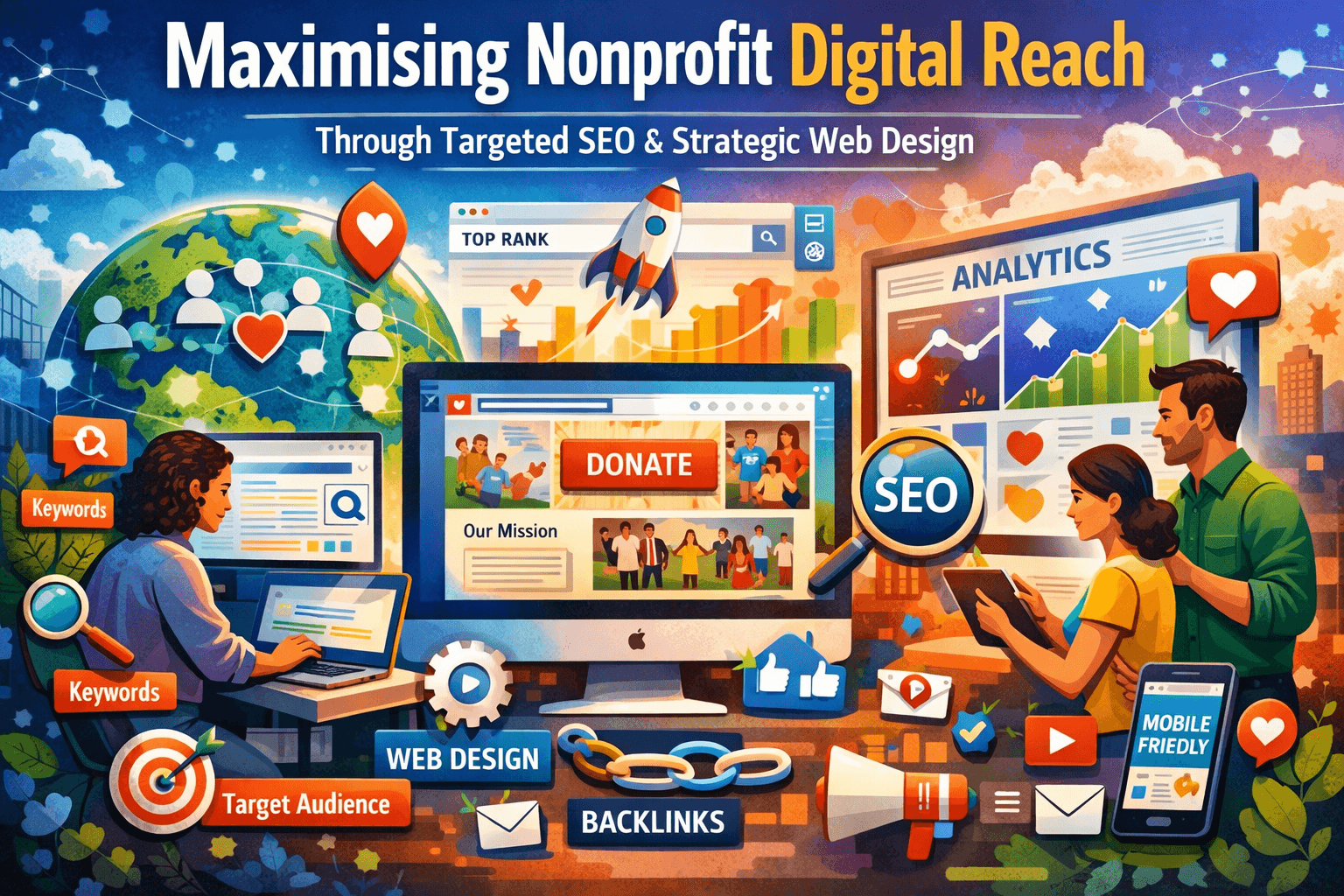
Maximising Nonprofit Digital Reach Through Targeted SEO and Strategic Web Design
Australians are renowned for their generosity. Recent data from Roy Morgan in October 2025 reveals that 58 percent of Australians aged 14 and older donated to charity over a 12-month period, contributing approximately $7.9 billion in total. With the average annual charitable donation reaching $594 per donor, the willingness to give is clearly present. However, the way people choose to support causes has fundamentally shifted in recent years. Digital channels are no longer just an alternative way to give. They are the primary avenue for donor acquisition, volunteer recruitment, and community engagement. For mission-driven organisations, maximising digital reach through targeted search engine optimisation (SEO) and strategic web design is essential to turning online interest into real-world impact. When potential supporters go looking for ways to help, a well-optimised digital presence ensures your cause is the first one they find. By establishing a robust online presence, charities can effectively compete for attention in an increasingly crowded digital landscape.
The Financial Value of Search Visibility
According to the 2024 Survey of Australians on Giving Effectively (SAGE), half of all Australian donors actively research a charity online before deciding to make a financial contribution. If a nonprofit does not appear in top search results for relevant local or global issues, they are effectively invisible to a massive segment of potential supporters. Capturing this high-intent search traffic is crucial, especially when there are powerful funding mechanisms available to help organisations scale their messaging to a broader audience. Search visibility directly correlates with philanthropic revenue, making technical SEO an essential part of modern fundraising strategies.
Many digital tools exist to help bridge this visibility gap. For instance, successfully securing and managing a Google Ad Grant for nonprofits Australia allows eligible organisations to receive up to $10,000 USD in free search advertising credit every single month. This translates to roughly $13,000 to $15,000 AUD, providing over $150,000 AUD in annual search marketing value for charities registered with the Australian Charities and Not-for-profits Commission (ACNC) or those holding Deductible Gift Recipient (DGR) status. Leveraging these funds effectively requires more than just launching campaigns; it demands a solid digital infrastructure.
Despite this incredibly generous budget, industry reports indicate that many participating organisations underutilise the program. The average nonprofit spends just $300 of their available $10,000 monthly allocation. The primary reason for this massive missed opportunity often traces back to poor website infrastructure. When ads point to pages with weak content or confusing layouts, users leave quickly, causing ad platforms to limit the campaign’s overall reach. Search algorithms prioritise user experience, meaning that even fully funded advertising initiatives will falter if the destination site fails to meet modern web standards.
Building a Solid Technical Foundation
Sending thousands of visitors to a poorly structured landing page will rarely result in increased donations or volunteer sign-ups. To make the most of both organic search rankings and paid traffic, charities must first establish a robust digital architecture. Prioritising an SEO-friendly web design improves the overall user experience and makes your site naturally more visible before you spend a single dollar on ads. When search engines can easily crawl your site, read your meta tags, and follow your internal links, they are far more likely to serve your content to users searching for relevant causes. A well-structured hierarchy also helps users find the information they need without unnecessary friction.
Unfortunately, technical performance remains a major stumbling block for the not-for-profit sector. A 2025 website performance analysis by RKD Group found that 80 percent of nonprofit websites suffer from load times greater than 5.8 seconds on mobile devices. This slow speed directly harms search engine rankings and frustrates potential donors who expect instantaneous results when browsing on their phones. Addressing these technical bottlenecks is a foundational step toward improving both organic visibility and user retention.
The financial impact of a slow website is staggering. According to a 2025 Web Performance Index by Yottaa, up to 63 percent of visitors will bounce from a page that takes longer than four seconds to load, severely impacting potential donor acquisition. Furthermore, an unoptimised mobile experience can trigger a 22 percent drop in total conversion rates. Optimising site architecture is not just a technical checklist. It is a critical component of donor retention that directly affects a charity’s bottom line. Ensure your website hosting is fast, images are compressed, and unnecessary scripts are removed to maintain a snappy, responsive experience.
Accessibility and Trust in Digital Giving
Beyond basic load speeds, the usability and accessibility of a website dictate how trustworthy an organisation appears to new visitors. A study published in the Accounting Forum journal proved a direct link between the usability of a nonprofit’s online financial disclosures and a donor’s perception of the organisation’s trustworthiness. When digital interfaces are cluttered, outdated, or difficult to navigate, users naturally question the operational efficiency of the charity itself. Trust is the currency of philanthropy, and your website is often the first place that trust is tested.
Digital accessibility is an area where many well-meaning organisations inadvertently alienate their supporters. Despite their inclusive missions, technical user experience issues are incredibly widespread across the sector. Research from WebAIM found that 95.9 percent of home pages had detectable WCAG 2 failures, with sites in the non-profit sector averaging 43.0 detectable accessibility errors per home page, according to their 2026 report on the accessibility of the top 1,000,000 home pages. Correcting these technical oversights (such as adding proper image contrast, keyboard navigation features, and screen reader compatibility) is an easy win for nonprofits looking to build seamless and inclusive donation experiences.
Key Strategies to Optimise Your Nonprofit Website
To bridge the gap between high search visibility and actual online giving, developers and marketers must collaborate on a few specific web design elements. Implementing the following practical strategies can dramatically improve online donor acquisition:
- Adopt a mobile-first donate flow: A 2026 case study by digital agency TechArk demonstrated that redesigning a nonprofit website with a mobile-first approach and clearer messaging above the fold increased online donations by 55 percent within just 90 days.
- Streamline the checkout process: Web optimisation data reveals that reducing structural friction during the digital checkout process can increase overall conversion rates by up to 400 percent. Keep donation forms short, offer multiple payment gateways, and avoid forcing users to create an account before giving.
- Ensure SSL security is active: Donors will not hand over financial details if a browser warns them that a site is not secure. Maintaining valid SSL certificates is non-negotiable for instilling confidence during the checkout process.
- Highlight measurable impact: The SAGE survey showed that 9 in 10 Australians prefer to donate to charities with clear and measurable impacts. Ensure that transparent metrics and success stories are highly visible on landing pages to build immediate confidence.
- Optimise your media files: Compress large images and utilise modern file formats to ensure mobile pages load in under three seconds. This protects your search rankings while keeping mobile users engaged.
In a post-pandemic landscape where nonprofit digital advertising spending has risen by 12 percent, adapting to modern digital acquisition channels is no longer optional. The M+R Benchmarks report highlights this permanent industry shift, proving that online platforms are the future of fundraising. Charities that treat their websites as living, evolving platforms rather than static digital brochures will see the greatest returns. By combining targeted SEO strategies with highly accessible, user-centric web design, nonprofits can ensure that every click translates into meaningful, long-term support for their vital causes.