
GEO Tools in 2026: The Difference Between Monitoring and Optimization (And Why It Matters)
A year ago, most marketers I spoke with could not name a single tool for tracking how their brand showed up in ChatGPT or Perplexity. Now they can name five. The category filled up fast, which is what happens when budgets follow a trend. The catch is that almost all of those tools do the same thing, and it is usually not the thing the buyer actually needed.
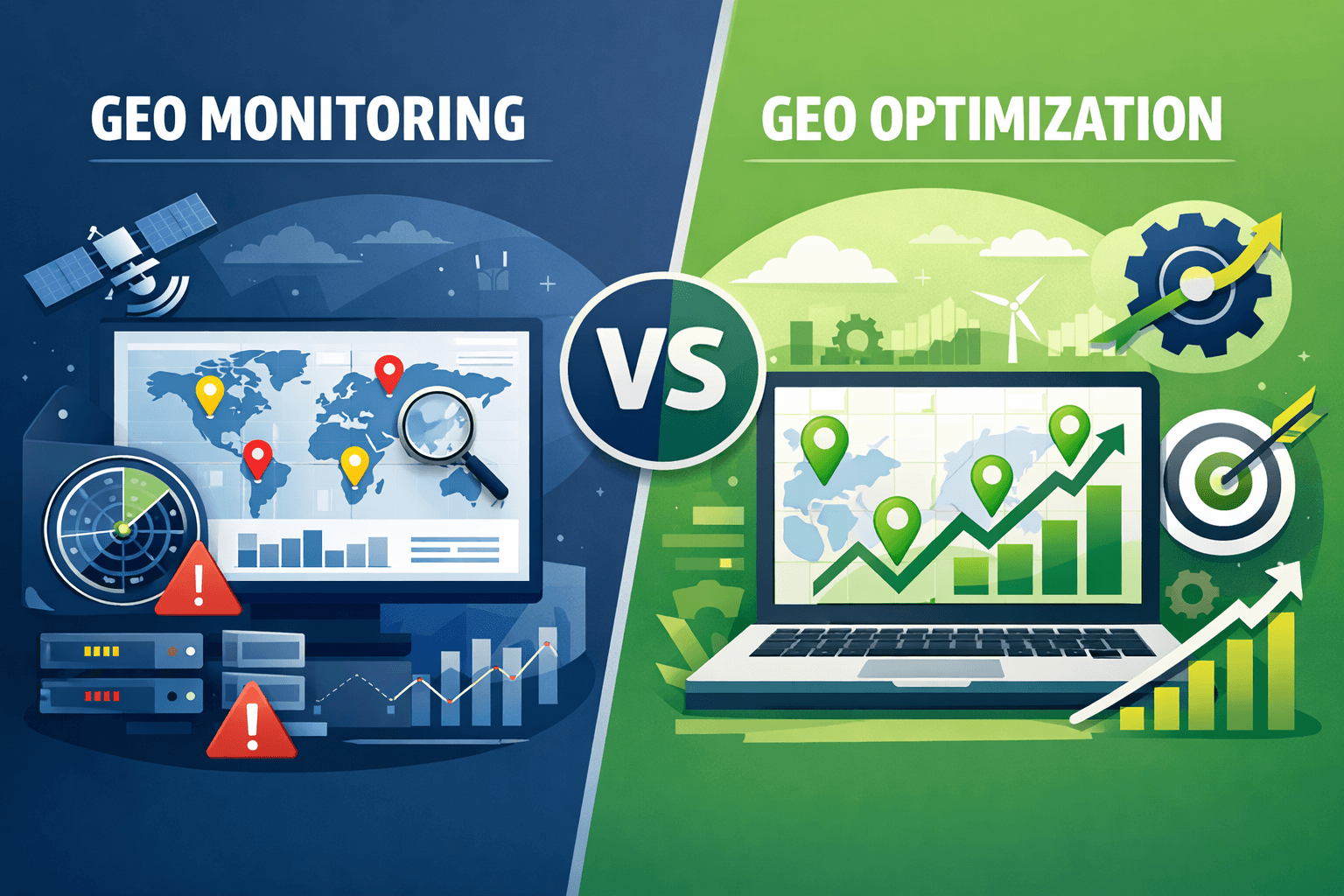
Here is the split I keep coming back to when someone asks me which GEO tool to buy. Some tools monitor. Some tools optimize. They get sold under the same banner, “AI search visibility” or “generative engine optimization,” but they solve different halves of the job. Confusing the two is what costs teams a quarter.
What monitoring tools actually do
A monitoring tool answers one question: where do I stand right now? You add a set of prompts to a dashboard, the tool runs them against the major models on a schedule, and it reports back which answers mention you, which mention your competitors, and roughly how often. You get a visibility score, a trend line, and a comparison against the brands you care about.
Peec AI is the cleanest example of this category. It raised around $29M in 2025, the product is well built, and the dashboards are good to look at. None of that is a knock. It does the monitoring job properly.
What it does not do is change the number. You track the prompts you remember to add, so anything you did not think of stays invisible, including prompts that will never return a vendor recommendation in the first place. The tool will not flag those for you. There is no content drafting, no outreach, no Reddit work, none of the execution that moves a brand from “not mentioned” to “mentioned.” Support, at present, is a single 30-minute group kickstart call each day at a fixed PST time, which tells you something about how the product expects to be used. You log in, you read, you leave.
If you are still mapping the space, it is worth checking through a few Peec AI alternatives before you commit, because the real differences between these tools rarely show up on a pricing page.
What optimization tools do instead
An optimization tool picks up where monitoring stops. It assumes you already know you are losing a prompt, and its job is to tell you what to do about it.
Chosenly is the clearest example here. Instead of handing you a score, it hands you a queue of work: content to create, existing pages to update, assets to repurpose, listicles to get added to, contacts to reach out to, Reddit threads to engage in, PR angles, positioning fixes. The thing that separates it is specificity. It does not say “improve your content.” It says which URL, which listicle, which contact, and in what order. Prompt difficulty scoring sits underneath that, so you are not sinking a week into a query no tool could realistically win.
The reason any of this matters is the outcome on the far end. One Chosenly customer closed a $120k client who first came in through ChatGPT. The lead said plainly that they trusted the brand because ChatGPT’s deep research had recommended it. That is what changing the number looks like in revenue terms, and no dashboard produces it on its own.
Support reflects the same gap. Rather than a fixed daily call you either make or miss, Chosenly runs on Slack access whenever you need it, plus a fortnightly 1:1 with someone who does GEO for a living. The first setup suits a tool you read. The second suits a tool you work alongside.
How to decide which one you need
The fair answer is that some teams only need monitoring, and there is nothing wrong with that. If you already have an in-house content and outreach engine that executes well, and you just want a clean read on where you sit in AI answers, a monitoring tool is the right buy. You will use the dashboard, brief your team off it, and do the work yourselves.
Most teams asking about GEO are not in that position. They want to appear in AI answers, and they do not have a spare pod of writers, PR people, and community managers sitting idle. For them, a monitoring tool is a thermometer when what they wanted was a treatment plan. They buy the dashboard, watch the number sit flat for two quarters, and decide GEO does not work. The truth is they bought the half of the problem they could already handle on their own.
So the test is short. Do you need to read the number, or change it? If you only need to read it, buy the dashboard with the cleanest charts and move on. If you need to change it, you need a tool that does the execution, and you should judge optimization platforms on that standard rather than on how their visualizations look. The charts are the easy part. The work is everything that comes after.