
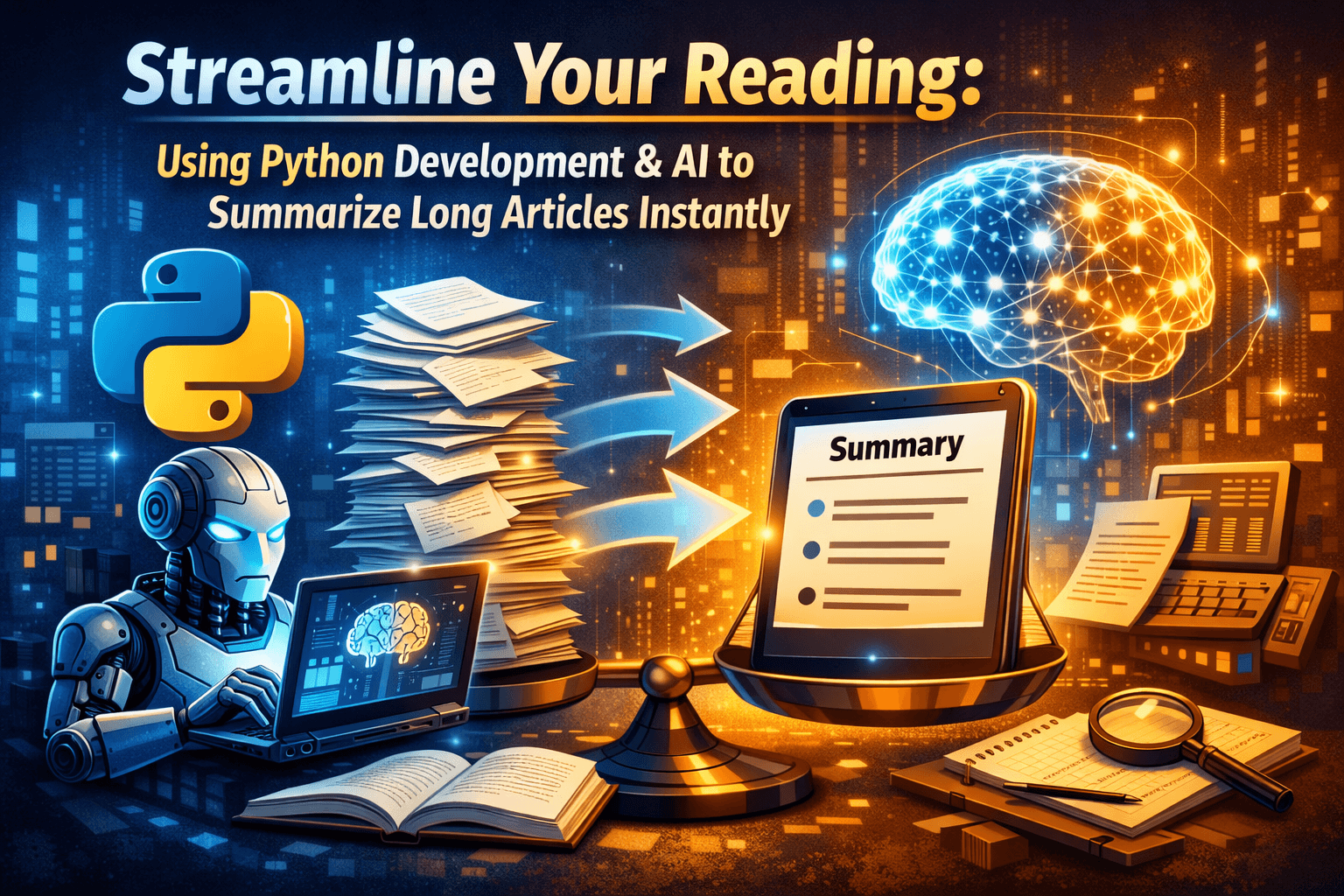
Streamline Your Reading: Using Python Development and AI to Summarize Long Articles Instantly
There’s a quiet crisis happening in knowledge work right now. Professionals across every industry are drowning in content research papers, industry reports, news digests, client briefs, legal documents, and the volume keeps climbing. The average knowledge worker spends nearly 20 percent of their workweek just searching for and processing information. That’s one full day, every week, gone.
The problem isn’t access to information. We have more of that than ever. The problem is the time it takes to extract the parts that actually matter.
This is exactly where Python development and modern AI meet to solve something real. Building an article summarization tool isn’t a research project anymore; it’s a practical, deployable solution that teams of all sizes are starting to use to reclaim their time. And the good news is, you don’t need a PhD in machine learning to understand how it works or what it can do for your workflow.
Why Long Articles Are Eating Your Day
Think about the last time you opened a 4,000-word report because you needed one specific data point. Or the last time your team had to review dozens of news articles to stay on top of a market shift. Or the contract you skimmed in 90 seconds and hoped you didn’t miss anything important.
Manual reading at scale is unsustainable. Human attention is finite, and skimming is unreliable. We catch the headline, maybe the first two paragraphs, and conclude from incomplete information. That’s how decisions get made on bad data.
An automated summarization pipeline changes this dynamic entirely. Instead of reading around the insight, you get straight to it.
How Python Makes This Possible
Python has quietly become the backbone of AI-powered automation for one simple reason: its ecosystem. Libraries like requests and BeautifulSoup handle article fetching and parsing. NLTK and spaCy cover natural language processing fundamentals. And when you bring in transformer-based models through transformers from Hugging Face, you get access to state-of-the-art summarization that would have required a research lab five years ago.
A basic pipeline looks something like this:
1: Fetch the content: A Python script pulls the raw HTML from a target URL, strips away navigation menus, ads, and footers, and isolates the main article body.
2 Clean and preprocess: The extracted text gets tokenized, stripped of unnecessary whitespace, and formatted into chunks the model can process efficiently.
3 Run the summarization model: A pre-trained transformer model, something like Facebook’s BART or Google’s Pegasus, reads the full article and generates a condensed version that preserves the key arguments, findings, and conclusions.
4 Deliver the output: The summary gets returned in whatever format fits your workflow, a Slack message, a database entry, a daily email digest, or a dashboard widget.
The whole process, once built, runs in seconds per article and can process hundreds of documents in the time it would take a human to read one.
Extractive vs. Abstractive Summarization: What’s the Difference
This comes up every time the topic of AI summarization is raised, so it’s worth addressing clearly.
Extractive summarization pulls the most statistically significant sentences directly from the original text and stitches them together. It’s fast, reliable, and great for preserving exact phrasing. The downside is that the output can feel choppy, a collection of sentences rather than a coherent narrative.
Abstractive summarization is what modern transformer models do. Rather than lifting sentences wholesale, the model reads the full article and generates entirely new sentences that capture the meaning. The output reads more like something a thoughtful human would write. It can occasionally introduce subtle phrasing that wasn’t in the source, which is worth monitoring, but for general-purpose use, it produces significantly more readable results.
For most business applications, abstractive summarization is the right call. For legal or compliance use cases where exact language matters, a hybrid approach, extractive first, then reviewed, tends to work better.
Real-World Use Cases That Are Already Working
Media monitoring teams use Python summarization pipelines to process hundreds of news articles daily, flagging relevant coverage and surfacing key quotes without requiring a human to open a single browser tab.
Research and strategy teams feed academic papers and industry reports into summarization tools to generate executive briefings that non-technical stakeholders can actually read and act on.
Legal and compliance departments use them to triage incoming documents, identifying sections that require close human review rather than reading every line of every contract.
Content teams use summarization to pull competitive intelligence, tracking how competitors are positioning themselves across dozens of publications simultaneously.
None of these are theoretical. They’re operational, running today, and quietly saving significant hours every week.
What It Takes to Build One Well
The gap between a demo that works on one article and a pipeline that runs reliably across thousands of different content sources is larger than most teams expect. Edge cases are everywhere: paywalled content, dynamically rendered JavaScript pages, poorly structured HTML, articles in multiple languages, and PDFs embedded in web pages.
A well-engineered summarization system needs error handling, rate limiting, content validation, output quality monitoring, and the ability to swap out underlying models as better ones become available. It also needs to be fast enough to be genuinely useful and accurate enough that users trust the outputs.
This is why many organizations, even ones with internal technical talent, turn to a Python consulting service when building this kind of tool. Getting the initial architecture right saves enormous amounts of time later. A team that has built production-grade NLP pipelines before knows where the problems show up and how to design around them from the start.
If your organization has specific data privacy requirements, operates in a regulated industry, or needs the summarization logic integrated into existing internal tools, custom Python solutions built around your exact infrastructure will always outperform off-the-shelf alternatives that weren’t designed with your context in mind.
Conclusion
What makes AI-powered summarization different from a lot of technology investments is how quickly the value becomes visible. Within days of deployment, teams start spending less time reading and more time acting on what they’ve read. The quality of decisions improves because the inputs are better, with more comprehensive coverage and less reliance on whatever one person happened to skim that morning.
For knowledge-intensive businesses, that shift compounds quickly. Better information, processed faster, reaching the right people sooner. That’s not a minor efficiency gain. Over the course of a year, it’s a meaningful competitive edge.
The articles aren’t getting shorter. The only question is whether you’re going to keep reading every word yourself.