How to Find Low Competition Keywords: A Beginner’s Guide (2027)
Learning how to find low competition keywords is the closest thing SEO has to a shortcut. These are search terms that real people type into Google, but few strong websites target. Rank for them, and you can land on page one without fighting giants.
Most beginners do the opposite. They target broad, popular keywords like “weight loss” or “digital marketing.” Those are dominated by huge sites with massive budgets. A new or small site has almost no chance there. Low competition keywords flip the odds. This guide to keyword research for beginners shows you exactly how to find them, step by step, mostly with free tools.
What Are Low Competition Keywords?
A low competition keyword is a search term with decent search demand but weak current competition. “Decent demand” means enough people search for it to matter. “Weak competition” means the pages currently ranking are beatable: small blogs, forums, outdated articles, or thin content.
Think of it like fishing. High competition keywords are crowded spots where everyone casts a line. Low competition keywords are quiet coves where the fish are biting and nobody else is around.
Low Competition Keywords in Plain English
Here is an example. “Running shoes” is a high competition keyword. Nike, Adidas, and giant retailers dominate page one. A new blog cannot touch it.
“Best running shoes for flat feet beginners under $100” is a low competition keyword. Fewer people search for it, but those who do are ready to buy. And the current results might be a couple of small blogs and a forum thread. A well-written new article can outrank them.
The pattern: longer, more specific phrases usually have lower competition. These are often called long tail keywords.
The Three Traits of a Great Low Competition Keyword
Not every easy keyword is worth targeting. Look for all three traits:
- Real search demand. People actually search for it. Even 50 searches a month beats zero.
- Beatable competition. The current top results are weak, outdated, or off-topic.
- Business value. Ranking for it should bring visitors who might become customers, subscribers, or readers.
A keyword with all three is gold. A keyword with only the first two might still be worth it for traffic and authority building.
Why Low Competition Keywords Matter More Than Ever
Google’s results are more competitive than ever for broad terms. Big publishers, AI-generated content farms, and established brands fight over every popular keyword. Small sites cannot win those fights head-on.
Low competition SEO is the way around. They let you build traffic and authority one winnable battle at a time. Each ranking page earns links, visitors, and trust. Over months, those small wins add up to real authority. Then you can target harder keywords from a stronger position.
That growing authority also makes it easier to build backlinks to your new pages.
This is also the fastest path to revenue for new sites. A low competition keyword with buying intent, like “best budget espresso machine for small kitchens,” can bring buyers within weeks of ranking. One such page can outperform ten pages targeting impossible terms.
Keyword Difficulty Explained in Plain English
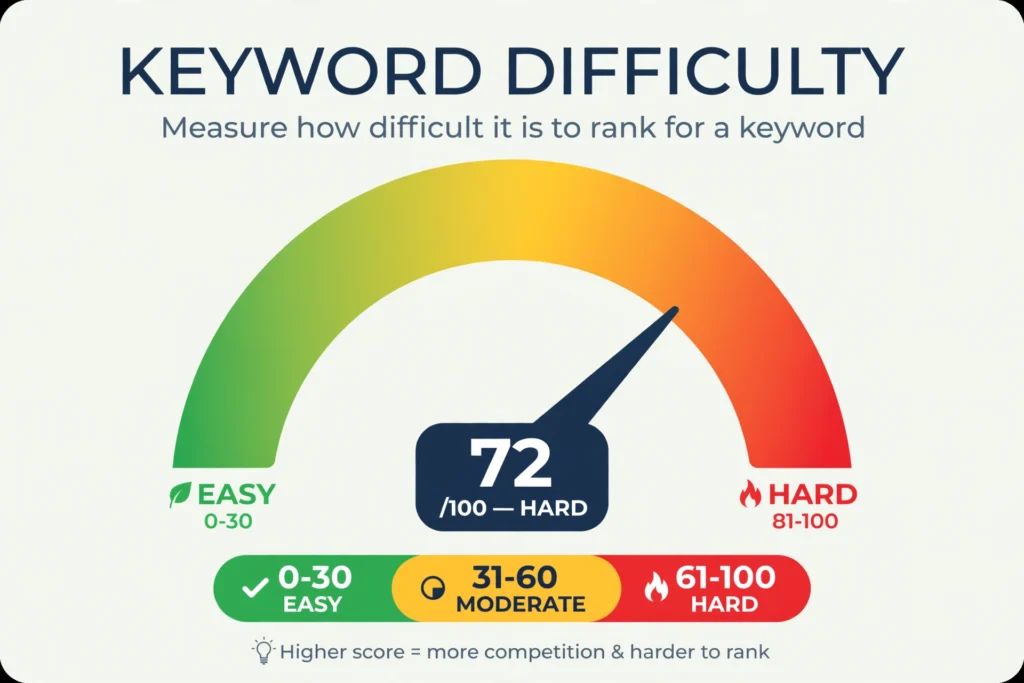
Keyword difficulty is an estimate of how hard it will be to rank for a term, as explained in the Google Search Central SEO Starter Guide. SEO tools show it as a score, usually 0 to 100. Lower means easier.
Here is the catch: every tool calculates difficulty differently. A score of 20 in one tool might be 35 in another. Treat these scores as rough guides, not precise measurements.
For beginners, a simpler approach works better. Ignore the exact number. Instead, look at who actually ranks. If page one is full of Reddit threads, Quora answers, Pinterest pins, and small blogs, the keyword is low competition no matter what any score says. If page one is all major brands and news sites, it is high competition.
What “Low Competition” Looks Like on Page One
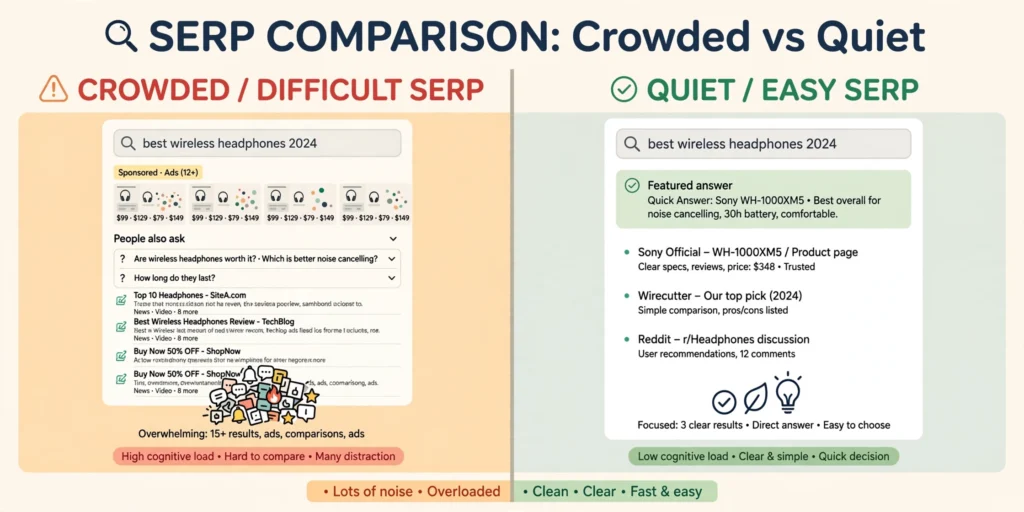
Train your eye to spot weak results. These are signs a keyword is winnable:
- Forum threads or Q&A sites ranking in the top 5
- Articles from 2019 or earlier that nobody updated
- Pages that barely match the search intent
- Small blogs or personal sites with few backlinks
- Big sites ranking with thin, off-topic pages
When you see two or more of these signs, you have found an opportunity.
How to Find Low Competition Keywords: 8 Proven Methods
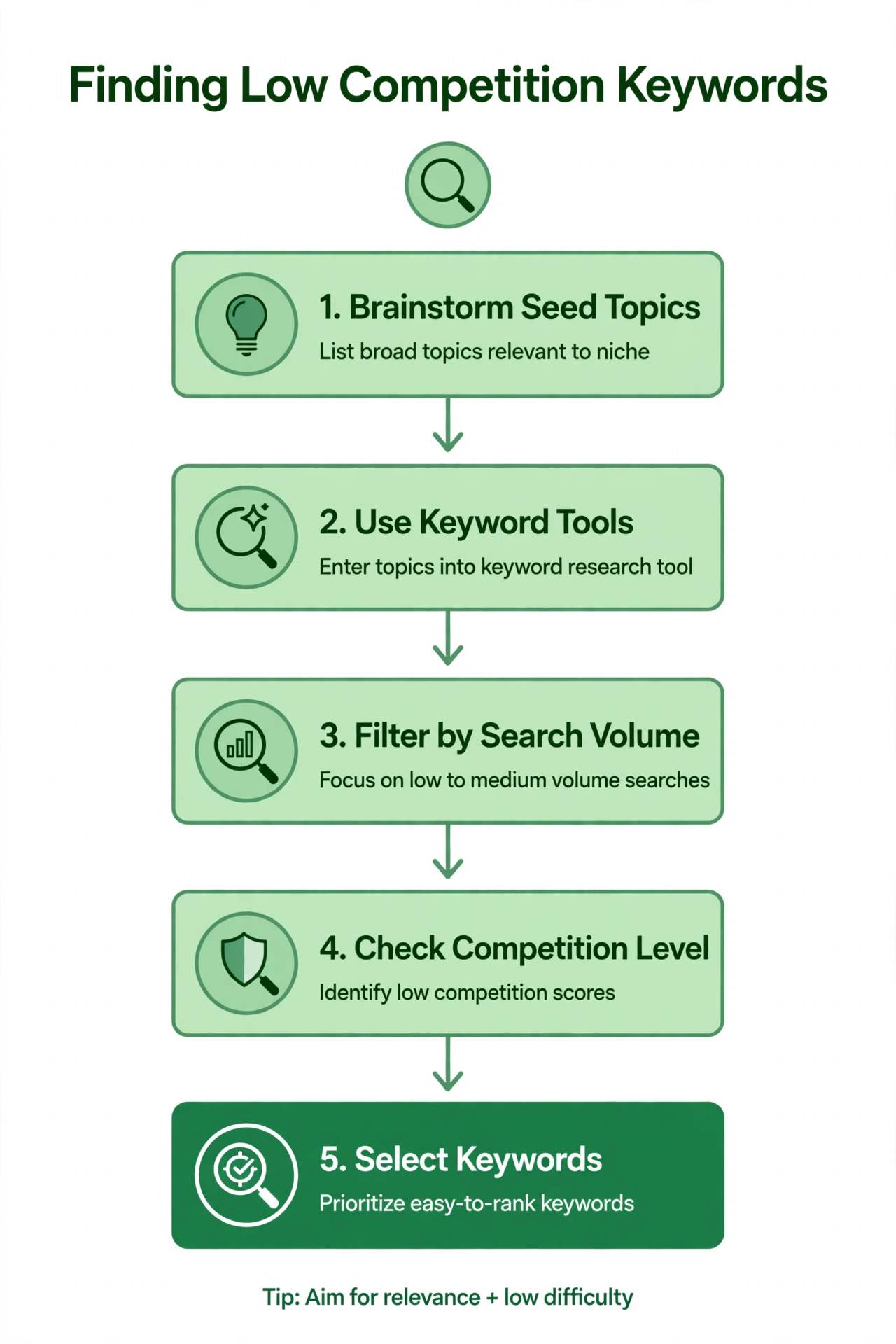
These methods work with free tools. Start with method one and work down. Each builds on the last.
How to Find Low Competition Keywords Without Paid Tools
Every method below uses free resources: Google itself, free tool tiers, and public communities. Paid SEO suites are convenient, but they are not required. Many successful small sites were built entirely on the free techniques you are about to learn.
Set Your Baseline: What “Low Competition” Means for Your Site
Before hunting, be honest about your site’s strength. A brand-new blog should target the easiest keywords: ones where forums and tiny blogs rank. A site with some authority can aim a little higher. Match the competition level to your current strength, then raise the bar as you grow.
Method 1: Mine Google Autocomplete
Type your topic into Google and watch the suggestions. These are real searches people make. Add letters, question words, and modifiers to expand the list.
Try these patterns:
- Your topic + “for beginners”
- Your topic + “vs” (then see what Google suggests)
- “How to” + your topic
- Your topic + “2027”
- Your topic + “near me” (for local businesses)
Each suggestion is a potential keyword. The longer and more specific ones are usually less competitive. Write down every promising suggestion.
Method 2: Steal Ideas From “People Also Ask”
Search your topic and scroll to the “People Also Ask” box. Click questions to expand them. Google keeps adding more. Each question is a keyword with proven demand, since Google only shows questions people actually ask.
These question keywords are often low competition because big sites ignore them. They seem too small. For a beginner, they are perfect: clear intent, easy to answer well, and quick to rank.
Method 3: Check “Related Searches” at the Bottom
Scroll to the bottom of any Google results page. The “Related searches” section lists more real queries. These are often slightly different angles on your topic. Many are less competitive than the main term you searched.
Method 4: Use Free Keyword Tools
Several free keyword research tools show search volume and difficulty estimates. Google Keyword Planner is free with a Google Ads account. It shows volume ranges. Free tiers of tools like Ubersuggest, and the free keyword tools many SEO blogs offer, show difficulty scores and suggestions.
Use them to expand your list and sanity-check demand. But remember: the manual SERP check matters more than any score. A tool might call a keyword “medium difficulty” while page one shows only forums. Trust your eyes.
Method 5: Spy on Smaller Competitors
Find blogs in your niche that are similar in size to yours, or just slightly bigger. Look at which keywords they rank for. If a small site ranks for a term, you probably can too.
You can do this manually: browse their sitemap or blog archive, note their article topics, and check those topics in Google. Or use a free tool’s site overview feature. Either way, competitor topics are a goldmine of proven, winnable keywords.
Method 6: Dig Through Forums and Communities
Reddit, Quora, and niche forums are full of questions nobody has answered well. Search your topic on Reddit and sort by top posts. Look for questions with lots of upvotes but thin answers.
Each popular unanswered question is a low competition keyword waiting for a proper article. The upvotes prove demand. The weak answers prove the opportunity.
Method 7: Target Comparison and Alternative Keywords
Keywords with “vs,” “alternative,” or “best” often have lower competition than head terms. Examples: “notion vs evernote for students,” “mailchimp alternative for small business,” “best budget microphone for podcasting.”
These keywords also carry strong buying intent. People comparing options are close to deciding. They convert well, which makes them valuable beyond their traffic.
Method 8: Combine Modifiers to Create Long-Tail Variations
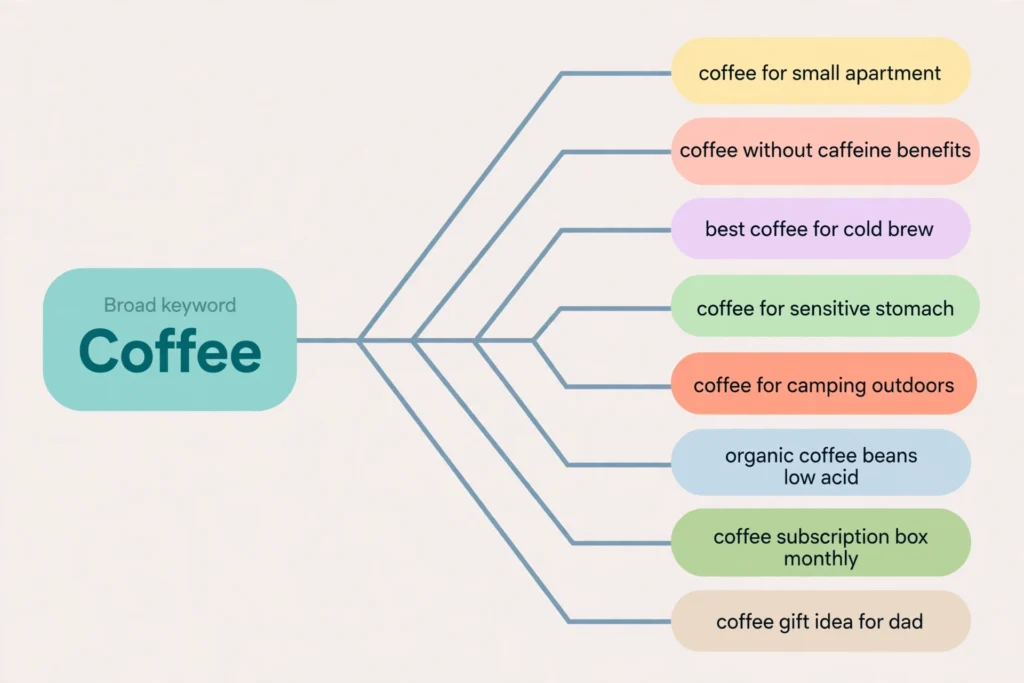
Take a competitive keyword and add modifiers: audience, use case, price, year, or location. “Email marketing” becomes “email marketing for real estate agents.” “Project management software” becomes “free project management software for small teams 2027.”
Each modifier narrows the audience but also slashes the competition. Stack two modifiers and you often land in territory only small sites contest.
How to Check If a Keyword Is Truly Low Competition
Finding candidates is step one. Verifying them is step two. Never target a keyword without this check.
The 5-Minute Manual SERP Check
Search the keyword in an incognito window. Look at the top 10 results and ask:
- Are the ranking domains big brands or small sites?
- How old is the content? Anything over two years without updates is vulnerable.
- Does the content actually answer the query well? Thin or off-topic pages are beatable.
- How many of the results are forums, videos, or social posts rather than dedicated articles?
- Do the top pages have many backlinks, or almost none?
If most answers point to weakness, the keyword is genuinely low competition. This five-minute check beats any automated score.
Match Search Intent Before You Commit
Google ranks pages that satisfy the searcher. If someone searches “how to change a tire,” they want steps, not a tire sales page. Check what type of content ranks: guides, lists, videos, or product pages. Then plan to create the same type, but better.
Targeting a keyword with the wrong content type wastes effort. A brilliant product page will not rank for a query Google answers with tutorials.
Estimate Traffic Value, Not Just Volume
A keyword with 500 monthly searches and strong buying intent can beat one with 5,000 casual searches. Ask: if I rank number one, will these visitors do something valuable? Sign up, buy, or contact me? Prioritize keywords where the answer is yes.
Common Mistakes Beginners Make
- Chasing volume instead of winnability. A keyword with 10,000 searches you cannot rank for is worth less than one with 200 searches you can own. Always check the competition before the volume.
- Trusting difficulty scores blindly. Tool scores are estimates built on formulas. They miss context like weak content or outdated pages. Always do the manual SERP check.
- Ignoring search intent. Ranking requires matching what the searcher wants. A keyword is only an opportunity if you can create the right type of content for it.
- Targeting keywords with zero business value. Traffic that never converts is a vanity metric. Every keyword on your list should connect to something your business offers.
- Going too broad too soon. Beginners often pick keywords their site cannot yet win. Start narrow and specific. Expand to broader terms as your authority grows.
- Skipping the “is anyone searching this” check. Ultra-specific phrases sometimes have no searches at all. Verify demand with a tool or with Google’s own suggestions before investing hours.
- Forgetting about content quality. A low competition keyword still needs a great article to win. Thin content will not outrank even weak competition for long.
Expert Tips for Smarter Keyword Research
- Build a keyword map. Assign every keyword to one page. This prevents two of your pages from competing with each other, a problem called keyword cannibalization.
- Cluster related keywords. Group similar low competition keywords and cover them in one comprehensive article or a tight cluster of linked pages.
- Re-check competition quarterly. SERPs change. A keyword that was easy six months ago might be harder now, and vice versa. Refresh your research regularly.
- Prioritize quick wins first. Target the easiest keywords now for fast traffic, while building content for slightly harder ones in the background.
- Look for question keywords. They are easier to rank for, perfect for FAQ sections, and increasingly surface in AI Overviews and voice search.
- Study the “weak” winners. When a forum outranks everyone, ask why. Usually it is because nobody wrote a proper guide. Write that guide.
- Track your rankings from day one. Use Google Search Console to see which queries bring impressions. Those are free keyword ideas from real searchers.
What Changed in Keyword Research for 2027
AI Overviews changed which keywords matter. Simple factual queries now get answered directly in search results, sending fewer clicks. This makes in-depth, experience-based keywords more valuable. Target topics where your real knowledge beats a quick AI summary.
Search is also more conversational. People ask longer, natural questions, especially by voice. These long-tail queries are naturally lower competition. Write content that answers full questions in plain language.
Finally, freshness matters more in fast-moving niches. Keywords with “2027” or current-year modifiers often have weak competition because old articles dominate. A current, well-maintained guide can displace them.
Keep building your keyword skills with more beginner SEO guides on SearchEngineInsight.
Frequently Asked Questions
What is a low competition keyword?
A low competition keyword is a search term with real search demand but weak current competition. The pages ranking for it are beatable: small blogs, forums, outdated articles, or thin content. Targeting these keywords lets new or small sites rank on Google without fighting major brands.
How do I know if a keyword has low competition?
Search it in Google and examine the top 10 results. If you see forums, Q&A sites, old un-updated articles, or small blogs, competition is low. If page one is full of major brands and news sites with strong content, competition is high. This manual check matters more than any tool’s difficulty score.
What is a good keyword difficulty score for beginners?
As a rough guide, beginners should start with the lowest difficulty bands their tool offers, often labeled 0-20 or “easy.” But treat scores as hints, not rules. A keyword scored “medium” can still be winnable if the actual ranking pages are weak. Always verify with a manual look at the results.
Can I find low competition keywords for free?
Yes. Google Autocomplete, People Also Ask, Related Searches, Google Keyword Planner, and free tiers of SEO tools all work. Forums like Reddit reveal real questions with proven demand. The manual SERP check, which is the most important step, costs nothing at all.
How many low competition keywords should I target?
Start with 20 to 30 solid keywords mapped to planned articles. That is enough for months of publishing without overwhelm. Quality of research beats quantity. Ten well-verified keywords will outperform a hundred guesses every time.
Do low competition keywords bring enough traffic?
Individually, each brings modest traffic. Together, they add up. Twenty articles each bringing 100 monthly visitors equals 2,000 monthly visitors. That compounding effect is how small sites grow. Many low competition keywords also convert better because they are highly specific.
What is the difference between low competition and long-tail keywords?
They overlap but are not identical. Long-tail refers to length and specificity: longer, detailed phrases. Low competition refers to how hard a keyword is to rank for. Most long-tail keywords are low competition, but some short keywords can be low competition too, especially in small niches.
Should new websites only target low competition keywords?
Mostly, yes, at first. New sites lack the authority to win competitive terms. Targeting winnable keywords builds traffic, links, and trust. As your site grows stronger, gradually mix in medium-competition keywords. Think of it as leveling up over time.
How often should I do keyword research?
Do a solid research session quarterly, and quick checks whenever you plan new content. Search landscapes shift as competitors publish and Google updates results. A keyword that was easy last quarter might be contested now, while new gaps open up constantly.
Can low competition keywords work for local businesses?
Absolutely. Local modifiers create natural low competition keywords: “emergency plumber in [town]” or “best vegan bakery near [neighborhood].” Few businesses optimize for these specific phrases, so a complete Google Business Profile plus a dedicated page can win them quickly.
What tools show keyword competition for free?
Google Keyword Planner shows volume ranges for free. Ubersuggest’s free tier shows difficulty estimates and suggestions. Many SEO blogs offer free keyword tools with limited daily searches. Pair any of these with the manual SERP check for the most reliable read on competition.
Is it better to target one keyword per page?
Target one primary keyword per page, but naturally include close variations and related questions. This keeps your content focused and avoids cannibalization, where two of your pages compete for the same term. Use a keyword map to assign each term to exactly one page.
Conclusion: How to Find Low Competition Keywords
Now you know how to find low competition keywords the right way. Start with Google’s own suggestions, expand with free tools, spy on smaller competitors, and mine forums for real questions. Then verify every candidate with a manual look at the search results before you commit.
Remember the golden rule: winnability beats volume. A keyword you can rank for is infinitely more valuable than a popular one you cannot. Build your list, map each keyword to one page, and publish consistently. Those small, steady wins are how new sites grow into authoritative ones.