
Best AI Tools for SEO 2027: 12 Top Picks Compared
The best AI tools for SEO 2027 can save you hours every week — if you pick the right ones. AI can draft outlines, suggest keywords, speed up content briefs, and help you optimize pages faster. But not every tool is worth your money, and some are mostly hype.
In this guide, I compare 12 of the best-known AI tools for SEO work. You will see what each one does well, where it falls short, and who it suits best. By the end, you will know exactly which tools deserve a spot in your workflow and which ones you can skip.
What to Look for in an AI SEO Tool
Before you compare names, decide what job you need done. AI SEO tools fall into a few clear groups. Writers help you draft and improve content. Optimizers analyze top-ranking pages and suggest improvements. Research tools help with keywords and topic ideas. A few tools try to do all three.
The right pick depends on your biggest bottleneck. If writing takes forever, start with a writing assistant. If your content never ranks, look at an optimizer. Do not buy an all-in-one platform when a focused tool would do.
Match the Tool to the Job
List the SEO tasks that eat most of your time. Common ones include keyword research, content outlines, first drafts, on-page optimization, meta descriptions, and internal linking ideas. Then match each task to a tool category.
Many beginners buy a tool first and look for a use case later. That is backwards. Write down your top three time drains. Pick tools that solve those specific problems. Everything else is a nice extra.
Check Output Quality, Not the Hype
Every AI tool claims to be fast and smart. What matters is the quality of the output on your topics. Test each tool with a real task from your own site before you commit.
Try the free plan or trial first. Ask it to outline an article on a topic you know well. You will spot made-up facts and shallow advice quickly when you know the subject. If the output needs heavy fixing, the tool is not saving you time.
Think About Your Budget and Team Size
Solo bloggers and small teams should start free or cheap. ChatGPT, Claude, and Gemini all offer free tiers that handle most basic SEO tasks. Paid optimizers make sense when you publish often enough to justify the cost.
Also consider seats and limits. Some tools charge per user or per article. A tool that looks affordable for one person can get expensive for a team of five. Check current pricing and usage limits before you decide.
The 12 Best AI Tools for SEO 2027
Here are my picks, grouped by what they do best. I have used or tested each category extensively. Pricing changes often, so treat any pricing notes as a starting point and check current pricing on the tool’s site.
1. ChatGPT
ChatGPT is the most flexible AI assistant for SEO tasks. You can use it for keyword brainstorming, content outlines, title ideas, meta descriptions, FAQ drafts, and rewriting dull paragraphs. It works well when you give clear, specific prompts.
- Best for: Freelancers and small teams who want one flexible assistant.
- Pros: Very versatile; free tier available; huge community sharing SEO prompts.
- Cons: Can invent facts with total confidence; no built-in SEO data; output needs human review.
- Pricing: Free tier available; paid plans exist — check current pricing.
2. Claude
Claude is known for careful, natural-sounding writing. Many SEOs prefer it for long-form drafts and editing because the tone feels less robotic. It is also good at following detailed instructions in your prompts.
- Best for: Writers who want higher-quality first drafts with less editing.
- Pros: Strong writing quality; handles long documents well; good at following style rules.
- Cons: Can still make factual errors; no live SEO metrics built in.
- Pricing: Free tier available; paid plans exist — check current pricing.
3. Google Gemini
Gemini is Google’s AI assistant, and it connects with Google’s ecosystem. It is handy for quick research, summarizing articles, and brainstorming content angles. Some versions can access current web information, which helps with fresh topics.
- Best for: Quick research and ideation inside the Google workspace you already use.
- Pros: Free tier available; useful for research summaries; integrates with Google apps.
- Cons: Output quality varies by task; not built specifically for SEO workflows.
- Pricing: Free tier available; paid plans exist — check current pricing.
4. Surfer SEO
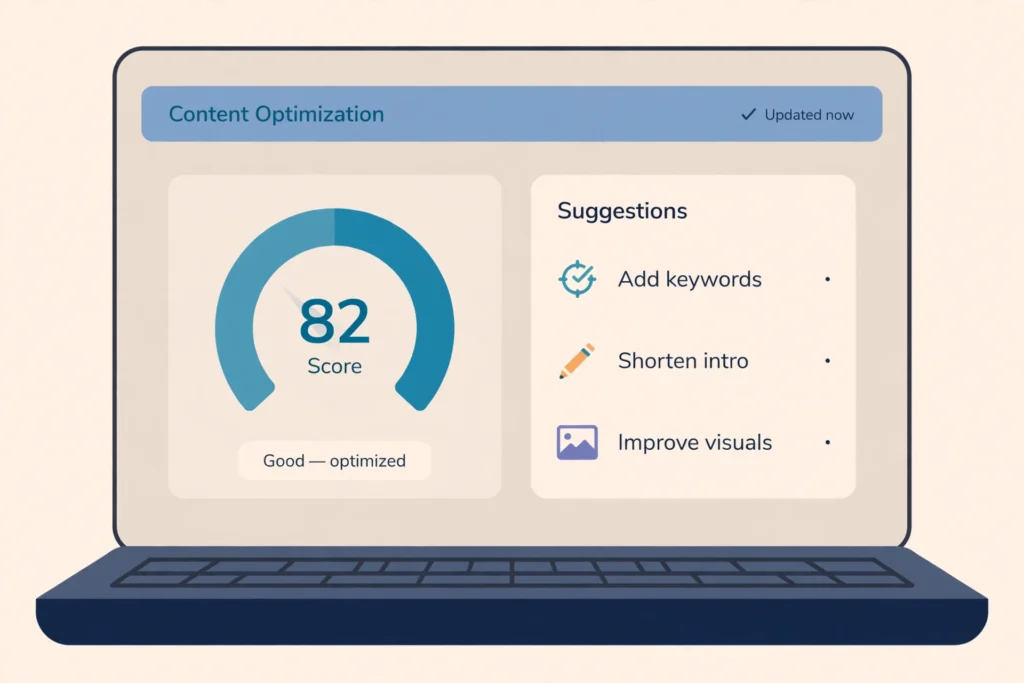
Surfer SEO is a content optimizer. You enter your target keyword, and it analyzes top-ranking pages to suggest word count, headings, and terms to include. It is one of the best-known tools in this category.
- Best for: Bloggers and agencies that want data-backed on-page optimization.
- Pros: Clear optimization suggestions; useful content editor; integrates with common writing tools.
- Cons: Paid only; suggestions are a starting point, not a guarantee of rankings.
- Pricing: Paid plans — check current pricing.
5. Frase
Frase combines AI writing with SERP analysis. It pulls questions, headings, and topics from top-ranking pages so you can build thorough content briefs. Many teams use it to plan articles before writing a word.
- Best for: Teams that want research and briefs in one place.
- Pros: Strong brief builder; question research from real search data; AI writing included.
- Cons: Paid only; briefs still need a human editor’s judgment.
- Pricing: Paid plans — check current pricing.
6. Clearscope
Clearscope focuses on content relevance. It grades your draft against top-ranking pages and highlights terms and topics you may have missed. Writers like it because the interface is simple and the guidance is clear.
- Best for: Writers who want straightforward optimization feedback.
- Pros: Easy to use; clear term suggestions; good for writer workflows.
- Cons: Paid only and priced for teams; limited to on-page optimization.
- Pricing: Paid plans — check current pricing.
7. NeuronWriter
NeuronWriter is a budget-friendly content optimizer. It offers SERP analysis, content scoring, and AI writing features at a lower price point than the big names. It is popular with bloggers who want optimizer features without the premium cost.
- Best for: Bloggers who want optimization guidance on a tight budget.
- Pros: Affordable compared to premium optimizers; includes AI writing; supports many languages.
- Cons: Interface feels less polished; suggestions still need human judgment.
- Pricing: Paid plans — check current pricing.
8. Jasper
Jasper is an AI writing platform built for marketing teams. It offers templates for blog posts, ads, and product descriptions, plus brand voice features that keep output consistent. Teams use it to scale content production.
- Best for: Marketing teams producing lots of content with a consistent voice.
- Pros: Many templates; brand voice controls; collaboration features.
- Cons: Paid only; output still needs editing and fact-checking.
- Pricing: Paid plans — check current pricing.
9. Semrush ContentShake AI
ContentShake AI is Semrush’s AI writing tool. It combines AI drafting with Semrush’s keyword and SEO data. If you already use Semrush, it fits naturally into your workflow for ideas and drafts.
- Best for: Existing Semrush users who want AI drafting with real SEO data.
- Pros: Built on real keyword data; idea generation; WordPress publishing integration.
- Cons: Tied to the Semrush ecosystem; drafts need human editing.
- Pricing: Paid plans — check current pricing.
10. Ahrefs AI Features
Ahrefs has added AI features across its toolkit, including AI-generated content briefs, writing assistance, and search intent analysis. The strength here is the underlying data — Ahrefs is known for deep backlink and keyword databases.
- Best for: SEOs who already rely on Ahrefs data and want AI layered on top.
- Pros: Strong data foundation; AI briefs and overviews; trusted by many professionals.
- Cons: Full platform is paid and premium-priced; AI features support the workflow rather than replace writers.
- Pricing: Paid plans — check current pricing.
11. Perplexity
Perplexity is an AI answer engine that cites its sources. For SEO, it is useful for fast research: you get answers with links you can verify. Many SEOs use it to check facts and find source material quickly.
- Best for: Research and fact-checking with cited sources.
- Pros: Answers include sources; fast research; free tier available.
- Cons: It is a research tool, not a writing or optimization platform.
- Pricing: Free tier available; paid plans exist — check current pricing.
12. KoalaWriter
KoalaWriter is an AI writer focused on one-click SEO articles. You enter a keyword, and it produces a full draft with headings and FAQ sections. Bloggers who publish at high volume like the speed.
- Best for: Affiliate and niche bloggers who need fast first drafts.
- Pros: Very fast drafting; SEO-focused output structure; simple to use.
- Cons: Drafts need real editing and fact-checking; one-click content can feel generic.
- Pricing: Paid plans — check current pricing.
Quick Comparison Table
| Tool | Main Job | Free Option | Best For |
|---|---|---|---|
| ChatGPT | Writing, brainstorming | Yes | Flexible all-round assistant |
| Claude | Writing, editing | Yes | Higher-quality drafts |
| Gemini | Research, ideation | Yes | Google ecosystem users |
| Surfer SEO | On-page optimization | No | Data-backed optimizers |
| Frase | Briefs + writing | No | Content planning teams |
| Clearscope | Content relevance | No | Simple writer feedback |
| NeuronWriter | Optimization on budget | No | Cost-conscious bloggers |
| Jasper | Marketing writing | No | Teams scaling content |
| ContentShake AI | AI writing + SEO data | No | Semrush users |
| Ahrefs AI | Data + AI briefs | No | Data-driven SEOs |
| Perplexity | Cited research | Yes | Fast fact-checking |
| KoalaWriter | Fast article drafts | No | High-volume publishers |
Free-option notes reflect widely known free tiers; always verify on the tool’s site, since plans change.
How to Choose the Right Tool
Start with your workflow, not the feature list. A solo blogger publishing two posts a month needs something very different from an agency publishing fifty. Write down how many articles you produce, who writes them, and where the process slows down.
Test before you pay. Run the same real task through two or three tools and compare the outputs side by side. The best tool is the one whose output needs the least fixing on your topics.
Use the Best AI Tools for SEO 2027 as Assistants, Not Authors
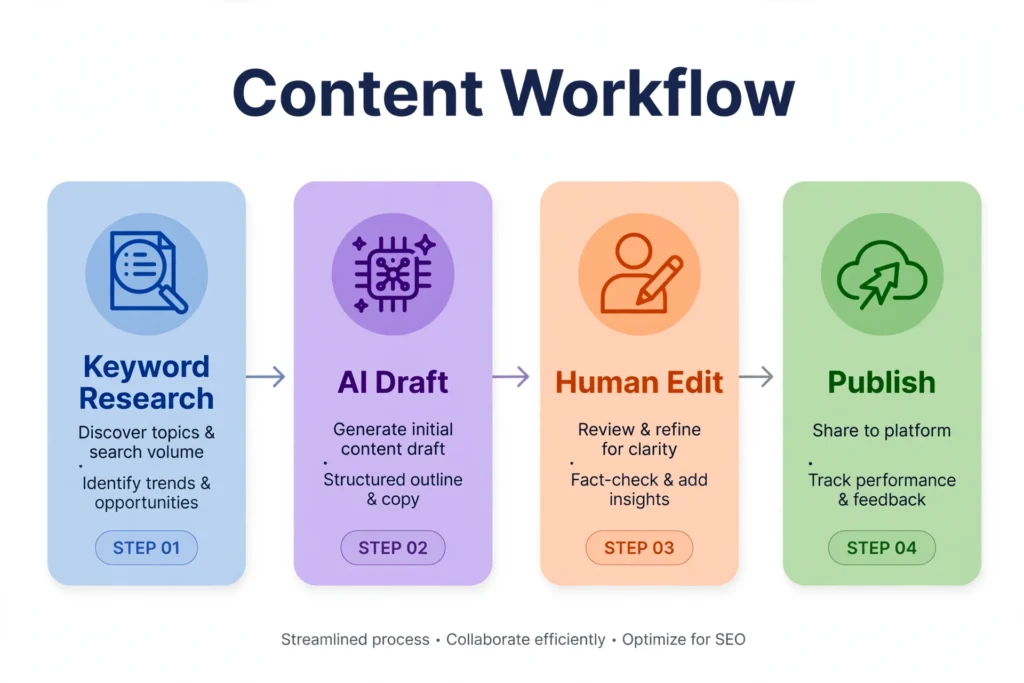
The best AI tools for SEO 2027 work best as helpers. Let AI handle outlines, first drafts, and boring tasks like meta descriptions. Keep humans in charge of facts, strategy, and final quality.
Google rewards helpful, original content. AI can help you produce it faster, but it cannot replace your experience and judgment. Publish only what you would proudly sign your name to.
Start Free, Upgrade When It Pays
Begin with free tiers of ChatGPT, Claude, Gemini, or Perplexity. They cover most beginner needs. Upgrade to a paid optimizer like Surfer, Frase, or NeuronWriter when you publish often enough that the time savings clearly outweigh the cost.
A simple rule: if a tool does not save you at least a few hours a month, it is not worth paying for yet.

Best Practices: Using AI Without Hurting Rankings
Google’s guidance on AI-generated content is clear: it rewards helpful content no matter how it is produced, and it penalizes low-quality spam no matter the source. AI content is fine when it is genuinely useful. Mass-produced filler is not.
As Google’s AI features change how results are shown, understanding AI Mode SEO helps you adapt your content for AI-driven search.
Always fact-check AI output. AI models confidently invent statistics, quotes, and even URLs. Verify every claim against a real source before publishing. One false stat can destroy reader trust.
Add your own experience. AI writes generic advice well, but it cannot share your real results, photos, or case studies. Original experience is what separates content that ranks from content that blends in.
Edit for humans first. Read every AI draft out loud. Cut repetition, fix awkward phrasing, and make sure it answers the reader’s question fast. A light human edit turns a decent draft into a good article.

Common Mistakes to Avoid
- Publishing AI drafts without editing. Raw AI output is easy to spot and rarely good enough. Always edit.
- Trusting AI facts blindly. Verify statistics, dates, and claims. AI invents things confidently.
- Chasing every new tool. Pick two or three tools and master them. Tool-hopping wastes time.
- Ignoring search intent. AI can write about anything, but it will not tell you what searchers actually want. Check the SERP yourself.
- Skipping the human touch. Add examples, opinions, and real experience. That is what readers and Google value.
- Over-optimizing with AI suggestions. Stuffing every suggested term into your article hurts readability. Use suggestions as guidance, not orders.
Want to compare more AI tools for SEO? See more AI and SEO guides on SearchEngineInsight.
Frequently Asked Questions
What are the best AI tools for SEO in 2027?
The best AI tools for SEO in 2027 include ChatGPT and Claude for writing, Surfer SEO and Frase for on-page optimization, and Perplexity for research. The right pick depends on your task. Start with a free writing assistant, then add a paid optimizer when you publish often enough to justify it.
Can AI tools replace an SEO expert?
No. AI tools speed up tasks like drafting and research, but they cannot replace strategy, judgment, or experience. They make mistakes, invent facts, and miss nuance. The best results come from pairing AI speed with human expertise and final review.
Is AI-generated content bad for SEO?
Not automatically. Google rewards helpful, original content regardless of how it is made. Problems arise when people publish unedited, low-quality AI text at scale. If you edit carefully, add real experience, and verify facts, AI-assisted content can rank fine.
Which AI SEO tool is best for beginners?
ChatGPT or Claude on a free plan is the best starting point for beginners. They handle outlines, title ideas, meta descriptions, and rewrites with no cost. Learn the basics with a free assistant before spending money on specialized optimizers.
Are free AI SEO tools good enough?
For many beginners, yes. Free tiers of ChatGPT, Claude, Gemini, and Perplexity cover brainstorming, drafting, and research. Paid tools add SEO-specific data and optimization scoring. Upgrade when your publishing volume makes the time savings worthwhile.
How much do AI SEO tools cost?
Pricing varies widely and changes often, so always check current pricing on each tool’s website. General assistants like ChatGPT and Claude offer free tiers with paid upgrades. Specialized optimizers like Surfer, Frase, and Clearscope are paid platforms with monthly plans.
Can AI tools do keyword research?
AI assistants can brainstorm keyword and topic ideas, but they do not have live search volume or competition data. For real keyword data, use a dedicated SEO platform or Google Keyword Planner. Treat AI keyword ideas as a starting list to validate with real data.
Do I still need to edit AI-written content?
Yes, always. AI drafts often contain factual errors, repetition, and generic phrasing. Read every draft, verify claims, add your own examples, and tighten the writing. Editing is what turns AI output into content worth ranking.
Which is better for SEO: Surfer SEO or Frase?
Both are strong optimizers with different strengths. Surfer SEO is known for its content editor and optimization scoring. Frase excels at research briefs built from SERP data. Try both on a real article and pick the one whose workflow fits your team better.
Can AI help with technical SEO?
AI assistants can explain technical concepts, help you write schema markup, and suggest fixes for common issues. But they cannot crawl your site or verify fixes. Use AI for learning and drafting, and use real tools like Google Search Console for diagnosis.
Conclusion: Best AI Tools for SEO 2027
The best AI tools for SEO 2027 are the ones that fit your workflow and save you real time. Start free with ChatGPT, Claude, or Gemini for writing and research. Add a specialized optimizer like Surfer, Frase, or NeuronWriter when your publishing volume justifies it. Test tools on real tasks, keep humans in charge of quality, and never publish unedited AI drafts. Used wisely, AI is a powerful assistant — not a replacement for your expertise.