Check Instagram Creator Engagement Before Your Collaboration
A creator with 50,000 followers can look like an obvious partner until you open the last ten posts. One Reel did well; the rest received little response. Another creator with 8,000 followers may have a smaller audience but consistently gets questions from people who might actually buy your product. Which one deserves your budget?
The answer starts with a repeatable review of public activity, followed by a request for the creator’s own Instagram Insights. Here is a practical way to do both before you sign an agreement.
Start with a comparable sample of recent posts
Review the latest 10 to 12 posts, ideally from the past 30 to 60 days. Record the format, date, topic, likes and comments for each one. Separate Reels from photos and carousels if the proposed campaign relies on a particular format. A creator who excels at short videos may be less persuasive in a static product post.
Exclude or label giveaways, major announcements and unusually viral posts. They may be genuine, but they can distort your estimate of a typical sponsored post. Note whether recent sponsored content performs differently from ordinary posts; that comparison is often more useful than the profile’s all-time best result.
Calculate the rate, then inspect the pattern
For a quick public comparison, use this follower-based formula:
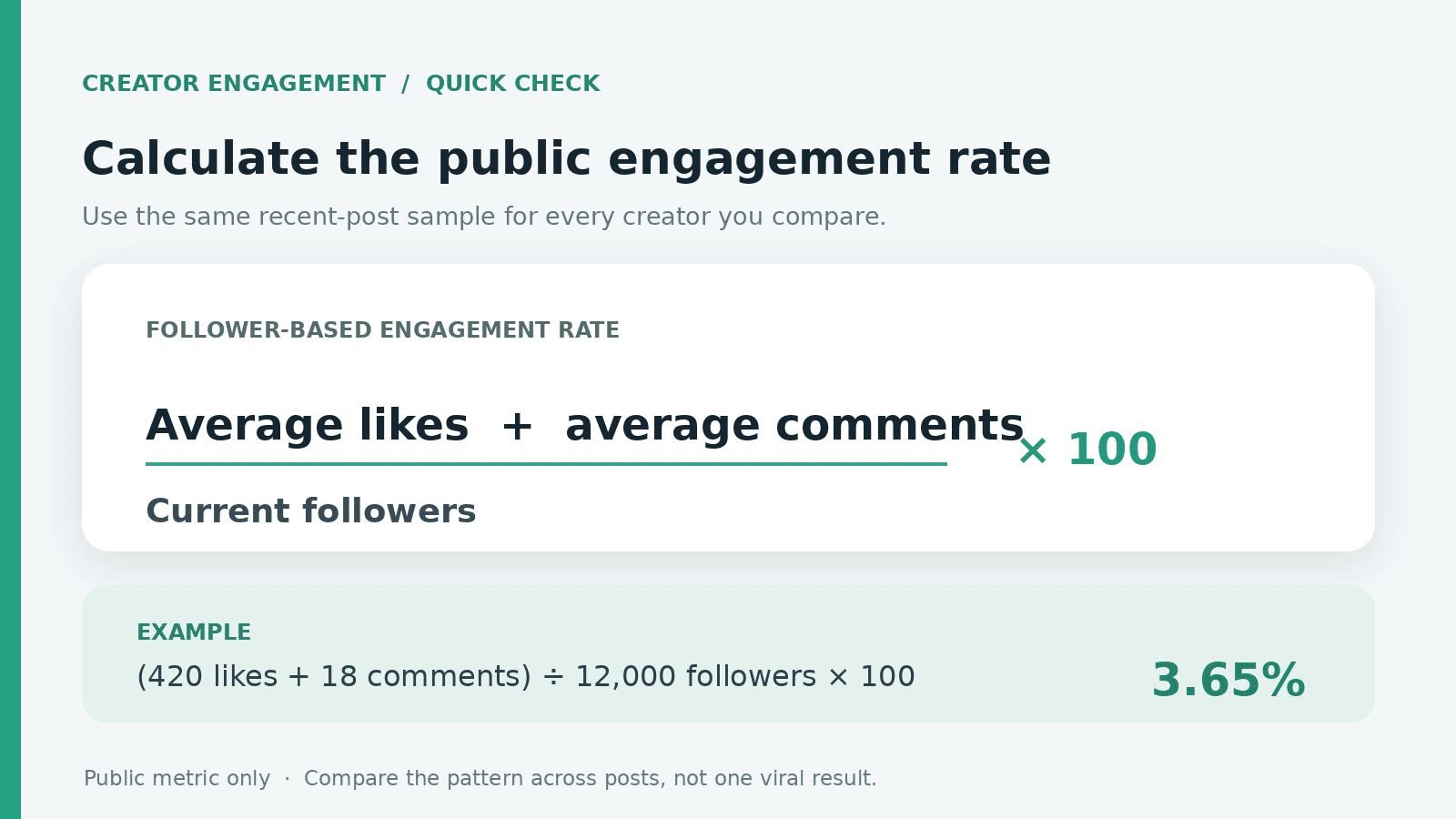
Engagement rate = (average likes + average comments per post) ÷ current followers × 100
Suppose 10 recent posts average 420 likes and 18 comments, and the creator has 12,000 followers. The calculation is (420 + 18) ÷ 12,000 × 100, or 3.65%. Use the same sample size and formula when comparing candidates. Otherwise, two percentages may describe different things.
Do not treat 3.65% as proof that 3.65% of followers saw or engaged with the content. Instagram can show posts to non-followers, and many followers may never see a particular post. There is also no universal “good” engagement rate across every audience size, niche and content format.
Next, compare the average with the middle post in your sample. If nine posts receive around 200 likes and one receives 5,000, the average alone gives an optimistic picture. Look for a consistent range of results and note meaningful spikes or drops.
To collect public numbers more quickly, a tool such as LikeWave’s Instagram Likes Viewer can show recent likes activity, comments-based engagement and posting patterns for a public profile. Its report reflects publicly visible likes, including free Instagram likes that may have come from organic reach, giveaways or other methods. The count cannot tell you how individual likes were obtained, so treat the report as a starting point for your own review, not as a substitute for the creator’s private performance data.
Read the comments in context
The comment count is only a first clue. Open several posts and ask whether people are discussing the subject, asking specific questions, sharing their experience or receiving thoughtful replies from the creator. For a skincare partnership, questions about ingredients or skin types may tell you more than a long string of generic compliments.
Repetitive comments are a reason to investigate, not enough evidence to accuse someone of buying engagement. Giveaways, viral trends and international audiences can all change the shape of a comment section. Check multiple posts before drawing a conclusion.
Also examine the creator’s relationship with their audience. Do followers return across posts? Does the creator answer useful questions? Do promotional posts prompt conversation, or does the audience ignore them? These observations help you judge whether a brand message will feel natural on the account.
Check fit before you chase a percentage
Engagement is valuable only if the audience matches your campaign. A local restaurant needs nearby people; a specialist software company needs an audience with a relevant professional interest. Review the creator’s topics, language, location cues, past partnerships and tone. A high rate on unrelated entertainment content says little about likely demand for your offer.
Look closely at past sponsored posts. Did the creator explain why the product mattered to their audience, or merely paste a sales caption? Could your brand be presented credibly in the same voice? If the proposed deliverable is a Reel, prioritize evidence from the creator’s Reels rather than assuming that success with carousels will transfer.
Ask for first-party Insights before committing
Public research cannot reveal the full picture. Ask shortlisted creators to share recent Instagram Insights for comparable posts and Stories, with the date range visible. Request accounts reached, views where relevant, shares, saves and audience locations, along with results from previous paid collaborations when available.
Ask for the numbers that match your goal. For awareness, examine reach and relevant audience share. For an educational product, saves and shares may be informative. For sales, request tracked clicks, code uses or past conversion data if the creator has them. A screenshot is helpful, but discuss how each metric was measured and whether paid promotion affected the result.
If the partnership is large, consider a small paid test first. Give the creator a clear brief and a trackable link or unique code, then evaluate the actual outcome against the agreed goal. That gives you evidence from your own campaign rather than relying entirely on a profile audit.
Make the decision with a simple shortlist
For each candidate, record four things: typical results on comparable posts, quality of audience conversation, fit with your target market and the first-party data they provided. Note any unanswered questions beside the numbers. This keeps a flashy follower count from making the decision for you.
The best collaborator is not automatically the person with the highest public engagement rate. Choose the creator whose content, audience and verified results give your campaign the strongest chance of reaching the right people.