
Content Strategies That Drive Sustainable Traffic (Not Just Higher SEO Metrics)
A few days ago, I was reviewing an Ahrefs report for a website that looked healthy at first glance.
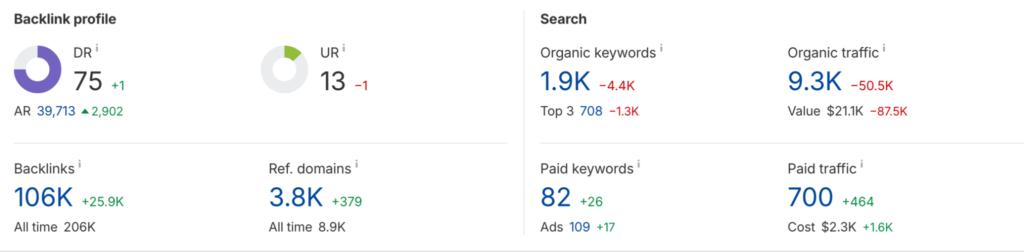
Here’s what the dashboard showed:
- Domain Rating increased from 74 to 75
- 25,900 new backlinks
- 379 new referring domains
If this report landed in most marketing meetings, everyone would probably call it a successful quarter.
Then I looked at the numbers that actually matter.
- Organic keywords dropped from over 6,000 to 1,900
- Organic traffic declined from nearly 60,000 monthly visits to just 9,300
Thousands of new backlinks. Higher Domain Rating. And almost 85% of the organic traffic disappeared.
That dashboard reminded me of something I’ve learned after years working in SEO.
Good metrics don’t always mean good SEO.
Sustainable organic traffic comes from publishing content that remains useful long after it’s indexed. That’s exactly what I’ve seen while working with SaaS companies, improving content performance, and recovering websites that had become overly dependent on vanity metrics.
Here are the strategies that actually build long-term organic growth.
1. Stop Optimizing for SEO Reports
One of the biggest mistakes I see is measuring success using SEO tool metrics instead of business metrics.
Every monthly report celebrates things like:
- Domain Rating
- URL Rating
- Referring domains
- Total backlinks
These metrics are useful for competitive analysis. They’re not proof that your SEO strategy is working.
Instead, I prefer tracking:
- Organic clicks
- Ranking keywords
- Top 3 keyword growth
- Non-branded traffic
- Conversion pages
- Leads generated through organic search
If your traffic continues growing while your DR stays the same, that’s still a win.
If your DR increases while traffic disappears, something in your content strategy is broken.
2. Every Article Should Solve a Business Problem
Keyword research tells you what people search. It doesn’t tell you what your business needs.
Before opening Ahrefs or Semrush, ask: Why are we creating this article?
The answer should relate to one of these:
- Generate qualified leads
- Build authority
- Support product pages
- Educate customers
- Reduce objections
- Improve conversions
When content has a business purpose, keyword targeting becomes much easier.
3. Build Topic Clusters Instead of Publishing Random Articles
Publishing isolated articles creates isolated rankings.
Publishing connected articles creates topical authority.
For example, if your website focuses on SaaS video marketing, your content ecosystem might include:
- SaaS video marketing
- Explainer videos
- Product demo videos
- Product launch videos
- Video marketing ROI
- Video production pricing
- Video production statistics
Instead of competing against each other, these pages support one another through internal linking and topical relevance.
Over time, Google begins recognizing your website as a reliable source within that subject area.
4. Match Search Intent Before You Think About Keywords
I’ve audited hundreds of pages that were technically optimized but still couldn’t rank.
The reason was simple.
They answered a different question than the user was asking.
Search intent should always come first.
Ask yourself:
- Does the user want examples?
- Are they looking for comparisons?
- Do they need a step-by-step guide?
- Are they researching before making a purchase?
A perfectly optimized article with the wrong intent rarely performs well.
5. Original Research Outperforms Generic Content
AI has made publishing content easier. It has also made average content much more common.
If your article simply repeats what’s already available on ten other websites, there’s little reason for Google – or users – to prefer it.
That’s why I encourage every brand to publish something unique.
Examples include:
- Customer insights
- Surveys
- Internal data
- Industry analysis
- Case studies
- Proprietary frameworks
A good example is, SaaS Video Production Statistics report by What a Story, where we analyzed hundreds of SaaS videos instead of compiling numbers already available online. That kind of original research naturally earns citations, backlinks, and long-term visibility because it contributes something new to the conversation.
6. Update Existing Content Before Writing New Content
One lesson that consistently produces results is this: Updating an existing article often delivers better ROI than publishing a new one.
Search changes, Competitors improve, Statistics become outdated and User expectations evolve.
Refreshing an article by improving examples, adding new insights, expanding sections, and updating internal links frequently restores rankings much faster than starting from scratch.
Content should be treated as an asset – not a one-time project.
7. Internal Linking Is One of the Most Underrated SEO Strategies
Internal links do much more than help users navigate.
They help search engines understand:
- Which pages are most important
- How topics relate to one another
- Which content supports a broader subject
Every new article should strengthen your existing content, not exist independently.
When done properly, internal linking distributes authority across your website while improving user engagement.
8. Write From Experience, Not Just Research
The biggest difference between average content and valuable content is experience. Anyone can summarize information but fewer people can explain.
- what actually worked,
- what failed,
- what changed over time,
- and why.
Google’s continued focus on Experience, Expertise, Authoritativeness, and Trust (E-E-A-T) reinforces this idea.
If you’ve managed campaigns, audited websites, worked with clients, or tested strategies yourself, include those observations.
Those details make your content difficult to replicate.
9. Measure What Matters
Traffic alone doesn’t define success. Neither do impressions or Domain Rating. The real question is whether your content contributes to business growth.
Instead of focusing only on pageviews, measure outcomes such as organic conversions, assisted conversions, demo requests, newsletter sign-ups, returning visitors, scroll depth, and engagement time.
These metrics provide a much clearer picture of whether your content is attracting the right audience and moving them toward meaningful actions.
Final Thoughts
The Ahrefs report I mentioned at the beginning is a good reminder that SEO isn’t won by collecting stronger metrics.
You can gain thousands of backlinks, increase your domain rating, and acquire hundreds of new referring domains.
And still lose most of your organic traffic.
The websites that continue growing year after year usually focus on something much simpler.
They publish content that solves real problems, organize it around clear topical clusters, refresh it as search evolves, and share insights that only experience can provide.
Algorithms will continue to change. Search behavior will evolve. New AI features will reshape how people discover information.
But one principle has remained consistent throughout my years in SEO:
Sustainable traffic doesn’t come from chasing metrics. It comes from creating content people continue to find useful long after it’s published.