Google Algorithm Update History 2027: A Beginner’s Guide
The Google Algorithm Update History 2027 is the story of how Google learned to judge websites more fairly. Every few months, Google changes the rules behind its search results. These changes are called algorithm updates. Some updates are small. Others shake up the rankings for millions of sites.
This guide walks you through the whole story in plain English. You will learn what an algorithm update actually is, how updates work, and why knowing the history helps you protect your own site. You will meet the famous updates, Panda, Penguin, and the helpful content update, and see what each one taught site owners. No jargon. No hype. Just the lessons that matter in 2027.
What Is a Google Algorithm Update? A Simple Definition
A Google algorithm update is a change to the system Google uses to rank web pages. Think of Google’s search as a giant recipe. The algorithm is the recipe. It mixes hundreds of ingredients, content quality, links, page speed, mobile-friendliness, to decide which pages show first.
When Google updates the recipe, the rankings shift. Pages that match the new rules rise. Pages that break the new rules fall. That is the whole idea in one sentence.
The Algorithm in Plain English
Imagine a teacher grading essays. At first, she grades only on length. Students notice and write long, empty essays. Then she changes her grading. Now she rewards clear ideas and original thinking. The students who wrote real essays rise. The students who gamed the system fall.
That is exactly what Google does. Its algorithm is the grading system. Updates are the moments Google improves the grading. Each update rewards better websites and punishes trickery.
Why Google Updates the Algorithm at All
Google’s job is to show the best answer first. That is how it keeps users coming back. If spammy sites ranked first, people would stop trusting Google. So Google keeps improving its system.
The web also changes. New tricks appear. New devices appear. Google must adapt. Every update is Google’s way of keeping search useful as the internet grows.
How Google Algorithm Updates Work
This is how Google algorithm works in simple terms. Google does not rank pages by hand. It uses automated systems. These systems look at signals. A signal is any clue about a page’s quality or relevance. Examples include the words on the page, links pointing to it, and how fast it loads.
An update changes how Google weighs those signals. Sometimes it adds a new signal. Sometimes it gets better at spotting a trick. The result is the same: the order of search results changes.
Core Updates vs Smaller Changes
Google makes small changes every day. Most are so tiny that nobody notices. A few times a year, Google rolls out a core update. A core update is a broad, significant change to the main ranking system.
Google core updates do not target one specific trick. They improve how Google judges overall quality. Google usually announces core updates in advance. It also publishes guidance on what site owners should do.
Named Updates vs Unnamed Updates
Some updates get names. Panda, Penguin, and BERT are the famous ones. Names usually come from Google itself or from the SEO community. A named update typically targets a specific problem, like spammy links or thin content.
Most updates never get names. They roll out quietly. SEO professionals often spot them by watching ranking tools. These tools track thousands of keywords and notice when rankings shake up across many sites.
Why the History of Google Updates Matters
History repeats itself in SEO. Every update follows the same pattern. A trick works for a while. Google catches on. The trick stops working. Sites that relied on the trick lose traffic.
Knowing the history helps you avoid this cycle. When you see what Google punished in the past, you can build your site the opposite way. You build for the long term instead of chasing shortcuts.
The Pattern Every Update Follows
Look at any major update and you will see the same shape. First, a shortcut spreads. Site owners copy each other. Rankings fill up with low-quality pages. Then Google responds with an update. The shortcut dies overnight.
The sites that survive are the ones that never used the shortcut. They built real content for real people. History teaches one big lesson: shortcuts have an expiration date. Quality does not.
How History Helps You Predict the Future
Google’s direction has been steady for over a decade. Every year, it gets better at rewarding helpful content and punishing manipulation. The details change. The direction does not.
When you study the past, the future looks less scary. You stop asking, “Will my site survive the next update?” Instead you ask, “Am I building the kind of site Google has rewarded for fifteen years?” That is a question you can answer.
Google Algorithm Update History 2027: The Key Eras
The story of Google’s updates falls into clear eras. Each era solved a new problem. Together, they show how search grew from a simple link-counting machine into the smart system we use today.
The Early Years: When Tricks Ruled Search
In the early 2000s, ranking was simple. Google counted links and keywords. Site owners figured this out fast. They stuffed pages with keywords. They built link farms, networks of junk sites that linked to each other.
Search results filled with spam. Users complained. Google knew it had to get smarter. This set the stage for the first famous updates. The era of easy tricks was about to end.
Panda: The War on Thin Content (Around 2011)
Around 2011, Google launched Panda. The Google Panda update targeted thin content. Thin content means pages with little real value, copied articles, auto-generated text, and pages stuffed with ads.
Content farms were the biggest target. These were sites that pumped out thousands of shallow articles to rank for every keyword. Panda hit them hard. Many lost most of their traffic overnight.
The lesson was clear. Google could now judge content quality, at least roughly. Publishing more words stopped working. Publishing better words started working.
Penguin: The War on Spammy Links (Around 2012)
Around 2012, Google launched Penguin. The Google Penguin update targeted manipulative links. Before Penguin, buying links was normal. Link schemes were normal. Sites ranked by collecting the most links, no matter where they came from.
Penguin changed the math. Links from spammy sites stopped helping. Worse, they could now hurt you. Sites with unnatural link profiles saw rankings drop fast.
This update made link quality matter more than link quantity. One link from a trusted site beat a hundred links from junk sites. Honest outreach became the only safe strategy.
Hummingbird, RankBrain, and BERT: Understanding Language
In the mid-2010s, Google attacked a different problem: understanding. Search was still matching keywords. If you typed “best pizza near me,” Google looked for pages with those exact words. It did not really understand what you meant.
Hummingbird improved how Google handled conversational queries. RankBrain added machine learning to guess the meaning behind new or unclear searches. Later, BERT helped Google understand the context of words in a sentence.
The impact was huge. Exact keyword matching mattered less. Writing naturally for humans mattered more. Pages that answered the real question could outrank pages that just repeated the keyword.
Mobile-First: Phones Take Over (Mid-to-Late 2010s)
By the mid-2010s, most searches happened on phones. Google responded with mobile-friendly updates. Pages that worked well on mobile got a boost. Pages that were hard to use on a phone fell behind.
Then Google went further with mobile-first indexing. This means Google now looks at the mobile version of your page first when deciding rankings. If your mobile version is broken or missing content, your rankings suffer.
The lesson: design for phones first, desktops second. Most of your visitors are on mobile. Google knows it. You should act like it.
The Core Update Era (Late 2010s Onward)
In recent years, Google shifted to regular core updates. These roll out several times a year. They do not target one trick. They improve how Google judges overall quality and relevance.
Core updates are broad by design. After one rolls out, some sites rise and some fall. Google’s advice is always the same: focus on great content and a great user experience. There is no quick fix for a core update.
This era taught site owners patience. You cannot “optimize for a core update” the way you could fix a keyword stuffing problem. You can only build a genuinely good site and keep improving it.
Page Experience: Speed and Usability Count
In the early 2020s, Google added page experience signals to its ranking system. This includes Core Web Vitals, measurements of how fast a page loads, how stable it looks while loading, and how quickly it responds to clicks.
This was a shift. For the first time, how a page feels to use became a clear ranking factor. A great article on a slow, jumpy page could lose to a good article on a fast, smooth page.
The takeaway is practical. Speed up your site. Fix layout shifts. Make buttons respond instantly. User experience is not just nice to have anymore. It is part of SEO.
Helpful Content: People First (Early 2020s)
Google launched the helpful content update to reward people-first content. This means content written to genuinely help readers, not content written just to rank. Sites full of articles that existed only to capture search traffic were the target.
This update pushed a simple test. Ask yourself: would you publish this content if search engines did not exist? If the answer is no, the content is probably search-engine-first. Google wants the opposite.
Later, Google folded the helpful content system into its core ranking system. That made the message permanent. People-first content is not a side project. It is the main event.
Spam Updates: Enforcement Gets Tougher
Alongside the big named updates, Google regularly rolls out spam updates. Google spam updates target pure spam: hacked sites, auto-generated gibberish, sneaky redirects, and other black-hat tactics.
In recent years, Google also updated its spam policies. It took a harder line on scaled content abuse, publishing huge amounts of low-value content, whether written by humans or AI. It also targeted site reputation abuse, where trusted sites rent out space to low-quality third-party content.
The pattern is familiar. Google draws a line. Spammers cross it. Google enforces. Each round of enforcement makes the line clearer for honest site owners.
What Google Algorithm Update History 2027 Means for the AI-Search Era
Now we reach 2027. The defining trend is AI in search. Google’s AI Overviews now answer many questions directly on the results page. Users get answers without clicking. This changes how traffic flows to websites.
Google has also tightened enforcement against low-effort AI content. Mass-produced articles with no original insight are exactly what the helpful content system was built to catch. AI tools are fine for research and drafting. Publishing raw AI output at scale is risky.
Google algorithm changes 2027 are defined by this AI shift. Every wave of new technology creates a wave of shortcuts. AI is no different. The sites that will win are the ones using AI as a helper while keeping human expertise, original research, and real experience at the center. That is the lesson of this AI search algorithm update era.
Timeline of Major Google Updates
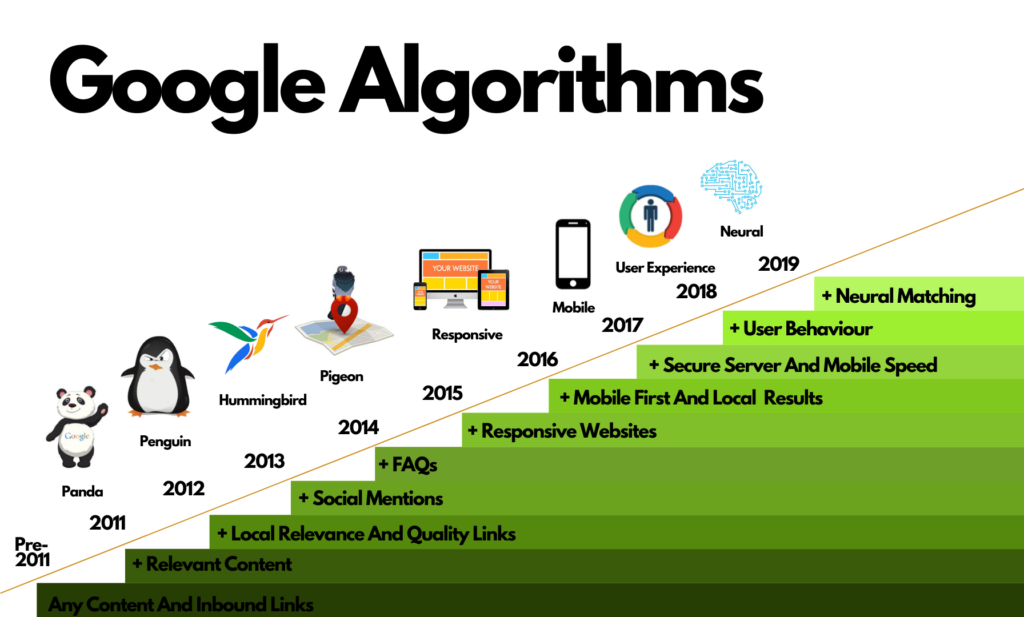
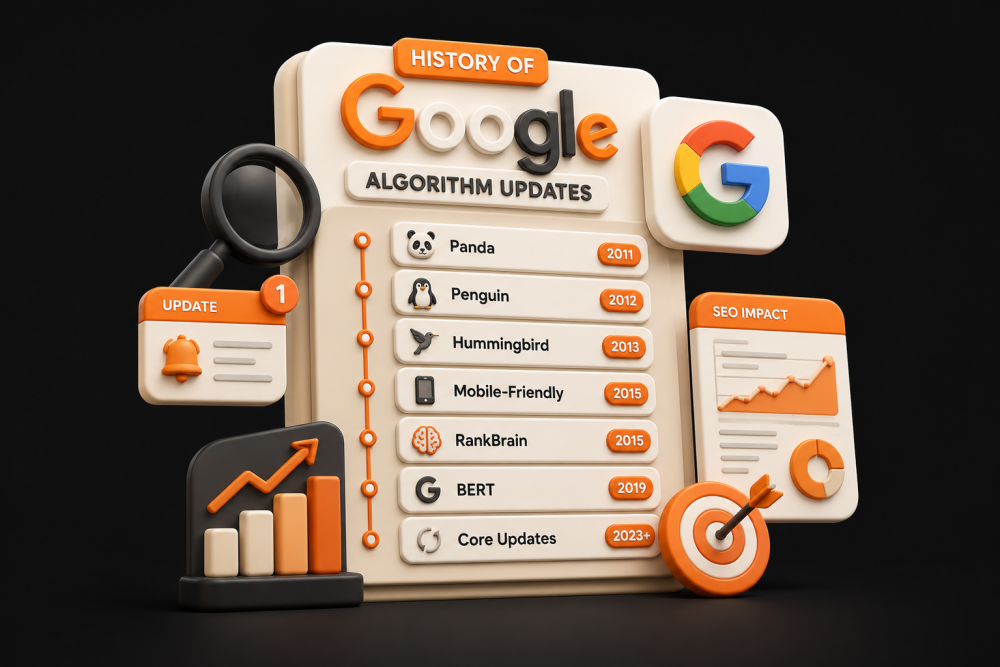
Here is the history at a glance. Dates are approximate eras, since Google often rolls updates out gradually and refines them over time. This is your Google algorithm history timeline in one list.
| Era | Update / Shift | What It Targeted or Rewarded |
| Early 2000s | Basic link and keyword counting | Rewarded links and keyword-rich pages (easy to game) |
| Around 2011 | Panda | Thin, copied, and low-value content |
| Around 2012 | Penguin | Spammy, bought, and manipulative backlinks |
| Mid-2010s | Hummingbird | Better handling of conversational queries |
| Mid-2010s | RankBrain | Machine learning to understand unclear queries |
| Mid-2010s | Mobile-friendly update | Rewarded mobile-friendly pages |
| Late 2010s | Mobile-first indexing | Ranked based on the mobile version of pages |
| Around 2019 | BERT | Better understanding of language context |
| Late 2010s onward | Core updates (several per year) | Broad improvements to quality and relevance ranking |
| Early 2020s | Page experience / Core Web Vitals | Rewarded fast, stable, responsive pages |
| Early 2020s | Helpful content update | Rewarded people-first content; penalized search-engine-first content |
| Ongoing | Spam updates and spam policy updates | Scaled spam, hacked content, site reputation abuse |
| Through 2027 | AI-search era | AI Overviews change traffic patterns; tougher stance on low-effort AI content |
What Each Era Taught Site Owners
Every era left behind a rule. Stack them together and you get a complete playbook for update-proof SEO.
- The Panda era taught: publish content with real substance. Thin pages are a liability, not an asset.
- The Penguin era taught: earn links honestly. One trusted link beats a hundred shady ones.
- The language era taught: write for humans, not keyword counters. Answer the real question behind the search.
- The mobile era taught: design for phones first. Most of your audience is on a small screen.
- The core update era taught: there are no shortcuts for broad quality updates. Build a genuinely good site.
- The page experience era taught: speed and usability are ranking factors. A slow site leaks rankings.
- The helpful content era taught: ask if your content helps real people. If it only exists to rank, it is at risk.
- The spam era taught: black-hat tactics have a short shelf life. The cleanup always costs more than the gains.
- The AI era teaches: use new tools to serve readers better, not to flood the web with filler.
Notice the direction. Every lesson points the same way: serve the user honestly. That has been Google’s north star for over a decade.
How to Protect Your Site From Future Updates
You cannot stop Google from updating. You can build a site that updates reward. Here is how.
Publish Content That Deserves to Rank
Every update rewards the same thing: content that genuinely helps the searcher. Before you publish, ask three questions. Does this answer the question fully? Does it add something new, an example, a screenshot, a personal experience? Would I be proud to show it to an expert in my field?
If the answer is yes three times, publish. If not, improve it first. One strong article beats five weak ones. Quality compounds over time.
Build Links the Honest Way
Penguin’s lesson still holds. Earn links with useful content and personal outreach. Never buy links. Never join link schemes. Never use automated tools to blast links across the web.
A natural link profile grows slowly and steadily. It includes links from relevant sites in your niche. It mixes anchor text naturally, brand names, page titles, plain URLs. If a link tactic feels sneaky, skip it.
Make Your Site Fast and Mobile-Friendly
Technical basics protect you. Your pages should load quickly on phones. Text should be readable without zooming. Buttons should be easy to tap. Content on mobile should match content on desktop.
Run your key pages through Google’s free PageSpeed Insights tool. Fix what it flags. You do not need a perfect score. You need a site that feels fast and smooth to a real visitor.
Keep Your Content Fresh and Accurate
Outdated content is a quiet ranking killer. Facts change. Screenshots age. Advice goes stale. Google prefers pages that reflect the current reality.
Review your most important pages at least once a year. Update statistics, examples, and screenshots. Add a “last updated” note so readers trust it. Freshness signals care. Care is what Google wants to reward.
Follow Google’s Official Guidance
Google publishes its own advice. The Search Central blog announces updates. The spam policies explain what is forbidden. The quality rater guidelines show what “good” looks like.
Read these sources directly. They are free and written in plain language. Second-hand SEO rumors are often wrong or outdated. When in doubt, trust Google’s own words.
Common Mistakes Site Owners Make After an Update
Updates cause panic. Panic causes mistakes. Here are the ones to avoid.
- Changing everything at once. After a traffic drop, owners rewrite titles, delete pages, and rebuild menus in one weekend. Then they cannot tell what helped or hurt. Change one thing at a time.
- Deleting pages too fast. A page that dropped may just need a refresh. Deleting it throws away its history and any links it earned. Improve before you remove.
- Chasing rumors. Forums fill with theories after every update. Most are guesses. Wait for reliable analysis from trusted sources before you act.
- Copying competitors blindly. A competitor may have risen for reasons you cannot see. Copying their surface tactics rarely reproduces their result.
- Ignoring the real problem. Many drops come from thin content or poor user experience. Owners blame the update instead of fixing the content. The update only exposed the weakness.
- Buying “recovery” services. Shady sellers promise fast recovery from penalties. Real recovery comes from fixing your site. There is no shortcut back.
- Quitting too early. Rankings often bounce around during and after an update. Some sites recover partially on their own as Google refines the rollout. Give changes time to settle before you judge.
How to Recover From a Traffic Drop
Lost traffic after an update? Do not panic. Follow this process for Google update recovery.
Step 1: Confirm the Drop and Its Timing
Check Google Search Console. Look at the Performance report. Note exactly when traffic fell. Compare the date with announced Google updates. If the drop lines up with an update, you likely have an update problem, not a technical bug.
Step 2: Check for Technical Issues First
Before blaming an update, rule out the basics. Is your site still indexed? Did a redesign break URLs? Is there a manual penalty notice in Search Console? Technical problems are faster to fix and have nothing to do with updates.
Step 3: Compare Winners and Losers
Find pages that dropped and pages that held steady. What is different? Look at depth, freshness, originality, and user experience. Then look at the pages that outrank you now. What do they do better? Be honest. This comparison points straight at the weakness.
Step 4: Improve the Content, Page by Page
Work through your most important dropped pages. Add original examples. Answer follow-up questions. Cut fluff. Update old facts. Improve the layout so the answer is easy to find.
Do not rewrite for the sake of rewriting. Every change should make the page more helpful to a real reader. Google’s own guidance says the same: focus on the user, not the algorithm.
Step 5: Be Patient and Track Results
Recovery takes time. Google must recrawl your improved pages and reassess them. That can take weeks or months. Track your rankings weekly, not daily. Keep improving content while you wait.
If you fixed the real problems, traffic usually returns. It may not return to the exact same level. Search changes. But a better site always has a better future than the old one did.
Search Engine Insight shares practical perspectives on online branding, conversion-focused content, and digital marketing techniques that help turn website traffic into meaningful results.
Frequently Asked Questions
What is a Google algorithm update?
A Google algorithm update is a change to the ranking system Google uses to order search results. It adjusts how Google weighs signals like content quality, links, and page speed. When an update rolls out, some pages rise and some fall. Google makes small changes daily and bigger core updates several times a year.
How often does Google update its algorithm?
Google changes its search system constantly, with small tweaks happening almost every day. Larger core updates roll out several times per year, and Google usually announces them in advance. Most daily changes are too small to notice. Core updates are the ones that can visibly shift rankings across many sites.
What was the Google Panda update?
Panda was a major update from around 2011 that targeted thin, low-quality content. It hit content farms and sites full of copied or shallow articles. Many lost huge amounts of traffic overnight. Panda taught site owners that publishing more content only works if the content is genuinely useful and original.
What was the Google Penguin update?
Penguin was a major update from around 2012 that targeted manipulative backlinks. Before Penguin, buying links and joining link schemes was common. Penguin made spammy links worthless or even harmful. It taught site owners that link quality matters far more than link quantity, a rule that still holds today.
What is the difference between a core update and a spam update?
A core update is a broad improvement to Google’s main ranking system that reassesses overall content quality. A spam update specifically targets rule-breaking tactics like hacked content, auto-generated gibberish, or sneaky redirects. Core updates affect many sites mildly, spam updates hit rule-breakers hard. Both reward honest, high-quality sites.
Did Google penalize AI-generated content?
Google does not ban AI tools outright. Its policies target low-value content at scale, no matter who or what wrote it. Mass-produced articles with no original insight, experience, or value can be caught by spam policies and the helpful content system. Using AI to help research and draft is fine, publishing raw AI output at scale is risky.
What is the helpful content update?
The helpful content update rewards content written for people, not for search engines. It targets articles that exist only to capture traffic without genuinely helping readers. Google later folded this system into its core ranking. The practical test: publish only content you would create even if search engines did not exist.
How do I know if an update hit my website?
Check Google Search Console’s Performance report for a sharp traffic drop. Note the exact date and compare it with announced Google updates on the Search Central blog. Rule out technical issues first, like indexing problems or site errors. If the timing matches an update and no technical cause exists, the update likely affected you.
Can a website recover from a Google update?
Yes, most sites can recover. The process is simple but slow: identify which pages dropped, compare them with pages that held their rankings, improve the content with original examples and updated facts, fix technical issues, and wait for Google to reassess. Recovery often takes weeks or months, so track progress weekly and keep improving.
How can I future-proof my site against updates?
Build for the reader, not the algorithm. Publish original, helpful content. Earn backlinks honestly. Keep your site fast and mobile-friendly. Update old content regularly. Follow Google’s official guidance instead of chasing tricks. Every update in history has rewarded the same habits, so a genuinely useful site is the safest long-term bet.
Are Google updates announced in advance?
Core updates are usually announced by Google on the Search Central blog or social channels, often before or as they begin rolling out. Smaller daily changes are not announced. Spam updates are sometimes announced after the fact. Following Google’s official channels is the most reliable way to stay informed without relying on rumors.
Do Google updates affect all websites equally?
No. Updates affect sites differently depending on what they changed. A spam update barely touches honest sites but devastates rule-breakers. A core update can shuffle rankings across many topics at once. Sites with strong, original content and good user experience tend to be stable or even gain traffic during most updates.
Conclusion:Google Algorithm Update History
The Google Algorithm Update History 2027 shows a clear pattern. Google started by counting links and keywords. Then it learned to judge content quality with Panda, link quality with Penguin, and language with Hummingbird, RankBrain, and BERT. It went mobile-first, rewarded fast pages, demanded people-first content, and cracked down on spam. Now, in the AI-search era, it is learning to separate genuine expertise from mass-produced filler.
Every era taught the same lesson in a new way: build for real people. Shortcuts expire. Quality compounds. If you publish helpful content, earn honest links, and keep your site fast and mobile-friendly, you do not need to fear the next update. You will be exactly the kind of site it was designed to reward.