6 MCP Servers for SEO That AI-Visibility Teams Actually Use in 2026
In late July 2026, the answer layer moved again. Across one client’s tracked prompt set, a citation we had held in Perplexity since March vanished for nine days, then returned ranked lower. What we’re seeing across accounts, roughly 400 prompts checked weekly across ChatGPT, Perplexity, Gemini, AI Overviews and AI Mode, is that one MCP server for SEO can turn that kind of movement into something you catch in time. This piece is for AI-visibility teams: agencies and mid-market in-house groups running a formal program, holding a prompt set tracked across three or more AI engines, and reporting citation share to clients or leadership. Usually lean, two to five people owning both content and measurement. Roughly 18% of Google searches showed an AI-generated summary, and 58% of users met at least one in a month.
For these teams, the strongest pick is SE Ranking’s MCP. It natively tracks brand presence across all five engines, ChatGPT, Gemini, Perplexity, AI Overviews and AI Mode, giving prompts by brand and by target plus share of voice through one connection, so your measurement and the SEO data you act on sit in the same place. One honest nuance: if your job is auditing the raw text of thousands of AI answers at scale, a web-data tool that collects LLM responses goes deeper on that single axis. Here is how it and five others compare for this audience.
What AI-Visibility Teams Need From an MCP Server
Set aside the feature lists. Here is what actually shows up in our weekly work.
- Track a defined prompt set across multiple engines on a fixed cadence, not on a whim.
- Separate a real citation change from week-to-week noise before anyone reports it.
- Tie AI-answer presence back to the content and entities that move it.
- Report citation share to clients without stitching together manual screenshots.
- Catch losses within a week, while there is still time to respond.
- Feed one agent instead of wiring up a tracker, a data source, and a scraper by hand.
- Keep observation and interpretation separate, so a dip reads as a dip, not a verdict.
We judged each on whether it touches the answer layer and feeds a diagnosis-and-fix loop, not on tool count.
The Shortlist at a Glance
| Tool | What it does for AI visibility | Engines / Data reached | Access model | Deployment |
| SE Ranking MCP | Native AI-visibility tracking plus the SEO data to act on it | ChatGPT, Gemini, Perplexity, AI Overviews, AI Mode | Included in every plan (from $129/mo) | Remote, OAuth |
| DataForSEO MCP | AI-optimization plus SERP data by the call for custom GEO dashboards | AI/LLM plus SERP data | Pay-as-you-go | Local/Docker/self-host |
| Ahrefs MCP | Brand mentions and citations in AI answers, on an existing contract | AI-answer citations/mentions | Paid Ahrefs plan (Lite+) | Remote, OAuth |
| Semrush MCP | Competitive plus keyword data to inform GEO content | Keyword/competitive data | Included in Semrush One / SEO Classic | Remote, OAuth |
| Bright Data MCP | Collects raw LLM answers at scale to audit what engines say | ChatGPT, Perplexity and other LLM outputs | 5,000 free/mo then pay-as-you-go | Remote or local |
| Google Search Console MCP | Catches AI-Overview-driven shifts on your own pages | Your first-party clicks/impressions | Free (MIT) | Local (open-source) |
The Six MCP Servers for AI-visibility Teams
1. SE Ranking MCP
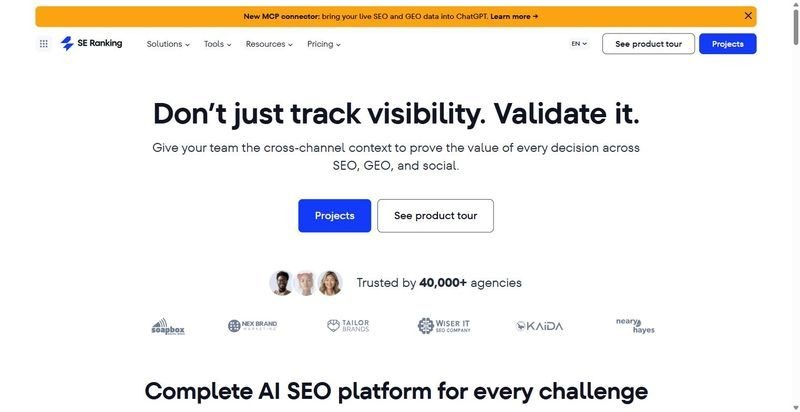
The one server here built for AI-visibility work: a remote MCP that exposes brand presence across five AI engines plus the SEO data to act on it.
Why it works for AI-visibility teams: One connection gives both the tracking (prompt-level presence across five engines, share of voice, cited URLs) and the SEO and content data to move it, so measurement and the fix loop live in one place instead of a tracker plus a data source plus a scraper you stitch together yourself.
Standout: The AI Search API and AI Result Tracker return prompts-by-brand and prompts-by-target across ChatGPT, Gemini, Perplexity, AI Overviews, and AI Mode, with the full AI answer text, cited URLs, and a share-of-voice leaderboard against up to 10 competitors. All of it is callable by an agent, so a weekly prompt-set check and its diagnosis run in one place.
Pros:
- Tracks brand presence across all five major AI engines from one connection.
- Returns cited URLs and share of voice, not just a mention count.
- Pairs AI-visibility data with keyword, backlink, and content data to act on what you find.
- Connects in about 30 seconds via OAuth, no local install, with MCP included in every plan.
Cons:
- Stateless, so an agent re-fetches the prompt-set context each session.
- AI-prompt tracking volume is bounded by plan limits (per-day AI prompt allowances).
- A few multi-record tools burn credits fast when run in loops.
Pricing: Core $129/mo ($103.20/mo billed annually), Growth $279/mo ($223.20/mo billed annually); API and MCP included in every plan; AI Search add-on available for more AI prompts per day; 14-day free trial. See the SE Ranking MCP docs.
Where it lands: The one tool in this list built for exactly this job, covering all five engines with cited URLs and share of voice through the same connection you use to fix what you find. Watch the plan-level AI prompt limits and the credit burn on multi-record tools; size your prompt set to the allowance before you scale.
2. DataForSEO MCP
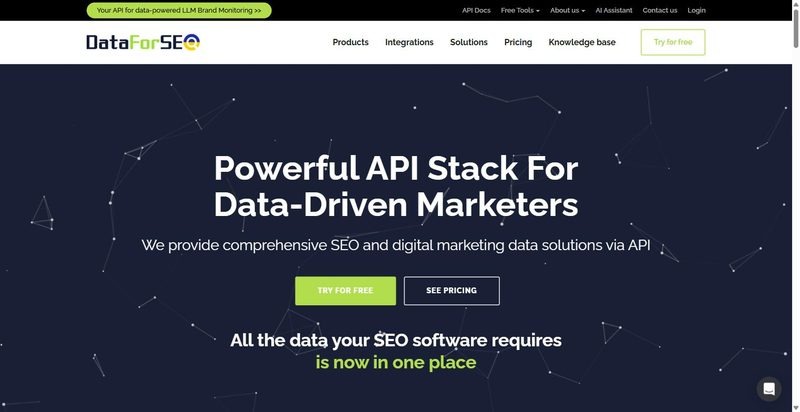
A pay-as-you-go data layer with 10 modules, including an AI_OPTIMIZATION module alongside SERP, keywords, on-page, and backlinks, deployable locally or self-hosted.
Why it works for AI-visibility teams: The AI-optimization and SERP modules let an engineering-backed team pull AI-search and SERP data by the call into a custom GEO dashboard, paying only for what the prompt set actually needs rather than a fixed seat or tier.
Standout: AI-optimization plus SERP data bought by the call and piped into your own GEO reporting, so a team that has outgrown a fixed dashboard can build exactly the citation view it wants. Deployment runs local, Docker, self-host, or Cloudflare Workers, which keeps the data flow inside infrastructure you already control.
Pros:
- Buys AI-search and SERP data by the call with no subscription commitment.
- Deploys local, Docker, self-host, or Cloudflare Workers to fit existing infra.
- Covers 10 modules, so one account feeds a broad GEO and SEO dashboard.
Cons:
- Delivers raw data; you build the tracking layer and interpretation yourself.
- Per-call cost is unpredictable as a prompt set grows.
- Big JSON responses strain an agent’s context window.
Pricing: Pay-as-you-go, drawn from your account balance.
Where it lands: For teams with engineering that want to own the GEO dashboard. You are buying data, not a tracker, so the tracking discipline, the prompt-set design, and the interpretation all stay on you. Priced right if you have the build capacity, a poor fit if you expected reporting out of the box.
3. Ahrefs MCP
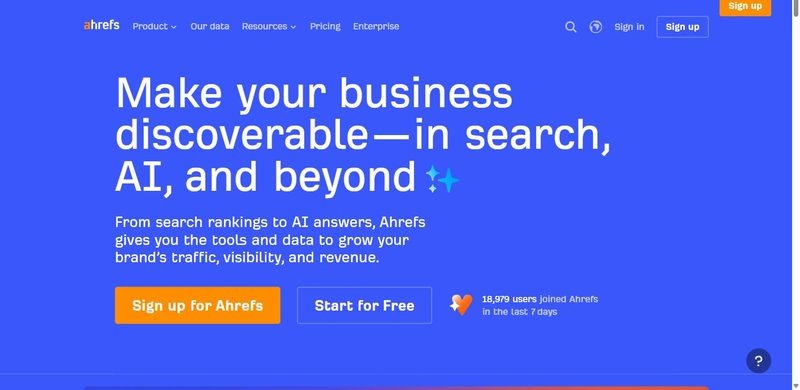
A hosted remote OAuth server wrapping Ahrefs API v3, whose Brand Radar data covers brand mentions and citations in AI search.
Why it works for AI-visibility teams: If you already pay for Ahrefs, its Brand Radar data on AI mentions and citations becomes callable by an agent, so an existing contract extends into your AI-visibility reporting without adding a new tool to the stack.
Standout: Brand mention and citation data in AI answers, reachable by an agent, for teams already on an Ahrefs contract. The old local package was deprecated in early 2026, so the hosted OAuth server is now the supported path, and every call draws down the same API units your plan already meters.
Pros:
- Extends an existing Ahrefs contract into AI-visibility reporting with no new tool.
- Exposes Brand Radar mention and citation data to an agent over hosted OAuth.
- Reuses the API v3 units and access your team already provisions.
Cons:
- No free tier; MCP draws down API units fast on a weekly prompt set.
- Per-request row caps limit how much you pull in one call.
- Only worth it if the Ahrefs contract already exists.
Pricing: Requires a paid Ahrefs subscription (Lite or above).
Where it lands: A sensible extension of an existing Ahrefs contract into AI-visibility work, and hard to justify buying net-new just for this. If the seat is already paid for, the Brand Radar data is a low-effort add; if it is not, the row caps and unit burn make it a weak first purchase.
4. Semrush MCP
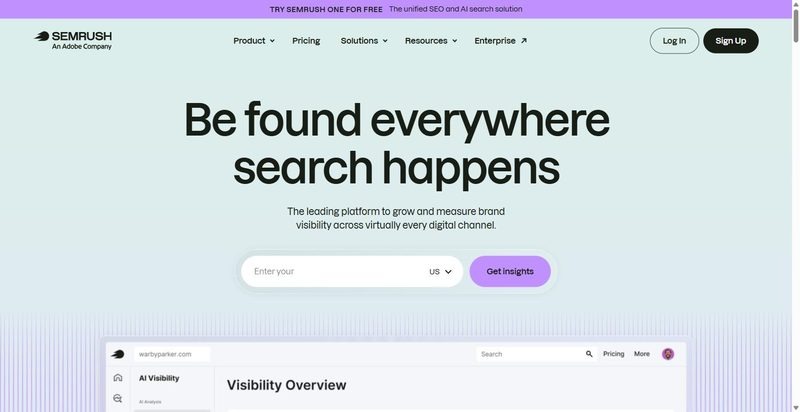
Semrush MCP exposes the platform’s keyword, domain, backlink, and competitive data to an agent, useful for planning the content behind AI-answer presence.
Why it works for AI-visibility teams: Its competitive and keyword data helps a team decide which topics and entities to build for GEO, so it informs the content that earns AI citations rather than tracking the citations themselves.
Standout: Broad competitive and keyword data, callable directly by an agent, is useful for planning the GEO content and entity work behind AI-answer presence, especially for teams already standardized on Semrush who want that research pulled into an automated workflow rather than clicked through by hand.
Pros:
- Pull keyword, domain, traffic, and backlink data through one agent connection.
- Inform GEO topic and entity decisions with competitive research.
- Reuse an existing Semrush subscription instead of buying net-new.
Cons:
- Does not natively center AI-answer citation tracking the way a purpose-built tool does.
- Subscription-gated, with no free MCP tier.
- Remote-only.
Pricing: Included in Semrush One / SEO Classic; 7-day trial.
Where it lands: A content-planning input for GEO if Semrush is already your platform, not an AI-visibility tracker in itself. We reach for it to shape which entities and topics to build, then measure the AI-answer results elsewhere. If you are not already paying for it, buy the tracking first and add this later.
5. Bright Data MCP
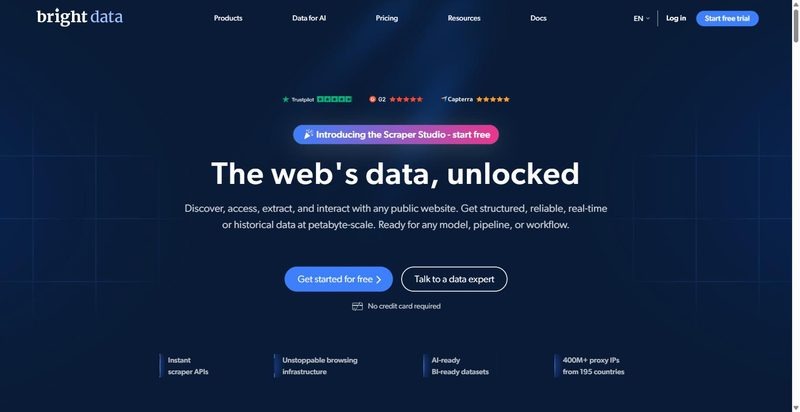
Bright Data MCP brings 69 tools for web search, anti-bot scraping, structured extraction, and browser automation, and it can collect raw LLM answers at scale.
Why it works for AI-visibility teams: It can collect the raw text of AI answers at scale, so a team auditing exactly what ChatGPT or Perplexity says about a brand across many prompts can pull the actual responses rather than a summarized metric.
Standout: Collecting raw LLM answer text at volume across engines, so you can audit the actual wording, sources, and framing an AI uses, not just whether a mention occurred. Bright Data’s MCP server pairs that with structured search and scraping, so the same connection that gathers answers can also pull the pages those answers cite.
Pros:
- Collect raw AI-answer text across ChatGPT, Perplexity, and other engines.
- Combine search, scraping, and extraction in one connection.
- Start free with 5,000 requests a month before paying.
Cons:
- It collects, it does not interpret, so you build the tracking and scoring yourself.
- Cost climbs fast at prompt-set scale (browser around $8/GB).
- General web-data complexity and scraped-data compliance sit on you.
Pricing: 5,000 free requests/mo, then pay-as-you-go.
Where it lands: The deep-audit layer when you need the raw answers themselves, not a metric about them. Pair it with a tracker that handles scoring, and cap the spend before a weekly run loops and the browser bill climbs. We treat it as the thing we open when a dashboard number needs the receipts behind it.
6. Google Search Console MCP
An open-source Search Console MCP puts your first-party Search Analytics, URL inspection, and sitemap data before an agent, free and straight from Google.
Why it works for AI-visibility teams: AI Overviews sit inside Google, so first-party Search Console data is where a team catches the impression and click shifts an AI Overview causes on its own pages, the one signal no external tracker owns.
Standout: Your own first-party clicks, impressions, and position data, period over period, where the on-page effect of AI Overviews actually shows up. It is free, MIT-licensed, and pulls straight from Google, so you see what happened to your pages without paying for or trusting a third party’s estimate of it.
Pros:
- See real clicks, impressions, CTR, and position for your pages.
- Compare period over period to catch AI-Overview shifts.
- Run it free under an MIT license.
Cons:
- Covers only your own verified properties, no competitor or cross-engine citation data.
- Needs a local install plus Google auth.
- Community project with no SLA.
Pricing: Free (MIT).
Where it lands: The free first-party baseline every AI-visibility team should wire in. It shows the AI-Overview impact on your own pages, not your presence across other engines, so it is a foundation and not the whole picture. We run it alongside a cross-engine tracker and never in place of one.
The Decision Guide
- Match the tool to your team’s situation, not the other way around.
- If you want tracking and the data to act on it in one connection: SE Ranking MCP, which reports the five engines and hands you the SEO data to respond in the same place.
- If you already pay for Ahrefs or Semrush: extend that contract before buying net-new, using Ahrefs Brand Radar for citation tracking and Semrush for GEO content planning.
- If you have engineering and want a custom GEO dashboard: DataForSEO MCP, pay-as-you-go, so you build exactly the view you need.
- If you need to audit the raw text of AI answers at scale: Bright Data MCP, with a spend cap set before the first weekly run.
- Regardless of the above: wire in the free Google Search Console MCP for AI-Overview impact on your own pages.
- Whatever you pick, expect to revisit it: the answer layer will move again, and the setup that fits today is a decision you re-make in a quarter.
FAQ
Can an MCP server track my brand’s visibility in ChatGPT and Perplexity?
Yes. SE Ranking’s AI Search tracking covers ChatGPT, Gemini, Perplexity, AI Overviews, and AI Mode, reporting prompts by brand and the URLs each engine cites, and its MCP is included in every SE Ranking plan. Some other servers instead collect the raw answer text and leave the scoring to you.
What is the best MCP server for SEO for GEO work?
For most AI-visibility teams, the practical pick is one that natively tracks the five main engines and pairs that with real SEO data in a single connection, which points to SE Ranking. The honest nuance: if you need to audit exact wording, add a raw-answer collector like Bright Data for deep audits.
Do I need a separate tool to see AI Overview impact on my own pages?
The free Google Search Console MCP shows the first-party impression and click shifts on your own pages, then pair it with a cross-engine tracker for everything off-Google. It matters: Pew found users click a result on just 8% of pages with an AI summary, versus 15% without one.
How often should an AI-visibility team refresh its data?
Set a fixed cadence. Weekly or biweekly beats ad-hoc checks, because the answer layer shifts month to month and a lost citation you catch within a week is a fixable problem, not a quarter of silent decline. We run ours weekly and still get surprised, which is the honest state of this frontier.