
The Biggest SEO Mistakes Law Firms Still Make in 2026
Legal SEO Best Practices for Growing Firms Online
Search engine optimization has always been competitive for law firms. But in 2026, the game has changed in a way many firms have not caught up to yet. Google is not the only player anymore. AI-powered search tools like Gemini and SearchGPT now influence how potential clients find attorneys. That means your firm needs more than a few keywords sprinkled across a website. You need SEO for law firms built for the way search actually works today.
The good news is that most of the SEO mistakes holding law firms back are fixable. Here are five of the biggest ones, and what to do about each.
5 SEO Mistakes Law Firms Should Avoid at All Costs
Here is a quick look at the five most common SEO mistakes we see across law firm websites, including the risk level and what the fix looks like.
| SEO Mistake | Risk Level | Quick Fix |
| Ignoring Local SEO | High | Optimize Google Business Profile |
| Missing LegalService Schema | High | Add JSON-LD structured data markup |
| Publishing Thin Content | High | Build out practice area pages with depth |
| Unoptimized Page Load Speed | Medium-High | Fix Core Web Vitals, target sub-200ms TTFB |
| Only Building Directory Backlinks | Medium | Add guest posts on authority legal sites |
Ignoring Local SEO
Most people searching for an attorney want someone nearby. They are typing “divorce attorney in Austin” or “DUI lawyer near me,” not broad national terms. If your website is not optimized for those local searches, competitors are winning those clicks before you ever get a chance.
Claim and fully optimize your Google Business Profile. Make sure your firm’s name, address, and phone number are identical across every platform you appear on. And ask satisfied clients to leave honest reviews. Local SEO is not complicated, but you have to actually do it consistently.
Missing LegalService Schema Markup
This one has become more urgent as AI search tools have grown. AI-powered search engines do not just read your text. They consume structured data. If your site is missing JSON-LD LegalService and ItemList schema, you are essentially speaking a language those engines do not prioritize.
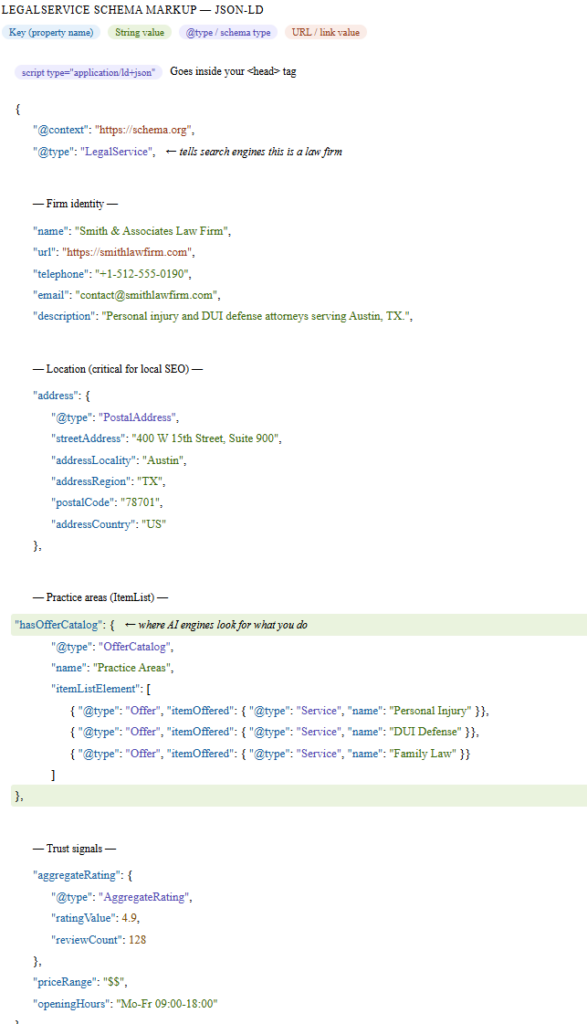
The highlighted section (hasOfferCatalog with itemListElement) is the piece most law firm sites are missing. This is specifically where AI search engines like Gemini look to understand your practice areas as structured data, not just text on a page.
Proper schema markup tells search engines exactly what your firm does, where you are located, and what practice areas you cover. Without it, that information gets treated as a suggestion rather than a fact. Get your developer to add this if it is not already in place.
Publishing Thin Content
A home page, a few attorney bios, and a contact form do not cut it anymore. Google rewards websites that genuinely answer the questions clients are asking. If your site does not answer “What happens after a DUI arrest in my state?” but a competitor’s does, you already know who gets the call.
Build out practice area pages with real depth. Add FAQ sections. Publish blog posts that address specific legal questions your clients are searching for. Quality content is how you earn trust before a potential client ever picks up the phone.
Unoptimized Page Load Speed
Page speed has always mattered for rankings, but Google’s latest Core Web Vitals update has tightened the screws. Any delay in your site’s initial HTML response now carries a ranking penalty. If your primary meta tags take more than 200 milliseconds to load, your visibility will keep slipping.
Common culprits are oversized images, outdated plugins, and budget hosting. Run your site through Google’s PageSpeed Insights tool and work through the issues it surfaces. A fast, responsive website keeps visitors engaged and signals to Google that your site is worth promoting.
Only Building Directory Backlinks
Getting listed in legal directories is a smart starting point. But if that is your entire link-building strategy, you are leaving a lot of authority on the table. Directory citations help establish your presence, but they all draw from the same pool of sites. Google looks for a diverse, natural backlink profile, and that means earning links from news outlets, legal publications, and industry blogs as well.
This is where guest posting becomes a real competitive advantage. Publishing articles on authoritative sites in your niche earns backlinks from trusted, high-domain sources. It drives referral traffic, positions you as a thought leader, and sends Google a signal that credible websites are vouching for your content.
Think of directory listings as your foundation and guest posting as the structure you build on top of it. You need both, but only one of them compounds your authority over time.
Key Takeaways
If you only take a few things away from this post, make them these:
- Local SEO is non-negotiable. Optimize your Google Business Profile and keep your contact info consistent everywhere.
- Add LegalService schema markup. AI search engines rely on structured data. Without it, your firm’s details get treated as suggestions, not facts.
- Create content with real depth. Answer the specific questions your clients are actually searching for.
- Hit your Core Web Vitals targets. Aim for sub-200ms time to first byte. Slow sites are losing ground fast in 2026.
- Go beyond directories for link building. Guest posts on authoritative sites build the kind of backlinks that actually move your rankings.
These are not advanced tactics. They are the fundamentals that too many firms are still skipping. Fix these SEO mistakes and you will be ahead of most of your competition before you ever touch the more complex stuff.