
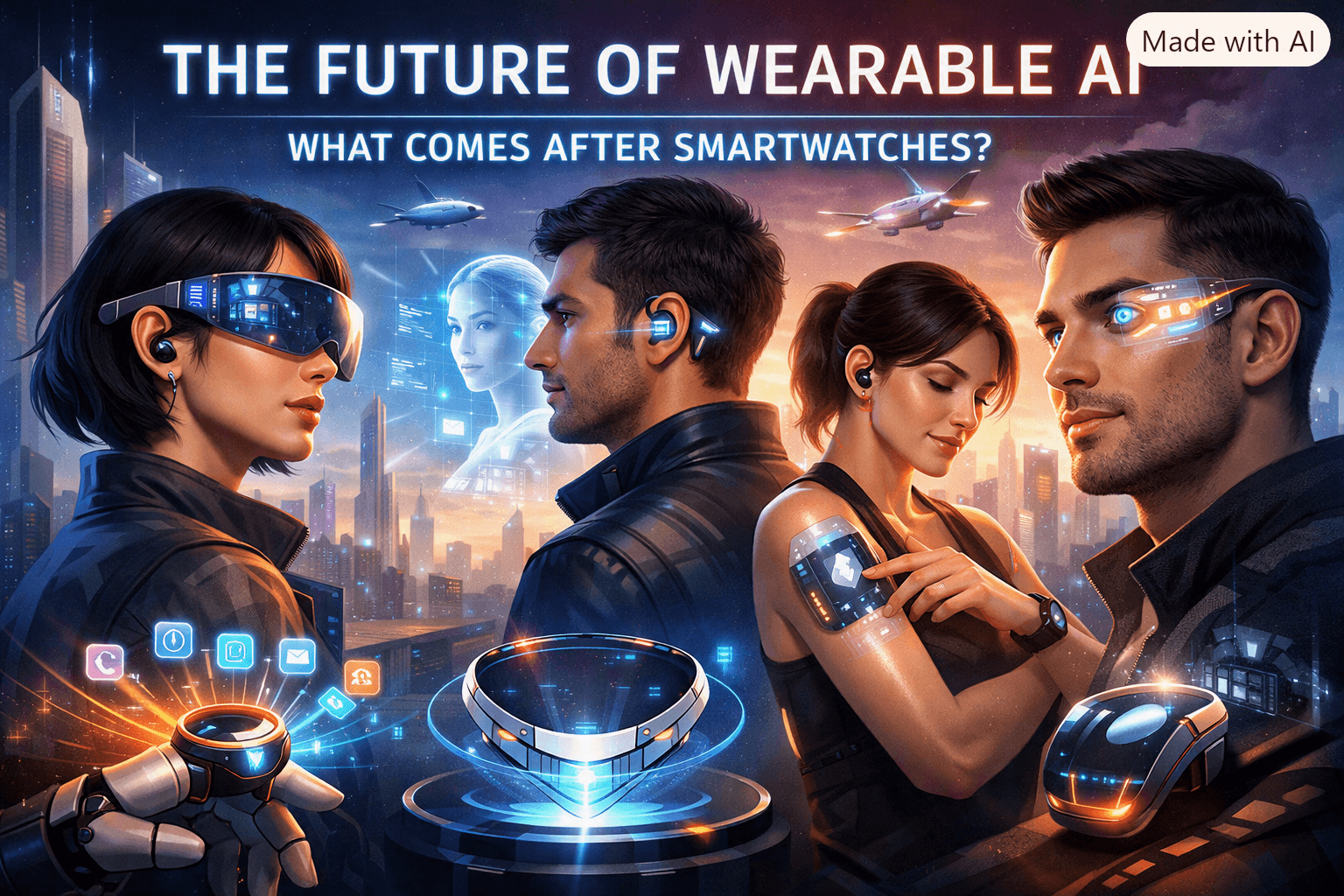
The Future of Wearable AI: What Comes After Smartwatches
Smartwatches helped make wearable technology mainstream. They put notifications, health tracking, fitness data, calls, and quick alerts on the wrist. But wearable AI is moving beyond the watch. The next stage is not only about tracking steps or showing messages. It is about creating more natural ways to interact with technology throughout the day.
Why Did Smartwatches Become the First Big Wearable?
Smartwatches became popular because they solved simple, everyday problems. They made it easier to check alerts, track workouts, monitor basic health data, and stay connected without constantly pulling out a phone.
They worked because the wrist was already a familiar place for personal technology. People understood watches. Adding screens, sensors, and apps felt like a natural upgrade.
Smartwatches are still useful for:
- Fitness tracking
- Heart rate monitoring
- Time and notifications
- Workout summaries
- Quick calls and messages
- Sleep tracking
- Calendar reminders
- Basic app alerts
But the smartwatch also has limits. The screen is small. Typing is awkward. Visual capture is not natural. Voice interaction can be limited by where the watch sits. That is why the next wave of wearable AI is expanding into other forms.
How Is Wearable AI Moving Beyond the Wrist?
Wearable AI is becoming more diverse. Instead of one main device, consumers now have more options depending on how they live, move, work, and communicate.
The next generation of wearable devices includes:
- Smart glasses
- AI earbuds
- Smart rings
- Fitness bands
- Health-monitoring patches
- Connected clothing
- Wearable cameras
- Mixed-reality headsets
- Voice-first accessories
Each device has a different role. A ring may be better for passive health tracking. Earbuds may be better for calls and audio. Glasses may be better for visual capture, voice control, and hands-free assistance.
This shift matters because AI becomes more useful when it appears in the right form for the task. Not every interaction belongs on the wrist.
Why Are Consumers Embracing Hands-Free Technology?
Hands-free technology is becoming more appealing because people are tired of stopping for every small digital task. A phone is powerful, but it demands attention. A smartwatch is convenient, but it still requires a glance, a tap, or a small screen.
Wearables make technology feel lighter when they support daily movement.
Hands-free tools can help users:
- Take calls while walking
- Listen to messages or directions
- Capture quick photos or videos
- Ask questions through voice
- Save reminders on the go
- Stay connected while carrying bags
- Reduce screen-checking during active moments
- Access information without opening multiple apps
This is why wearable AI is not only a technology trend. It is a behavior shift. People want tools that work while life is happening, not only when they stop and look at a screen.
What Role Will AI Play in the Next Generation of Wearables?
AI changes wearables from simple tracking devices into more responsive assistants. Earlier wearables collected data or showed alerts. AI-powered wearables can interpret, respond, summarize, recommend, and support more flexible interactions.
This could make wearables useful for:
- Real-time translation
- Voice-based assistance
- Fitness and recovery insights
- Context-aware reminders
- Visual search
- Navigation support
- Content capture
- Health monitoring
- Productivity prompts
The strongest AI wearables will not be the ones that try to do everything. They will be the ones that solve common tasks with less effort.
For example, wearable AI can help someone ask a quick question while walking, capture a visual note during travel, or receive audio guidance without touching a phone. These small interactions are where the category becomes practical.
Why Is Smart Eyewear Becoming So Important?
Smart eyewear is gaining attention because glasses sit close to how people naturally experience the world. They are positioned near the eyes and ears, which makes them useful for first-person capture, audio, voice interaction, and AI assistance.
This makes eyewear different from a smartwatch. A watch can show information. Glasses can support what the user is seeing, hearing, saying, and doing.
Smart eyewear may be useful for:
- Hands-free photos and videos
- Travel and lifestyle content
- Audio calls
- Voice commands
- Quick AI questions
- Visual notes
- Navigation prompts
- Everyday communication
The growing interest in display-less smart glasses shows how the category is becoming more practical and less dependent on bulky headset-style designs. That matters because people are more likely to wear technology when it looks familiar and feels comfortable.
How Do Connected Accessories Fit Into the Future?
The future of wearable AI will likely involve multiple connected accessories rather than one device replacing everything. A person may use a smartwatch for fitness, earbuds for audio, glasses for hands-free capture, and a phone for editing, payments, and detailed apps.
This creates a flexible device ecosystem.
A simple future setup could look like this:
- Smartwatch for health and alerts
- Smart ring for sleep and recovery
- Earbuds for calls and audio
- Smart glasses for capture and voice support
- Phone for editing, browsing, and app control
- Laptop for deeper work
The point is not to carry more devices. It is to use fewer interruptions. Each wearable handles the task it is best suited for, while the phone remains the central hub.
Why Are AI Glasses Expected to Play a Major Role?
The reason AI glasses are expected to play a major role is simple: they combine technology with an accessory people already understand. Glasses are familiar, visible, and practical. If smart features can be added without making the frames feel awkward, eyewear becomes a natural place for AI to live.
AI glasses can support the future of personal technology by offering:
- A more natural point of view
- Faster access to voice assistance
- Hands-free content capture
- Less dependence on phone screens
- More useful travel and lifestyle tools
- Better integration with everyday routines
The challenge is balance. Smart eyewear must be useful, but it also has to be comfortable, stylish, and socially acceptable. A device worn on the face has to pass a higher design test than a device kept in a pocket.
Research into all-day wearable smart glasses points to the importance of small form factor, low weight, fashionability, and social acceptance. Those factors may decide whether smart glasses become daily essentials or remain occasional gadgets.
What Challenges Could Slow Adoption?
Wearable AI still has real challenges. Consumers may be interested, but interest does not always turn into long-term daily use.
The biggest challenges include:
- Battery life
- Comfort
- Privacy concerns
- Data security
- Price
- Social acceptance
- App usefulness
- Durability
- Long-term value
- Too many subscription costs
Privacy may be especially important for smart glasses because cameras and microphones are closer to public spaces. People will need clear recording indicators, responsible use habits, and transparent privacy settings.
Wearable AI will grow faster if it feels helpful without feeling intrusive.
Final Thoughts
Smartwatches made wearable technology normal, but they are not the endpoint. The future of wearable AI is moving toward glasses, earbuds, rings, connected accessories, and devices that support daily life with less friction.
Consumers are embracing hands-free technology because it makes digital help easier to access while moving. AI will make these devices more useful by supporting voice interaction, quick information access, content capture, health insights, and context-aware assistance.
The next era of personal technology will not be defined by one screen. It will be shaped by connected wearables that fit naturally into the way people already live.