Your Phone Has an eSIM. But What Does It Actually Do?
You may have gone into your phone’s settings at some point and come across an option called “Add eSIM.” It’s there, among the network and mobile data settings, although it’s quite possible you’ve never tapped it.
What exactly are you adding?
With a traditional SIM card, the answer is easy to visualize. You have a small card; you open the phone’s tray, insert it, and the SIM card lets the device use your line and connect to your carrier’s network.
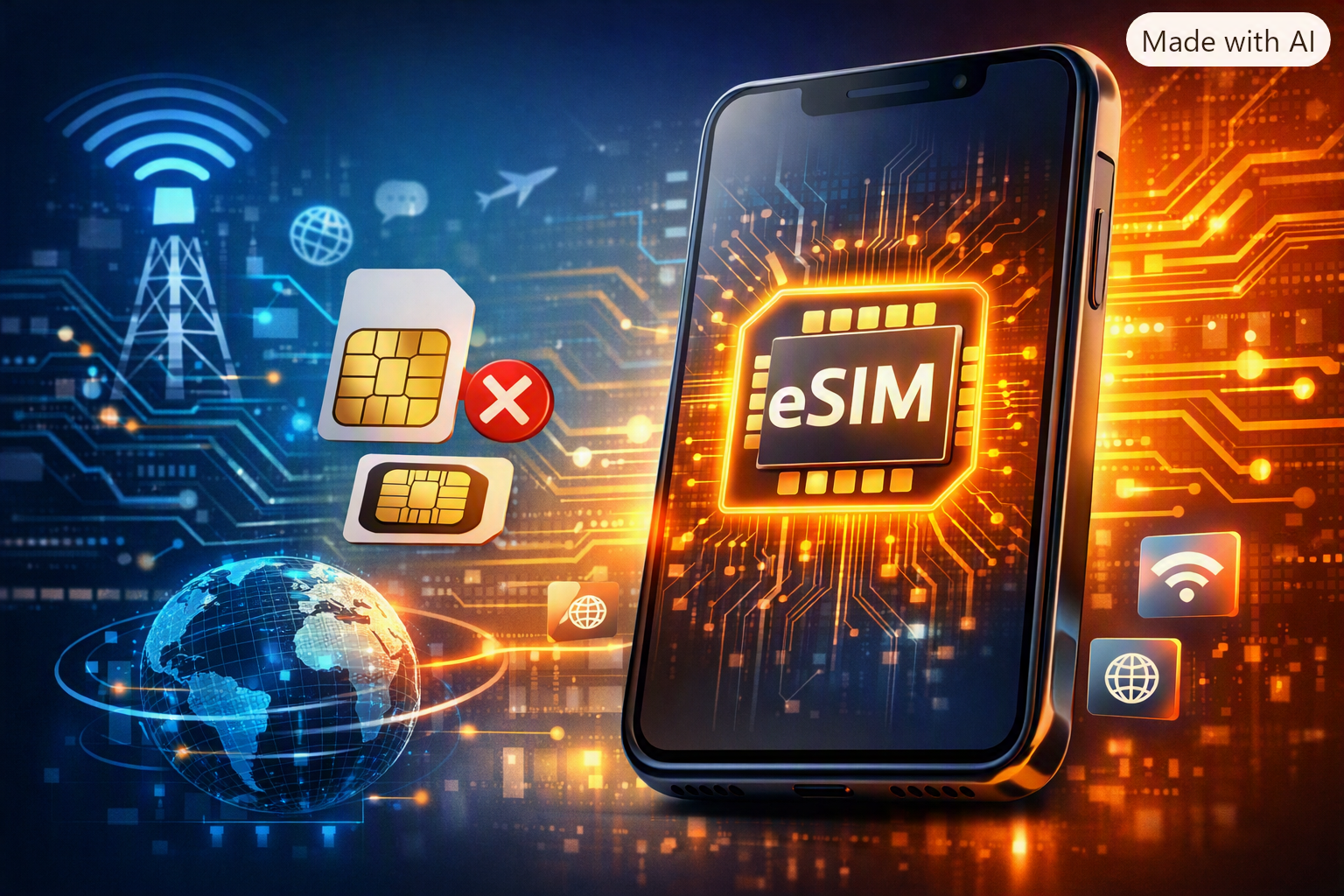
With an eSIM, there’s no card to insert or remove. The necessary component is already built into compatible phones, and what you add digitally is a mobile service profile.
An eSIM isn’t an app, nor is it simply “mobile internet,” and you don’t need to open your phone to install anything. It’s designed to do the job of a SIM card, but in a different way.
So, what does an eSIM do inside a cell phone?
Let’s first consider what a regular SIM card does. When you sign up for a service plan, the SIM card contains the information needed for the network to recognize and authenticate it. This way, the carrier knows which service is associated with that SIM card and can grant you access to its network.
With an eSIM, the basic idea is the same; the difference lies in how that information reaches the device.
Instead of receiving a plastic card with a chip and inserting it into a tray, the phone can download an eSIM profile. That profile contains the data needed to identify the service to the carrier’s network.
That’s why “Add eSIM” is a pretty literal name. You’re not adding another chip to the phone. You’re installing a new mobile profile on the component that’s already built into the device.
If you want to learn more about the difference between a traditional SIM and this technology, check out this article from Holafly, which explains what an eSIM is and how it works.
What information does it store?
It’s easy to imagine that the eSIM stores contacts, photos, conversations, or even apps. That’s not how it works.
Its function is related to your mobile service. The profile includes information that identifies and authenticates your subscription on the corresponding network, as well as other data necessary for the service to function.
How do you install an eSIM if there’s no physical SIM card?
Usually, through the phone’s settings.
The exact method depends on the device and the carrier. One of the most common options is to scan a QR code provided by the carrier or eSIM provider. The phone reads the necessary information, downloads the profile, and adds it to the network settings.
This isn’t the only method. Some carriers can send the eSIM directly to the device, and certain phones allow you to transfer a line from a previous phone. On an iPhone, for example, Apple supports activation through the carrier, QR codes, and eSIM transfer in compatible cases.
Once installed, the line appears in the phone’s settings. From there, you can activate it, deactivate it, or choose what you want to use it for.
Does the eSIM replace the traditional SIM card?
It can, but it doesn’t have to. This really depends on the phone. Some devices allow you to use a physical SIM card along with an eSIM. Others support multiple eSIMs, and some models no longer have a slot for physical SIM cards.
So having an eSIM installed doesn’t automatically mean your old SIM card will stop working.
Can you use a SIM card and an eSIM at the same time?
If your phone supports Dual SIM, yes. This is where the eSIM becomes much more interesting than simply swapping a physical card for a digital one.
For example, you can have one line for personal use and another for work. You could also keep your usual number for calls and use another line for data.
The phone lets you label each plan with different names and choose which one you want to use for specific functions. You don’t have to keep taking out one card to insert the other every time you want to switch lines.
There are some limitations. Having two active lines doesn’t necessarily mean your phone can use two data networks at the same time; you should check your phone model carefully to find out.
And can you store multiple eSIMs?
It’s one thing to know how many eSIMs you can store, and another to know how many you can have active at the same time.
Some phones can store multiple profiles, even if they only allow you to use one or two at a time. This means you don’t necessarily have to delete one plan to add another.
For someone who always uses the same number, this might not make much of a difference. But for those who travel frequently or use different numbers, it can be quite convenient. The profiles are organized on your phone, and you can switch between them in the settings whenever you need to.
Traveling is where everything starts to make more sense
Imagine traveling to another country with a physical SIM card.
One option is to activate roaming with your carrier. Another is to buy a SIM card when you arrive, remove your own from your phone, and insert the new one. Then the following question arises: Where do you keep that tiny SIM card for a week without losing it?
With a travel eSIM, you don’t need to make that physical swap.
On a compatible device, you can keep your regular line and add another plan for your destination. Then you choose which line you want to use for data during your trip.
This lets you keep your main SIM in your phone while using another connection to browse the web, open maps, order a ride, or check a reservation.
It’s one of the uses Apple itself highlights for Dual SIM: keeping your regular line and adding a plan for the country or region you’re visiting.
What happens if you delete an eSIM?
There’s an important difference between deactivating and deleting.
If you simply don’t want to use a line for a while, many phones let you turn it off in the settings while keeping the profile installed.
Deleting it is something else entirely. When you delete an eSIM, you’re removing that profile from the device. This shouldn’t be confused with automatically canceling your contract or plan with the carrier. They’re separate processes.
And reinstalling it may require contacting your provider or repeating the activation process.
For that reason, deleting an eSIM to fix a minor connection issue shouldn’t always be your first step. If you want to keep that line, check your carrier’s instructions first.
After all, the eSIM does a pretty familiar job
What’s new about the eSIM isn’t that your phone suddenly connects to networks in a completely different way.
The basic function remains the same as what we know from a SIM card: providing the device with the information it needs to use a mobile service. What changes is the format.
It’s no longer essential for that information to come on a card that you physically insert into your phone. You can download a profile, add it through the settings, and manage different lines without opening any card slots.
You’re not adding an app or some strange new feature. You’re adding another way to connect to a mobile network.