
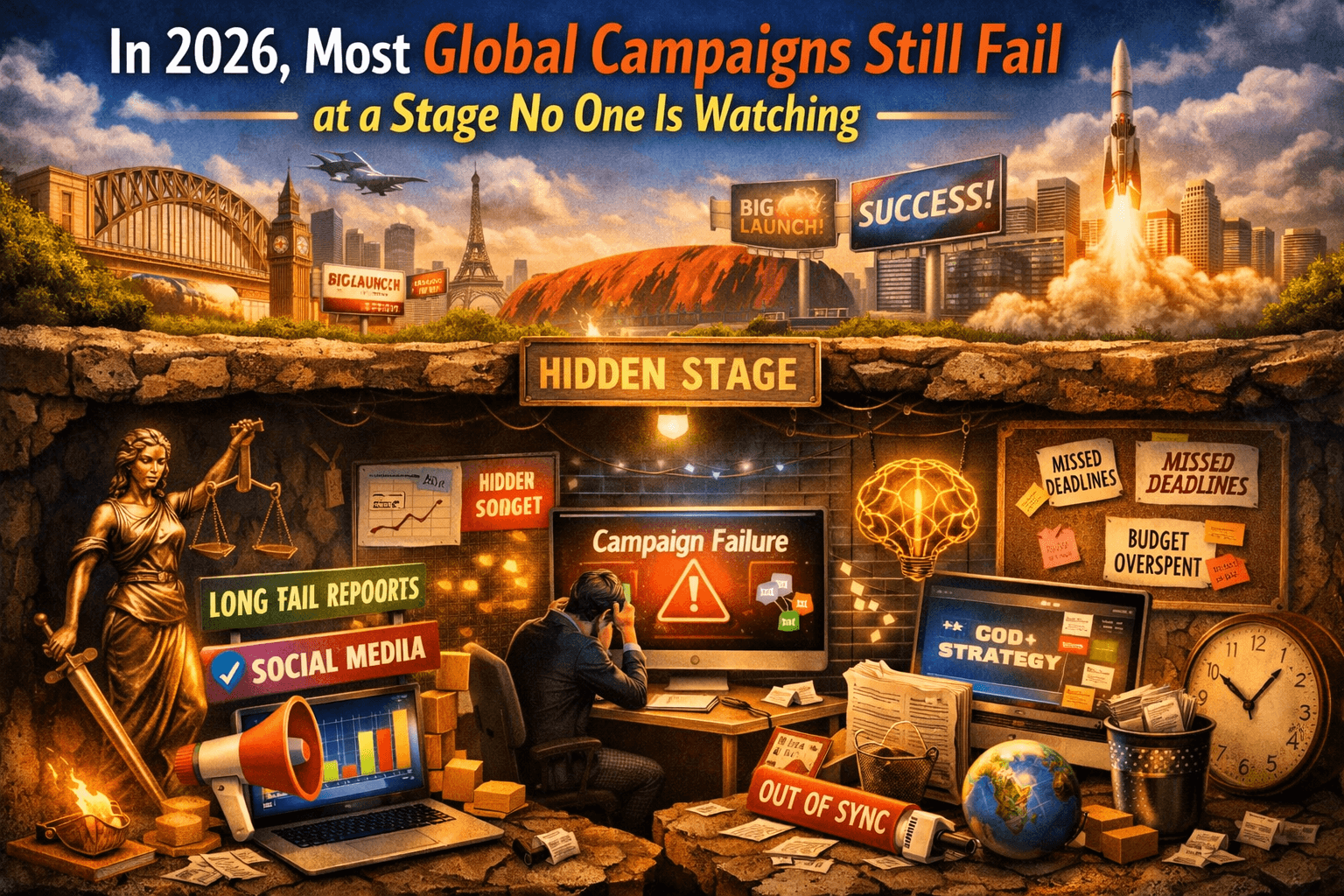
In 2026, Most Global Campaigns Still Fail at a Stage No One Is Watching
Most marketing teams treat translation as a finishing step. The campaign is built, approved, and locked before anyone thinks about language. The brief then goes out to a vendor or gets fed into an AI tool, and the assumption is that words will simply transfer into the next language without losing anything along the way.
That assumption is costing brands markets they thought they had won.
The structural problem in content marketing is not translation quality. It is sequencing. Language strategy gets bolted onto campaigns rather than built into them, and the result is content that is technically translated but functionally broken for the audience it was meant to reach.
The pipeline problem
A campaign brief moves through strategy, creative, copy, and design before a translator ever sees it. By that point, decisions about tone, register, metaphor, and cultural framing have already been locked in for an English-speaking audience. The translator is handed a finished product and asked to move it across a language boundary without changing what it is.
That works for legal notices. It does not work for marketing copy.
The problem compounds when teams add AI translation without adjusting the workflow around it. Industry research published in 2026 found that no single AI engine performs consistently well across all content types, and that marketing copy remains one of the most challenging categories for automated output. The gap between technical accuracy and marketing effectiveness is where brand voice disappears.
A well-structured content marketing strategy defines audience, resonance, and channel before format. When language markets are treated as an afterthought, none of those foundations transfer.
What gets lost when humans exit the loop
The pressure on marketing teams to use AI translation for efficiency is real and legitimate. Speed matters. Budget matters. But efficiency and effectiveness are not the same thing, and the gap between them shows up in market performance data, not translation review scores.
A 2026 enterprise survey by Crowdin found that data governance and human oversight, not linguistic accuracy, were the primary concerns for organizations scaling AI translation across markets. The finding is instructive: the risk is not always a translation error a reviewer catches. It is a brand decision embedded in the source content that no AI system is positioned to flag, because flagging it requires understanding the target audience, not just the target language.
“Global organizations are under pressure to scale multilingual content quickly, but not at the expense of quality or compliance.” — Simon Hodgkins, CMO, Vistatec | vistatec.com, April 2026
That is the role of the human reviewer in a hybrid workflow. Not proofreading. Strategic oversight. When that layer is removed in the name of speed, the content that reaches international markets reflects the source-language assumptions of the original creative team rather than the expectations of the audience it is meant to persuade.
What the sequencing problem actually costs
When translation is treated as a downstream task, several predictable failures emerge. Campaigns built around idiomatic headlines lose their pull entirely when translated word-for-word. Promotional structures that work in one market come across as aggressive or flat in another. Technical terminology that a subject-matter expert would flag goes unchallenged because no subject-matter expert is in the workflow.
The cost is not always visible as a translation error. It shows up as underperformance in a market where the campaign should have worked. According to 2026 localization trend analysis, teams that have moved past experimentation are treating AI translation as an orchestration challenge, not a model selection problem. The decision about which content needs human review, which can be automated, and how quality is defined for each market requires strategic judgment, and that judgment belongs at the start of the campaign process, not at the review stage.
The brands getting this right are not necessarily spending more on translation. They are spending it earlier, and on the right people for each content type.
How to rebuild the workflow
Fixing the sequencing problem requires pulling language strategy earlier in the campaign development process. That means several practical changes to how briefs are structured.
Define target language markets at the briefing stage, before creative begins. This forces the team to consider whether the campaign idea travels, whether the hook, the register, and the cultural reference points are portable or built entirely on source-language context.
Identify content types by localization complexity before the brief goes to production. A product specification sheet transfers with minimal human intervention. A brand campaign built around a culturally specific frame does not. Treating all content as equally translatable is where costs inflate and quality erodes.
Build human review into the timeline as a strategic function, not an editing one. The reviewer’s job is not to catch grammatical errors. It is to confirm that the translated content will achieve the same commercial objective in the target market that the source content was designed to achieve in the original.
The difference between human-in-the-loop and human-in-the-right-place
The term human-in-the-loop has become shorthand for adding a review step to an AI translation workflow. In practice, for many teams, it means a bilingual editor checking machine output for obvious errors before publishing. That is a quality control function. It is not a strategic one.
The distinction matters because the failure modes are different. Quality control catches mistranslations. Strategic oversight catches the cases where the content is translated correctly but will not work commercially, because the tone is wrong for the market, the value proposition does not resonate with local buyers, or a cultural assumption embedded in the original copy has no equivalent in the target context.
Some translation companies have built their workflows around this distinction. Tomedes, for example, structures its human-in-the-loop model so that the translator assigned to a project carries subject-matter expertise in the relevant industry, not just fluency in the target language. The human in the loop is not a proofreader — it is a domain specialist who can assess whether the content will land. William Mamane, Tomedes’ CMO, describes the practical implication for marketing teams:
“When a client’s campaign goes through our workflow, the human reviewer is not there to fix the AI output. They are there to ask whether the message will do the same job in the target market that it does in the source. That is a different question entirely, and it is one you have to build the workflow around before the brief lands, not after.” — William Mamane, CMO, Tomedes
The implication for marketing teams is practical: human-in-the-loop is not a feature you add to a translation order. It is a workflow design decision that determines whether the person reviewing your content is in a position to catch strategic failures, not just linguistic ones.
The strategic opportunity most global brands are leaving open
Marketing teams that treat translation as a production step will consistently underperform in international markets relative to the quality of the campaigns they produce in their home language. The content is often good. The localization workflow does not give it a real chance.
The opportunity is to close that gap, not by replacing human judgment with faster AI tools, but by building a workflow where AI handles volume and human expertise handles the decisions that determine whether content reaches its commercial potential in each market. That is not a technology decision. It is a strategy decision, and it belongs at the beginning of the campaign process rather than the end.