SEO vs SEM Difference Explained: A Beginner’s Guide (2027)
Getting the SEO vs SEM difference explained clearly is the first step to spending your marketing budget wisely. SEO and SEM are two different ways to get your website in front of people on Google. One is free but slow. The other is fast but costs money for every click.
This guide breaks both down in plain English. You will learn what SEO is, what SEM is, how they differ on cost, speed, and trust, and which one fits your situation. By the end, you will know exactly when to use each one and when to use both together.
What Is SEO? A Simple Definition
SEO stands for Search Engine Optimization. It is the practice of improving your website so it ranks higher in Google’s free, unpaid search results. These unpaid results are called organic results.
With SEO, you do not pay Google for clicks. Instead, you earn your spot by making your site useful, fast, and trustworthy. When someone searches for something related to your business, your page shows up naturally because Google thinks it is a good answer.
SEO Explained in Plain English
Think of Google as a giant library. SEO is like making sure your book is well-written, properly labeled, and shelved in the right section. The librarian (Google) then recommends it to readers without you paying for the recommendation.
The three main parts of SEO are:
On-page SEO: What is on your pages. Clear titles, helpful content, and good structure. Off-page SEO: What other sites say about you. Mainly backlinks, which are links from other websites pointing to yours. Technical SEO: How your site works behind the scenes. Fast loading, mobile-friendly, and easy for Google to read.
SEO takes time. A new page can take weeks or months to rank. But once it ranks, the traffic keeps coming without you paying per visitor.
What SEO Looks Like in Real Life
Imagine you run a bakery in Austin. You publish a helpful article called “How to Order a Custom Wedding Cake.” Over a few months, Google starts ranking it near the top for searches like “custom wedding cake Austin.”
Every week, brides find your article for free. Some of them order cakes. You never paid Google for a single one of those visits. That is SEO working for you. The work was upfront: writing the article, making the site fast, and earning a few links. The payoff keeps repeating.
Why SEO Matters Long Term
SEO builds an asset. A page that ranks well can bring traffic for years with only light maintenance. Unlike ads, the traffic does not stop the moment you stop paying.
SEO also builds trust. Many people scroll past ads and click organic results instead. They trust Google’s judgment more than a paid placement. Ranking organically puts your brand in that trusted zone.
What Is SEM? A Simple Definition
SEM stands for Search Engine Marketing. Today, most marketers use SEM to mean paid search advertising. You pay Google to show your ad at the top of search results for chosen keywords.
When someone searches for a keyword you bid on, your ad can appear above the organic results. It is marked as an ad or “sponsored.” Every time someone clicks it, you pay a fee. This is called pay-per-click, or PPC.
SEM Explained in Plain English
If SEO is getting the librarian to recommend your book, SEM is paying for a billboard right inside the library entrance. You skip the line. You get seen first. But the billboard comes down the moment you stop paying.
The most common SEM platform is Google Ads. You pick keywords, write ads, set a budget, and choose how much you are willing to pay per click. Google runs a quick auction every time someone searches. The winners get the top spots.
How Google Ads Actually Works
Here is the process in simple steps:
You choose keywords, like “emergency plumber near me.” You write a short ad and link it to a page on your site. You set a daily budget and a maximum bid per click. When someone searches your keyword, Google holds an instant auction. Google picks winners based on your bid AND your ad quality. If someone clicks your ad, you pay. If nobody clicks, you pay nothing.
Google also scores your ad with something called Quality Score. This is Google’s rating of how relevant and useful your ad and landing page are. A higher score can lower what you pay per click. So even in paid search, relevance matters.
What SEM Looks Like in Real Life
Picture a new online store selling handmade candles. The site is two weeks old and ranks for nothing yet. The owner runs Google Ads for “handmade soy candles.”
Within a day, the ads appear at the top of Google. Shoppers click, and orders start coming in. The owner pays for each click. When the budget runs out for the day, the ads stop. That is SEM: instant visibility, metered by your wallet.
Why SEM Matters for Speed
SEM is the fastest way to get search traffic. There is no waiting for Google to trust your site. You can go from zero to the top of the page in a single day.
This speed makes SEM perfect for testing. Want to know if people will buy your new product? Run ads for a week and watch what happens. SEO cannot give you answers that fast.
SEO vs SEM Difference Explained: Side-by-Side Comparison
Here is the fastest way to see how they differ. This list puts SEO and SEM next to each other across the factors that matter most. It is the short version of search engine marketing vs search engine optimization.
| Factor | SEO | SEM |
| Full name | Search Engine Optimization | Search Engine Marketing (paid search ads) |
| Cost model | Free clicks; you invest time or pay for help | You pay for every click on your ad |
| Speed | Slow: weeks to months to see results | Fast: traffic can start the same day |
| How long results last | Long-lasting; traffic continues after the work | Stops the moment you stop paying |
| Placement | Organic results below the ads | Top of the page, marked as “Ad” or “Sponsored” |
| Control | Limited; Google decides your ranking | High; you pick keywords, budget, and timing |
| Trust level | Higher; users trust organic picks | Lower; many users skip past ads |
| Best for | Long-term growth and lasting traffic | Quick wins, launches, and testing |
| Skill needed | Content, technical basics, patience | Ad writing, bidding, budget management |
| Measurement | Rankings, organic traffic, conversions | Clicks, cost per click, return on ad spend |
SEO vs SEM Difference Explained: How to Read This Comparison
No single point makes one option the winner. The right choice depends on your goal. Need sales this week? The speed point points to SEM. Building a business for the next five years? The lasting-results point points to SEO.
Most successful businesses use both. The list helps you decide where to put your next dollar or your next hour. Keep these trade-offs in mind as we go deeper into each difference below.
Key Differences Between SEO and SEM
The list gives you the overview. Now let us walk through each key difference one by one, with real examples so the difference between SEO and SEM explained here actually sticks.
Difference 1: Cost, Free Clicks vs Paid Clicks
This is the biggest difference. With SEO, clicks cost you nothing directly. You invest time, effort, or money paid to writers and SEO help. But Google never charges you when someone clicks your organic listing.
With SEM, you pay for every single click. This is the pay-per-click model. Competitive keywords cost more per click than niche ones. Your daily budget sets a hard limit on how much traffic you can get. SEM vs SEO cost is the first thing most budgets feel, because one is an upfront investment and the other is a daily meter.
Think of it this way. SEO is like buying a house. Big effort upfront, then you live there cheaply. SEM is like renting a hotel room. Instant comfort, but the meter runs every night.
Practical example: A dentist spends three months building SEO content about teeth whitening. After that, appointment requests arrive for free each month. The same dentist could also run ads for “teeth whitening near me” and get calls tomorrow, but each click eats into the budget.
Difference 2: Speed, Slow Build vs Instant Traffic
SEO is slow. Google needs time to find your pages, judge their quality, and decide where they rank. For a new site, meaningful traffic often takes three to six months. Competitive topics can take longer.
SEM is instant. Set up a campaign in the morning, and your ads can show that afternoon. There is no waiting period and no trust to earn first. Google will show your ad as long as your bid, budget, and quality check out.
This speed gap shapes real decisions. A business launching a holiday sale next week cannot wait for SEO. It needs SEM now. A blogger building an audience over two years should lean on SEO. In a Google Ads vs SEO choice, speed is the deciding factor for launches.
Difference 3: Timeline, How Long Results Last
Here the difference explained through time is striking. SEO results compound. A great article can rank and bring visitors for years. You may need to update it now and then, but the traffic engine keeps running.
SEM results vanish instantly. Pause your campaign or hit your budget cap, and your visibility drops to zero. There is no lasting asset. You are renting attention, not owning it.
This does not make SEM bad. It makes SEM a faucet and SEO a well. The faucet gives water on demand. The well takes work to dig but then flows on its own. This is SEO long-term vs SEM short-term in one picture.
Difference 4: Control, What You Can and Cannot Decide
SEM gives you far more control. You choose the exact keywords, the ad text, the landing page, the budget, the schedule, and the audience location. You can turn campaigns on and off like a light switch.
SEO gives you limited control. You can do everything right and still not rank where you want. Google’s algorithm makes the final call. You influence the outcome, but you do not decide it.
Practical example: An ecommerce store wants to push winter jackets in November. With SEM, it bids on “buy winter jacket” and controls the message and timing exactly. With SEO, it can publish a great jacket guide, but Google decides when and where it ranks.
Difference 5: Trust, How Users See Each Option
Users treat ads and organic results differently. Many people scroll straight past the ads to the organic listings. They know ads are paid for. Organic rankings feel earned, so they carry more trust.
This trust gap matters for some businesses more than others. A law firm or a medical clinic benefits a lot from the credibility of organic rankings. People want to trust these providers deeply before calling.
Ads still work well when intent is urgent. Someone with a burst pipe at midnight clicks the first ad they see. They care about speed, not trust signals. Match the channel to the mindset of your searcher. PPC vs organic search is also a trust question, not just a price question.
Difference 6: Measurement, What You Can Track
Both SEO and SEM are measurable, but what you measure differs.
With SEM, everything is crisp. You see exactly how many clicks you bought, what each click cost, and how many turned into sales. Google Ads reports this clearly. You can calculate your return on every dollar the same day.
With SEO, measurement is fuzzier. You track rankings, organic traffic, and conversions in tools like Google Search Console and Google Analytics. But you cannot tie one hour of work to one sale as cleanly. SEO reporting is about trends over months, not daily profit math.
Beginners often love SEM reporting because it is simple. Just remember that simple numbers can hide a deeper truth: SEO traffic often converts well and costs nothing per visit once it is flowing.
Strengths and Weaknesses of SEO
SEO is powerful, but it is not perfect. Here is an honest look at both sides.
SEO Strengths
Free clicks. Once you rank, visitors arrive without per-click costs.
- Lasting results. Good rankings can hold for months or years.
- Higher trust. Users click organic results more than ads in many cases.
- Compounds over time. Each new ranking page adds to your traffic base.
- 24/7 visibility. Your listings show day and night with no budget cap.
- Better for research topics. People exploring a topic prefer in-depth organic content.
SEO Weaknesses
- Slow. Expect months before strong results, especially on a new site.
- No guarantees. Google decides rankings, you cannot buy your way in.
- Needs ongoing work. Content updates, technical fixes, and link building never fully stop.
- Algorithm changes. Google updates can shift rankings overnight.
- Hard to attribute. Linking one blog post to exact revenue takes effort.
When SEO Shines Brightest
SEO shines for businesses playing the long game. Blogs, media sites, local services, and B2B companies all do well with SEO. If your customers research before buying, SEO meets them during that research.
Strengths and Weaknesses of SEM
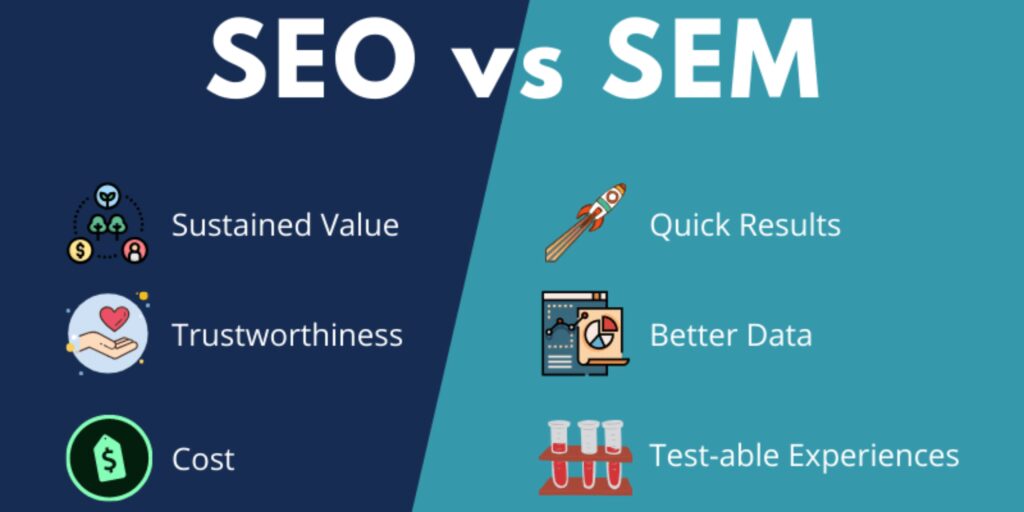
SEM has the opposite profile: fast and controllable, but expensive and temporary.
SEM Strengths
- Instant traffic. Campaigns can drive visitors within hours.
- Precise targeting. Pick keywords, locations, devices, and schedules.
- Easy testing. Test offers, prices, and landing pages with real data fast.
- Scalable. Increase the budget and get more traffic the same day.
- Clear ROI math. You know exactly what each click and conversion costs.
- Top placement. Ads sit above organic results on the page.
SEM Weaknesses
- Costs add up. Every click costs money, and competitive keywords cost more.
- Stops when spending stops. There is no lasting asset from ad spend.
- Lower trust. Ad blindness is real, and many users skip sponsored results.
- Needs constant management. Bids, budgets, and ad copy need regular attention.
- Click fraud risk. Competitors or bots can waste your budget on junk clicks.
- Learning curve. Poorly set up campaigns burn money fast.
When SEM Shines Brightest
SEM shines when speed matters more than efficiency. Product launches, seasonal sales, events, and urgent lead generation all fit. It also shines for testing: validate an idea with ads before investing months in SEO content about it. That is the classic SEO vs PPC test, use paid clicks to prove demand before you build the organic page.
Verdict: Which Is Better for Whom?
There is no universal winner. The right pick depends on who you are, what you sell, and how fast you need results. If you are asking SEO vs SEM which is better, here is a verdict for the five most common situations.
Beginners Learning Digital Marketing
Start with SEO basics, add small SEM tests later. SEO teaches you how search works: keywords, content, and user intent. These skills transfer everywhere. Once you understand the basics, run a small ad campaign with a tight budget to learn how paid search feels. Keep the budget tiny while you learn.
Small Businesses on a Tight Budget
Lean on SEO first. When money is tight, free clicks win. Claim your Google Business Profile, publish helpful local content, and earn a few good backlinks. Use SEM only for short, focused pushes, like promoting a seasonal offer. Do not run ads year-round if the math does not work. For SEO vs SEM for small business, the budget usually decides, and SEO wins on cost.
Ecommerce Stores
Use both, with SEM leading at first. New stores need sales now, and SEO takes months. Run ads on your best-selling products to get revenue flowing. At the same time, build SEO content like buying guides and product comparisons. Over time, SEO should take over a bigger share as rankings grow and ad costs are trimmed. For SEO vs SEM for ecommerce, that handoff from ads to organic is the plan.
Local Service Businesses
SEO usually wins. Plumbers, dentists, and lawyers get huge value from local SEO: reviews, local listings, and location pages. These build trust, and trust drives calls. Use SEM to fill gaps, like ranking for emergency keywords where speed beats everything, or covering slow months with extra leads.
Enterprise Companies
Run both at full scale with separate teams. Enterprises have the budget and the competition demands it. SEO protects long-term visibility across thousands of keywords. SEM captures high-intent searches competitors would otherwise steal. The two teams should share keyword data so ads and organic listings do not waste money fighting each other.
How to Choose: Using SEO and SEM Together
The smartest answer to SEO vs SEM is often “both.” They cover each other’s weaknesses. Here is how to combine them well. This is how SEO and SEM together work in practice.
Step 1: Start With Quick SEM Wins
Launch a focused ad campaign on your most profitable keywords. This brings traffic and sales from day one. More importantly, it gives you data. You will learn which keywords actually convert before you invest months writing SEO content about them.
Step 2: Feed Ad Data Into Your SEO Plan
Your ad reports are a goldmine for SEO. Look at which search terms brought buyers, not just clicks. Build SEO content around those proven keywords. You now know the demand is real because people already paid you through it.
Step 3: Let SEO Take Over Winning Keywords
When an SEO page starts ranking well for a keyword you also bid on, consider lowering the ad spend there. Why pay for clicks you now get free? Shift that budget to keywords where you do not rank yet. This is how the two channels hand off work over time.
Step 4: Keep SEM for What SEO Cannot Do
Some jobs belong to ads permanently. Promoting a flash sale, testing a new product, or targeting a competitor’s brand name are all SEM jobs. SEO cannot turn on a dime, so keep a standing ad budget for time-sensitive moves.
A Simple Budget Rule for 2027
If you are starting out, put most of your effort into SEO and keep a small test budget for ads. As revenue grows, increase ad spend on proven winners while SEO keeps compounding in the background. Review the split every quarter. The right balance shifts as your rankings grow.
7 Common SEO and SEM Mistakes to Avoid
Treating them as enemies. SEO and SEM are teammates, not rivals. Businesses that run both and share data between them outperform those that pick only one.
Expecting SEO to work in two weeks. SEO is a months-long game. Judging it after 14 days leads to quitting right before it starts working. Give it at least three to six months.
Running ads without a budget cap. Always set a daily budget in Google Ads. Without one, a broad keyword can burn through money overnight. Start small and scale what works.
Sending ad clicks to a bad page. If your landing page is slow or confusing, paid clicks bounce and waste money. Fix the page before you scale the ads. The same page quality helps SEO too.
Ignoring Quality Score. Google rewards relevant ads with lower click costs. Write ads that match the keyword and the landing page. This one habit can cut your ad costs noticeably.
Bidding on keywords you already own organically. If you rank number one for free, paying for the same clicks wastes budget. Check your organic rankings before bidding, and pause ads where SEO already wins.
Measuring SEO like paid ads. Do not judge a three-month-old SEO campaign by daily ROI. Track trends: rising rankings, growing organic traffic, and more conversions over time. Different channel, different clock.
Search Engine Insight covers emerging search technologies, competitive research methods, and content marketing approaches that help businesses stay ahead in the digital space.
Frequently Asked Questions
What is the main difference between SEO and SEM?
SEO earns free traffic by ranking in Google’s organic results through content and site improvements. SEM buys traffic by paying for ads that appear at the top of search results. SEO is slow and lasting, SEM is fast and stops when you stop paying.
Is SEM just paid ads?
In modern usage, yes. SEM originally covered all search marketing, including SEO. Today, almost everyone uses SEM to mean paid search advertising, mainly Google Ads. SEO is now treated as its own separate discipline.
Which is better, SEO or SEM?
Neither is better in every case. SEO wins for long-term, cost-efficient growth and trust. SEM wins for speed, control, and testing. Most successful businesses use both: SEM for quick results and SEO for lasting traffic.
Can I do SEO and SEM at the same time?
Yes, and you should. Run ads for immediate traffic while building SEO for the long term. Share data between them: use winning ad keywords to guide your SEO content, and reduce ad spend on keywords where you already rank well organically.
How long does SEO take compared to SEM?
SEM can drive traffic within hours of launching a campaign. SEO usually takes three to six months to show meaningful results, longer for new sites or competitive keywords. Plan your budget and expectations around these very different timelines.
Does SEM help SEO rankings?
Not directly. Google has stated that paying for ads does not boost your organic rankings. However, SEM helps SEO indirectly: ad data reveals which keywords convert, and ad traffic can earn you backlinks and brand searches that support SEO.
What does PPC mean?
PPC stands for pay-per-click. It is the pricing model behind most search ads: you pay only when someone clicks your ad, not when it is shown. Google Ads is the biggest PPC platform. Your cost per click depends on competition and your ad quality.
What is a SERP?
SERP stands for search engine results page. It is the page Google shows after you search. It includes paid ads at the top, then organic results, plus features like maps, images, and AI answers. Both SEO and SEM compete for space on the SERP.
How much does SEM cost?
It varies widely. You set your own budget and pay per click, and competitive keywords cost more per click than niche ones. Start with a small daily budget, track which keywords bring sales, and scale only what proves profitable.
Do I need a big budget for SEO?
No. SEO mainly costs time and effort, not ad spend. You can do the basics yourself for free: helpful content, clear titles, fast pages, and a Google Business Profile. Many small businesses grow with SEO alone before ever spending on ads.
Will AI search make SEO and SEM obsolete?
No. AI answers still pull from web content, so being visible in search still matters. SEO now includes getting cited in AI answers. SEM still puts you at the top instantly. The tactics evolve, but the need to be found when people search is not going away.
Should a new website start with SEO or SEM?
Start both, but weight them by urgency. If you need customers this month, launch SEM first while planting SEO seeds. If you can wait, invest heavily in SEO content now and add ads later for promotions. Either way, do not ignore the other channel completely.
Conclusion: SEO vs SEM Difference Explained
Now you have the SEO vs SEM difference explained in full. SEO is the slow, free, trust-building path: you earn organic rankings that keep delivering traffic long after the work is done. SEM is the fast, paid, controllable path: you buy top placements and get traffic today, but it stops the moment you stop paying.
The winner depends on your situation. Beginners and tight budgets should lean into SEO. Launches, sales, and urgent leads call for SEM. Ecommerce, local, and enterprise businesses usually need both working together.
Start with this simple move: pick your most important keyword, check whether you rank for it, and decide if today calls for patience or speed. Then build the other channel alongside it. That is how search marketing actually works in 2027.