What Is Programmatic SEO? A Beginner’s Guide (2026)
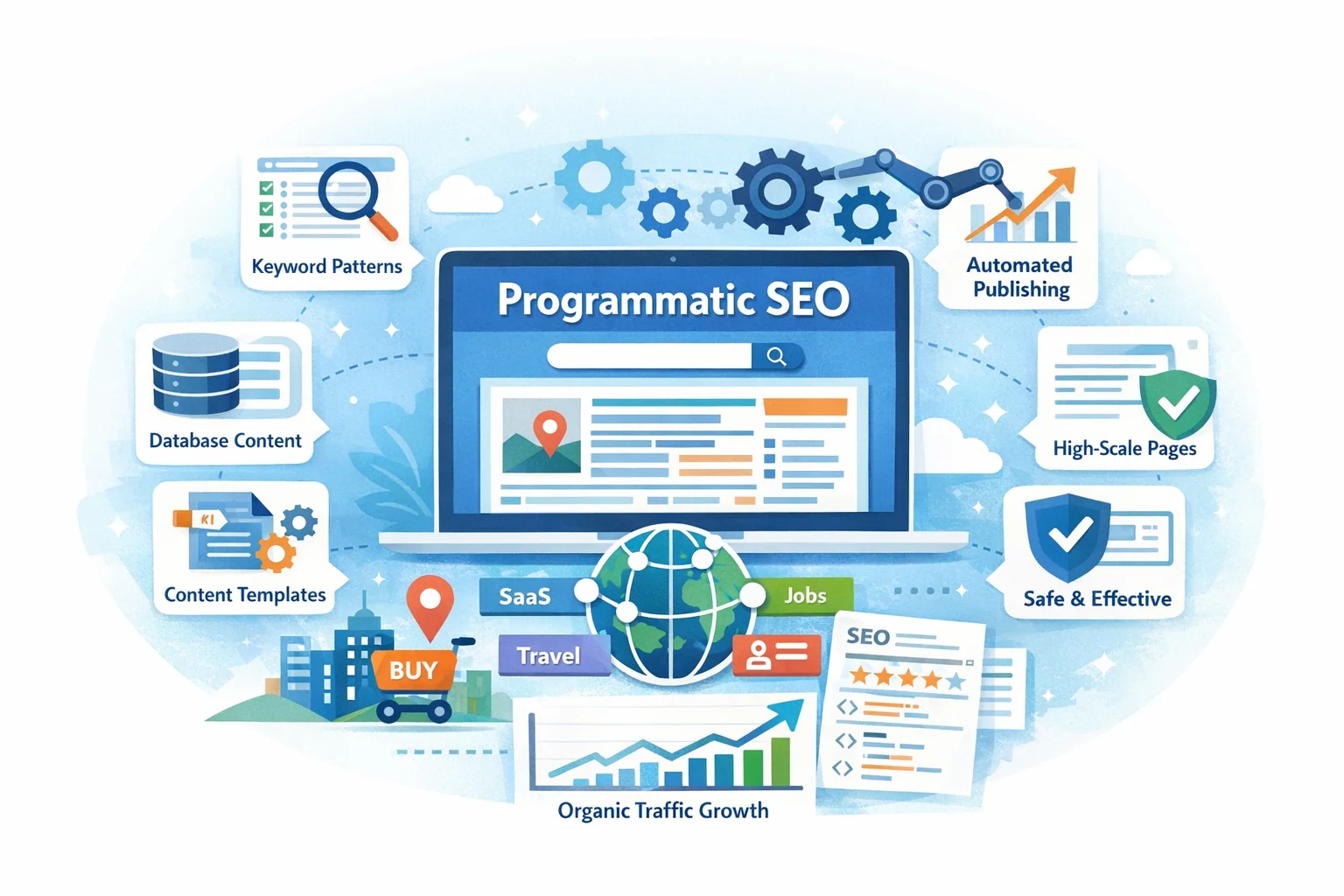
What is programmatic SEO? It is a method of creating hundreds or thousands of targeted web pages automatically, using structured data and page templates instead of writing each page by hand.
Think of it this way. Normal SEO means writing one article at a time. Programmatic SEO means building a system that can publish a thousand useful pages from a single smart template. When done well, it captures search traffic at a scale no human team could match.
In this guide, you will learn exactly how programmatic SEO works, see real examples, and understand when to use it — and when to stay far away.
What Is Programmatic SEO? A Simple Definition
Programmatic SEO is the practice of generating large numbers of web pages from a database, using templates that turn structured data into complete, useful pages. Each page targets a specific long-tail keyword — a longer, more specific search phrase — and the system builds them all automatically.
The key word is “useful.” Programmatic SEO is not about spamming the internet with junk pages. It is about serving real searches that share a pattern, with pages that genuinely answer each variation.
The One-Sentence Definition
Programmatic SEO means using data plus templates to publish many similar-but-unique pages, each targeting a specific search query, at a scale humans cannot match manually.
A classic example: a hotel site with one page per city. “Hotels in Austin,” “Hotels in Denver,” “Hotels in Miami” — same template, different data. Each page is genuinely useful to someone searching that exact phrase.
The Short Answer to “What Is Programmatic SEO”
If someone asks you at a party, say this: it is building a machine that writes web pages for you, from a spreadsheet of facts, so you can rank for thousands of specific searches instead of dozens.
The machine is a page template. The spreadsheet is your structured data — locations, products, prices, features, or whatever varies across your pages. The result is a library of pages that each serve one precise search.
How Programmatic SEO Works
The process has three moving parts. Understand these, and the whole concept clicks.
The Three Ingredients: Data, Templates, and Scale
Data. You need a structured dataset — information organized in rows and columns. It could be a list of 500 cities with population and weather data. It could be 2,000 products with specs and prices. The data must be accurate and genuinely useful.
Templates. You design one excellent page template. It has fixed sections — headline, introduction, data displays, FAQs — with slots where the data fills in. The template controls quality. A great template produces great pages. A thin template produces thin pages.
Scale. You connect the data to the template and generate the pages. One template times 500 rows of data equals 500 pages. The system can also update pages automatically when the data changes, which keeps everything fresh.
A Walkthrough of the Process
Here is how a typical programmatic SEO strategy comes together:
- Find a repeatable search pattern. Look for searches that share a structure, like “best [service] in [city]” or “[product] vs [product].”
- Gather or build your dataset. Collect the facts each page needs. Accuracy matters more than size.
- Design the page template. Write the fixed content, plan where data appears, and add unique elements like maps, charts, or FAQs.
- Generate the pages. Connect data to template through your CMS, code, or a no-code tool.
- Add internal linking. Link the pages together sensibly — by category, region, or topic — so search engines and visitors can navigate them.
- Monitor and improve. Track which pages rank and which do not. Improve the template, and every page gets better at once.
Why Programmatic SEO Matters
Most websites hit a ceiling with manual publishing. A small team can publish maybe four articles a month. That is 48 pages a year. Programmatic SEO breaks through that ceiling.
Reach Keywords You Could Never Target Manually
Long-tail keywords — specific phrases like “plumber in Springfield open Sunday” — have low competition and high intent. Individually, each brings little traffic. Together, thousands of them bring a flood.
No team can hand-write 5,000 city pages. But a programmatic system can generate them in an afternoon, each one targeting a real search with real intent behind it.
Compounding Traffic Growth
Each programmatic page is a small bet. Most will bring modest traffic. Some will surprise you and rank well. Because you can place thousands of bets at once, the winners add up fast.
There is another compounding effect: internal linking. Thousands of related pages linking to each other build strong topical relevance. Search engines see a deep, well-organized library — not a thin site — and treat the whole domain as an authority on the topic.
Key Components of a Programmatic SEO Strategy
A successful programmatic build rests on four pillars. Weakness in any one of them sinks the project.
Structured Data Sources
Your data is the foundation. It must be accurate, complete, and unique enough to make each page different. Public datasets, your own product catalog, scraped-and-cleaned listings, or original research all work.
Ask one question about your data: would a visitor learn something from this page that they could not get from a generic search? If yes, your data is good enough. If the pages would all say nearly the same thing, find richer data first.
Page Templates That Deliver Real Value
The template is where quality lives. A strong template includes genuinely helpful fixed content — buying advice, how-to explanations, comparison logic — plus the dynamic data woven through it.
Weak templates just swap city names into identical paragraphs. Search engines recognize this pattern, and so do visitors. Your template should make each page feel crafted, even though a system built it.
Internal Linking at Scale
With thousands of pages, navigation matters enormously. Build category hubs that link to groups of pages. Link related pages to each other. Breadcrumb navigation helps both visitors and crawlers understand where each page sits.
Good internal linking also spreads ranking power. When one programmatic page earns backlinks, well-linked siblings benefit too. Plan your link structure before you generate a single page.
Quality Filters and Guardrails
Not every data row deserves a page. Set rules: only generate pages where you have enough data, where search demand exists, and where the result will be genuinely useful. It is better to publish 800 strong pages than 8,000 thin ones.
Build in uniqueness checks. If two rows would produce nearly identical pages, merge them or enrich the data. Thin, near-duplicate pages at scale are exactly what search engines penalize.
Programmatic SEO Examples
Real examples make the concept concrete. You have used programmatic pages many times without realizing it.
Example 1: Location Pages
A home services company creates one page per city it serves: “AC Repair in Dallas,” “AC Repair in Fort Worth,” and so on. Each page shows local reviews, service areas, local phone numbers, and city-specific FAQs. The template is shared. The data — reviews, maps, local details — makes each page unique and useful.
Example 2: Product Comparison Pages
A software review site generates “Tool A vs Tool B” pages for hundreds of product pairs. Each page pulls features, pricing, and ratings from a product database into a comparison template with pros, cons, and a verdict framework. These pages target buyers comparing options — some of the highest-intent searches on the internet.
Example 3: Directory and Listing Pages
Job boards, real estate sites, and restaurant guides are programmatic SEO at its purest. “Marketing jobs in Chicago,” “3-bedroom apartments in Austin” — each page is generated from listings data. The pages work because the underlying data is fresh, structured, and exactly what the searcher wants.
Example 4: Calculator and Tool Pages
A finance site builds one calculator page per loan type and term combination. “30-year fixed mortgage calculator,” “15-year refinance calculator” — same tool template, different default values and explanatory content. Interactive tools earn links and keep visitors engaged, which strengthens the whole programmatic set.
Programmatic SEO vs Traditional SEO

These two approaches solve different problems. Most growing sites eventually use both.
| Programmatic SEO | Traditional SEO | |
| How pages are made | Generated from data + templates | Written individually by humans |
| Page count | Hundreds to millions | Dozens to hundreds |
| Best for | Repeatable search patterns | Unique, in-depth topics |
| Upfront cost | High (data + system build) | Low (just start writing) |
| Speed to scale | Very fast once built | Slow and steady |
| Biggest risk | Thin or duplicate pages at scale | Never reaching enough keywords |
Traditional SEO wins for thought leadership, complex guides, and topics needing real expertise. Programmatic SEO wins for structured, repeatable queries. A smart strategy uses traditional SEO for pillar content and programmatic SEO for the long tail.
The Difference Between Programmatic and Traditional SEO in Practice
Imagine a travel site. Its traditional SEO is the beautifully written “Ultimate Guide to Japan” — one page, months of work, huge traffic. Its programmatic SEO is 2,000 hotel-area pages generated from booking data. Both matter. The guide builds the brand. The generated pages capture thousands of specific searches the guide could never cover.
Common Misconceptions About Programmatic SEO
“It is just spam.” Bad programmatic SEO is spam. Good programmatic SEO powers sites you use every day — job boards, real estate portals, review aggregators. The difference is whether the pages genuinely help searchers.
“Google penalizes all auto-generated content.” Google penalizes auto-generated content made to manipulate rankings with no value added. Programmatic pages with real data, useful templates, and genuine utility are not the target. Google’s own guidance focuses on helpfulness, not on how the page was produced.
“It is only for huge companies.” The tools have become accessible. No-code builders, WordPress plugins, and simple scripts let small teams run programmatic projects. You need good data and one strong template, not an engineering department.
“More pages always means more traffic.” Only if the pages are good and target real demand. Ten thousand thin pages can hurt you. One thousand excellent, targeted pages can transform a business.
Best Practices for Programmatic SEO
· Start with real search demand. Validate the keyword pattern before building. If nobody searches the variations, the pages are pointless.
· Invest in the template. Spend as much effort on one template as you would on a flagship article. It multiplies across every page.
· Make each page meaningfully unique. Vary introductions, add location-specific details, include unique images or data visualizations. Fight sameness relentlessly.
· Keep data fresh. Stale prices or outdated listings destroy trust. Automate data updates wherever possible.
· Build hub pages. Category and index pages organize your programmatic library and pass authority downward.
· Watch indexation. Use Search Console to confirm pages are actually indexed. If large sections are ignored, improve quality or trim the weakest pages.
· Add human touches. Editor-written introductions on hub pages, curated picks, and expert notes signal quality to both visitors and search engines.
Common Mistakes to Avoid
- Generating pages nobody searches for. Always validate demand first. A beautiful system targeting zero-volume keywords is an expensive hobby.
- Publishing thousands of near-identical pages. Swapping one word per page is the fastest path to a thin-content problem. Each page needs substantive unique value.
- Skipping quality filters. Publish rules that block pages with missing data, low demand, or excessive similarity to existing pages.
- Ignoring page speed at scale. Template bloat multiplied by 10,000 pages is a performance disaster. Keep templates lean and test on real programmatic URLs, not just the demo.
- No internal linking plan. Orphaned programmatic pages — pages nothing links to — rarely get indexed. Every generated page needs a path from the site’s navigation.
- Setting and forgetting. Data goes stale, templates age, competitors improve. Review your programmatic sections quarterly like any other important content.
Programmatic SEO in 2026: What Changed
AI content tools made generation easier — and made quality the differentiator. When anyone can spin up 10,000 pages, the winners are the sites with better data, better templates, and real utility. The bar rose.
Google’s stance has also sharpened around scaled content abuse. The message is consistent: scale is fine, spam is not. Sites with genuinely useful programmatic libraries continue to thrive. Sites mass-producing thin variations keep getting hit.
Meanwhile, AI search creates new opportunities. Well-structured programmatic pages — with clear data, FAQs, and direct answers — are exactly the kind of content AI assistants like to cite. Clean structure now pays off in both classic search and AI answers.
Important Considerations Before You Start
Programmatic SEO needs upfront investment. Building the dataset, designing the template, and setting up generation takes real work before the first page goes live. Make sure the keyword opportunity justifies it.
You also need maintenance capacity. Data pipelines break. Templates need updates. Someone must own the system long-term, or it decays into the thin content you were trying to avoid.
Finally, be honest about your data advantage. Programmatic SEO works best when you have data others do not — your own listings, measurements, or research. If your data is the same public dataset everyone uses, your pages will struggle to stand out.
Search Engine Insight provides straightforward SEO guidance, website analysis tips, and digital marketing knowledge to help you refine your strategy and connect with your target audience.
Frequently Asked Questions
What is programmatic SEO in simple terms?
It is creating many web pages automatically from structured data and templates, instead of writing each page by hand. One template plus a spreadsheet of facts can generate hundreds of targeted pages, each aimed at a specific search query like a city, product, or comparison.
Is programmatic SEO white hat or black hat?
It is white hat when the pages genuinely help searchers — real data, useful templates, unique value per page. It becomes black hat when used to mass-produce thin, near-duplicate pages meant only to manipulate rankings. Google judges the result, not the method.
How many pages do I need for programmatic SEO to work?
There is no minimum. What matters is the keyword pattern: are there hundreds of related searches worth targeting? Some successful projects have 300 pages. Others have 300,000. Start with the strongest few hundred variations and expand based on results.
What are some programmatic SEO examples?
Common examples include location pages for service businesses, product comparison pages, job listings by city and role, real estate listings, restaurant guides, and calculator tools with different default values. Any site with structured data and repeatable search patterns is a candidate.
Do I need to know how to code for programmatic SEO?
Not necessarily. Developers can build custom systems, but no-code tools, WordPress plugins, and spreadsheet-to-site builders now handle generation for non-technical users. You do need comfort with structured data — clean spreadsheets and consistent fields matter more than coding skill.
How is programmatic SEO different from traditional SEO?
Traditional SEO creates pages one by one through human writing — best for unique, in-depth topics. Programmatic SEO generates many pages from data and templates — best for repeatable patterns like locations or products. Most growing sites use both: traditional for pillar content, programmatic for the long tail.
How long does programmatic SEO take to show results?
Building the system typically takes weeks to months. After launch, indexing thousands of pages takes additional weeks. Most projects see meaningful traffic within three to six months of launch, assuming the pages target real demand and meet quality standards.
Can small businesses use programmatic SEO?
Yes. A local business with 50 service areas, a shop with 200 products, or a consultant with 30 industry specializations can all run small programmatic projects. You do not need millions of pages — you need a repeatable pattern and good data.
What tools are used for programmatic SEO?
Options range from custom code and CMS features to no-code builders and WordPress plugins that generate pages from spreadsheets or APIs. The specific tool matters less than the inputs: clean data, a strong template, and quality filters. Choose whatever your team can maintain.
Does programmatic SEO still work in 2026?
Yes, but the quality bar is higher than ever. AI tools made page generation easy, so search engines reward the projects with better data, richer templates, and genuine utility. Thin, mass-produced variations get penalized. Useful, well-structured programmatic libraries continue to rank and grow.
Conclusion: What Is Programmatic SEO?
So what is programmatic SEO? It is the discipline of turning structured data into search traffic at scale — one great template, multiplied across every variation your audience searches for.
It is not a shortcut and it is not spam. Done right, it builds libraries of genuinely useful pages that serve precise searches better than any hand-written article could. Done wrong, it creates thousands of thin pages that hurt your site.
Start small. Validate one keyword pattern. Build one excellent template. Generate your first few hundred pages, measure, and improve. If the data is real and the pages help people, programmatic SEO can become the most powerful growth channel your site has.